Moving to Canada does not necessarily mean you need to start learning to drive from scratch. If you already hold a valid driver's licence from another country, you may be able to use it temporarily or exchange it for a Canadian provincial licence, depending on where you live and where your original licence was issued. However, the rules are not the same across Canada. Each province and territory determines how long newcomers and visitors can drive with a foreign licence, which countries qualify for licence exchanges, and whether applicants must pass additional tests. This guide explains how to use a foreign driver's license Canada, when you need an International Driving Permit (IDP), how to exchange your existing licence, and what documents to prepare before applying.
1. Can You Drive in Canada With a Foreign Driver's License?
Yes. In many cases, you can drive in Canada with a valid driver's licence issued by your home country. However, your eligibility depends on your immigration or residency status, the province where you are driving, and the conditions attached to your original licence.
Canada does not have one national driver's licensing system. Instead, provincial and territorial governments issue licences and establish their own requirements. This means a licence that is acceptable for driving in one province may be subject to different conditions in another. According to the Government of Canada, newcomers may be permitted to drive temporarily using a valid licence from their home country, an International Driving Permit, or both, depending on local regulations.
You should generally meet the following conditions before driving:
- Your foreign driver's licence is valid and has not been suspended or revoked.
- Your licence authorizes you to operate the type of vehicle you intend to drive.
- You are still within the permitted period for using a foreign licence in your province.
- You carry the required original documents while driving.
- You meet any translation or International Driving Permit requirements.
Having a valid foreign licence does not automatically give you unlimited driving privileges in Canada. If you become a resident of a province, you may need to obtain a local licence within a specific period.
2. How Long Can You Use a Foreign Driver's License in Canada?
The permitted period depends on your province, residency status, and sometimes the type of licence you hold.
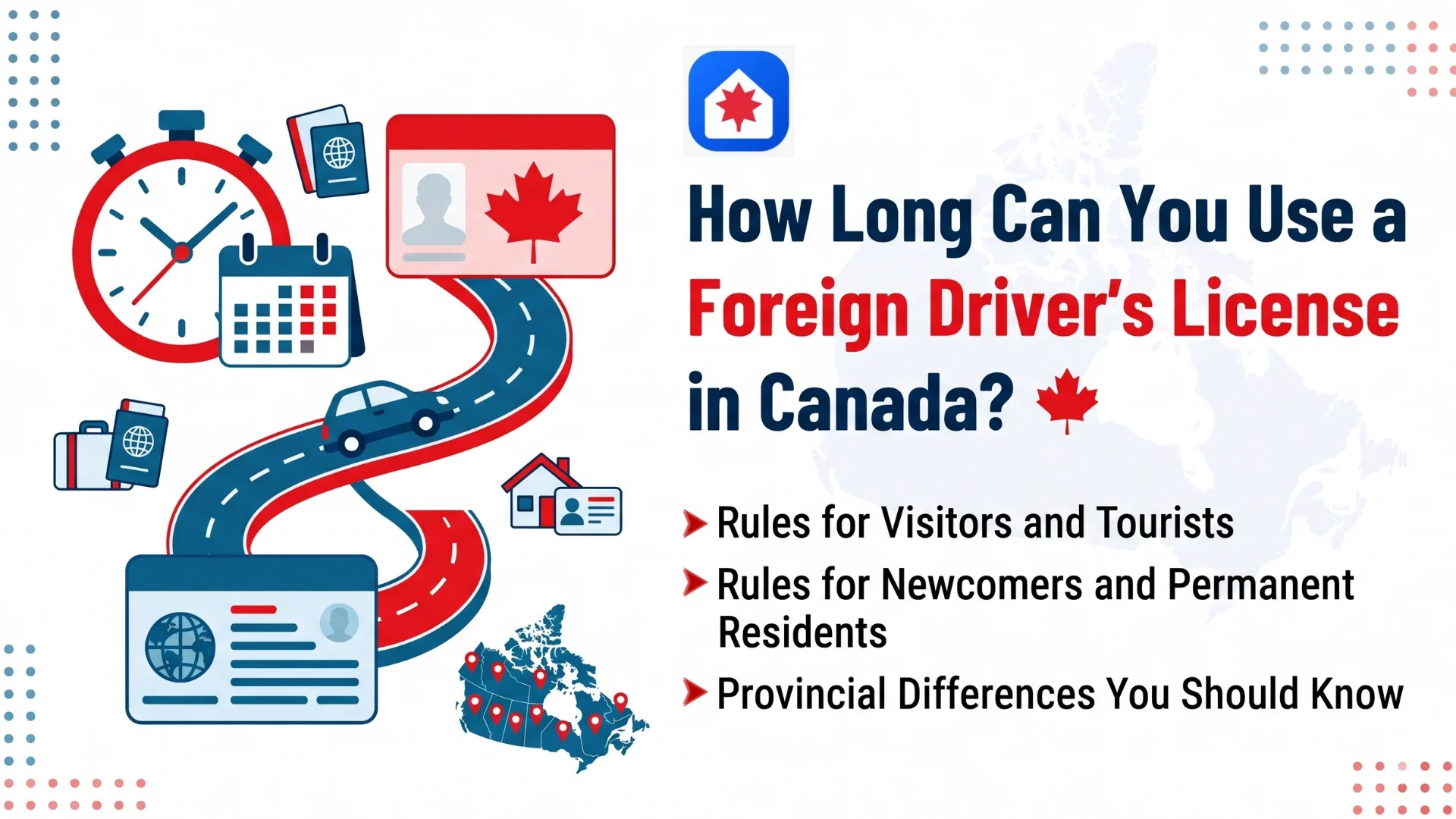
2.1. Rules for Visitors and Tourists
If you are visiting Canada temporarily, you can generally use your valid foreign driver's license in Canada for a limited period, provided you meet the applicable provincial requirements. Some provinces also recommend or require an International Driving Permit if your licence is not written in English or French.
For example, Alberta allows visitors from another jurisdiction to drive for up to one year using a valid licence from their home jurisdiction. If the licence is not in English, an IDP is strongly recommended. Both documents must be carried while driving. British Columbia allows tourists to drive using their current licence for up to six months, subject to its requirements.
2.2. Rules for Newcomers and Permanent Residents
If you move to Canada and establish residency in a province, you will generally need to exchange your foreign licence or obtain a provincial driver's licence within the applicable period. The deadline may be shorter than the period available to tourists.
For example:
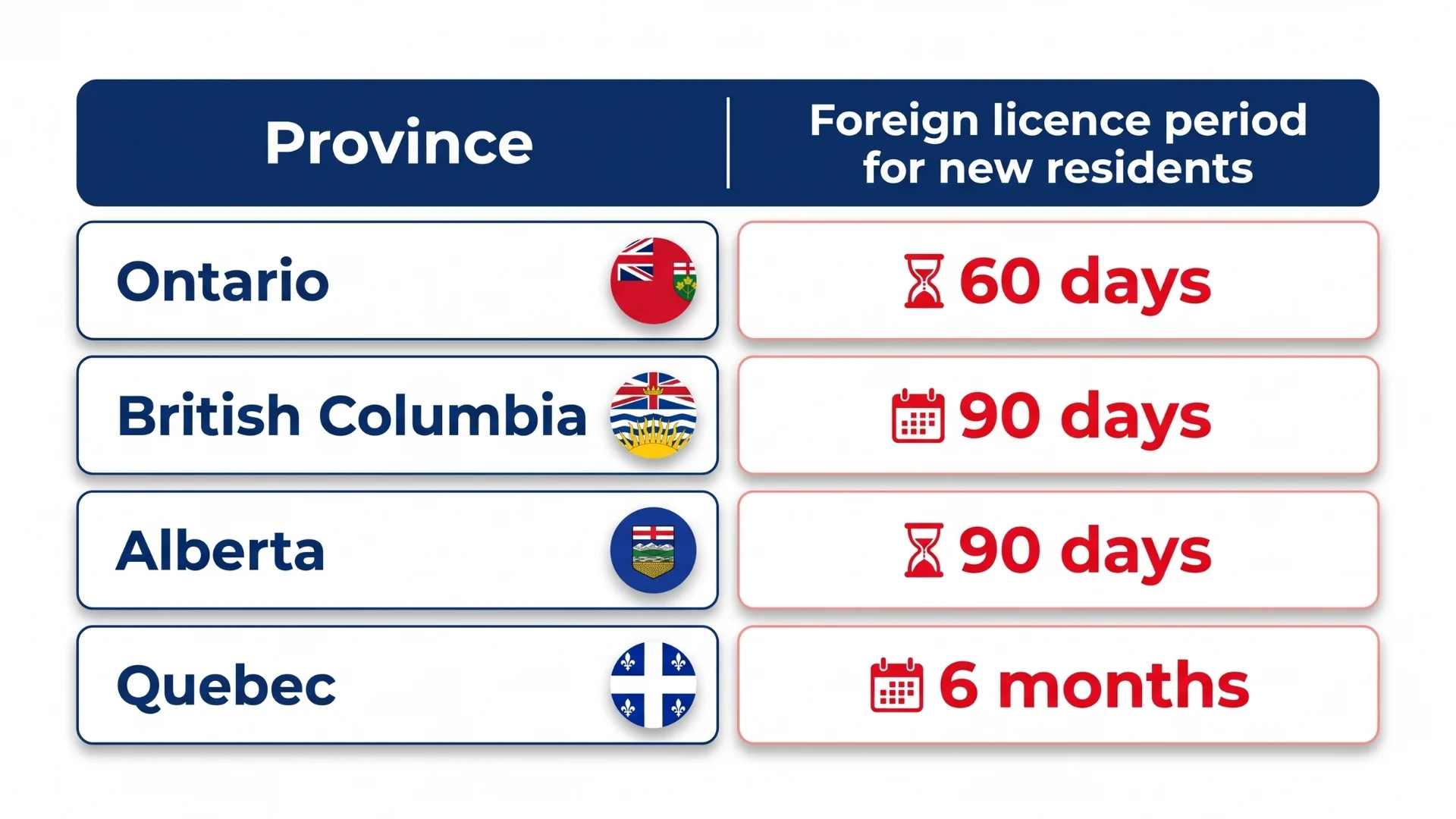
- A newcomer moving to Ontario has 60 days to switch to an Ontario driver's licence.
- A new resident of British Columbia has 90 days to exchange their existing licence.
- A new resident of Alberta must exchange their licence within 90 days.
- A new resident of Quebec can drive with a valid foreign licence for up to six consecutive months before obtaining a Quebec licence.
2.3. Provincial Differences You Should Know
The following table provides a quick comparison of the rules in four major Canadian provinces.
3. Do You Need an International Driving Permit in Canada?
3.1. What Is an International Driving Permit?
An IDP is not a separate driver's licence. It is an accompanying document that provides a standardized translation of your existing licence.
It generally includes information such as:
- Your personal details.
- Your original driver's licence information.
- The vehicle categories you are authorized to operate.
- Translations of important licence details into multiple languages.
For example, if you hold a driver's licence issued in a country where the official licence is written in a language other than English or French, an IDP can help Canadian authorities interpret your driving credentials.
3.2. When Should You Carry an IDP?
You should consider obtaining an IDP before travelling to Canada if:
- Your original licence is not written in English or French.
- Your destination province recommends an IDP.
- You plan to rent a vehicle, and the rental company requests additional documentation.
- You want to reduce potential communication difficulties during a traffic stop.
Some provinces have specific translation requirements that an IDP alone may not satisfy. For example, Ontario requires a certified translation of a foreign licence that is not written in English or French when applying for an Ontario licence. Therefore, check the provincial licensing authority's requirements before paying for translation services or applying for an IDP.
3.3. Does an IDP Replace Your Foreign Driver's License?
No. An IDP must always be used together with your original, valid driver's licence. You cannot use an IDP on its own to demonstrate that you are legally authorized to drive. You should carry both documents whenever the applicable rules require an IDP.
It is also important to understand that an IDP does not extend the period during which you can legally use your foreign licence after becoming a resident of a Canadian province. If your permitted driving period expires, obtaining an IDP does not remove your obligation to apply for a provincial licence.
4. How to Exchange a Foreign Driver's License in Canada
The foreign licence exchange process depends on the province where you live and the country that issued your original licence. Here are the main steps to follow.
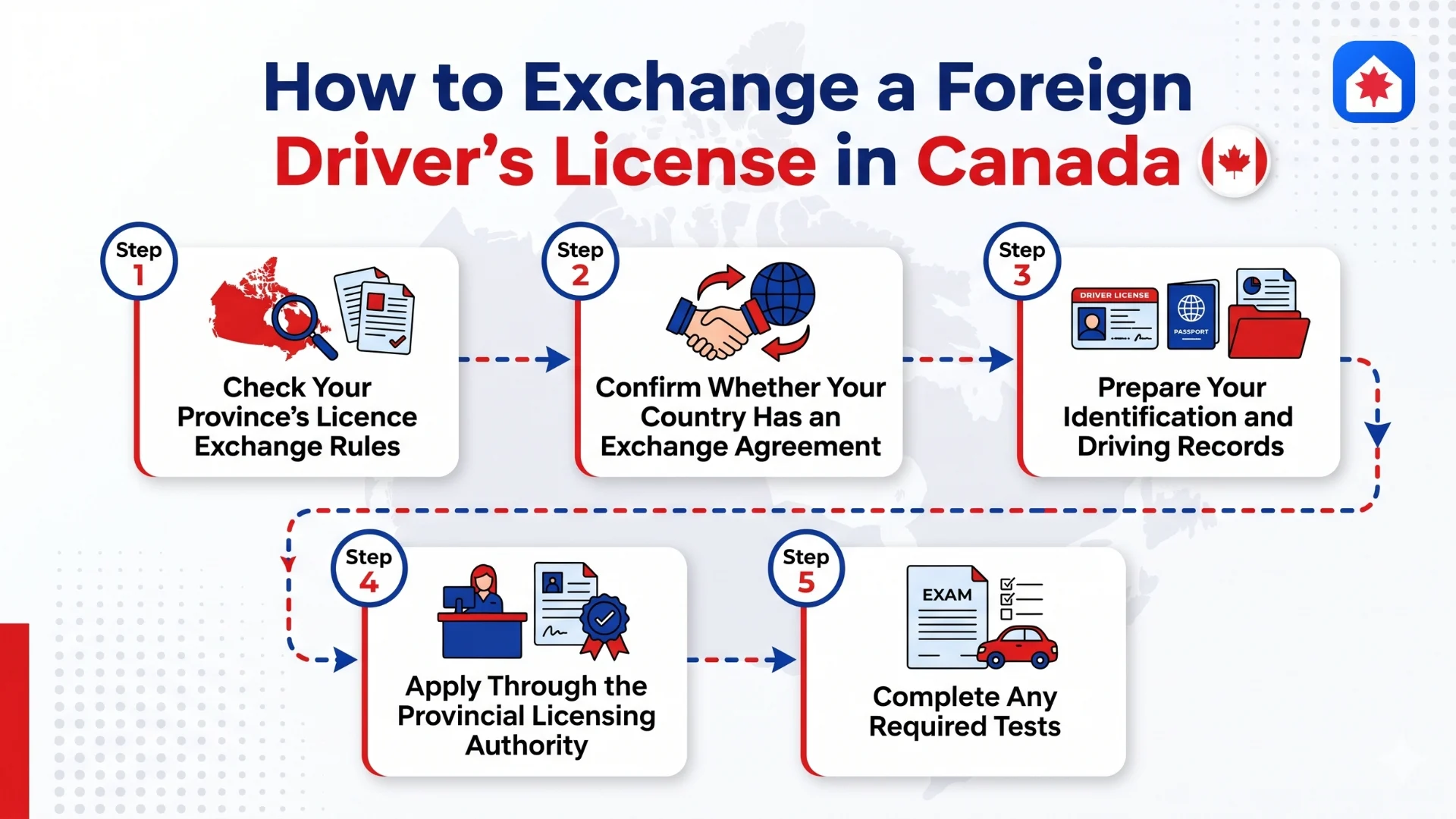
4.1. Step 1: Check Your Province's Licence Exchange Rules
Start by identifying the government agency responsible for driver's licences in your province.
For example:
- Ontario: Ministry of Transportation of Ontario (MTO), through DriveTest and ServiceOntario.
- British Columbia: Insurance Corporation of British Columbia (ICBC).
- Alberta: Alberta Registry Agents.
- Québec: Société de l'assurance automobile du Québec (SAAQ).
Visit the official website and look for information about exchanging an out-of-country driver's licence. Check the deadline for new residents, eligible countries, accepted licence categories, and testing requirements.
4.2. Step 2: Confirm Whether Your Country Has an Exchange Agreement
Your country of origin can significantly affect how easily you obtain a Canadian licence. If your country has a reciprocal licensing agreement with your province, you may qualify for a direct exchange without taking a knowledge or road test.
For example, Ontario recognizes eligible licences from several countries and jurisdictions, including the United States, Australia, Germany, France, Japan, New Zealand, South Korea, Switzerland and the United Kingdom.
However, exchange eligibility can differ between provinces. A country recognized by Ontario is not necessarily treated the same way by British Columbia or Quebec.
You should also check whether the agreement covers your particular licence class. Some agreements apply to passenger vehicles but not motorcycles or commercial vehicles.
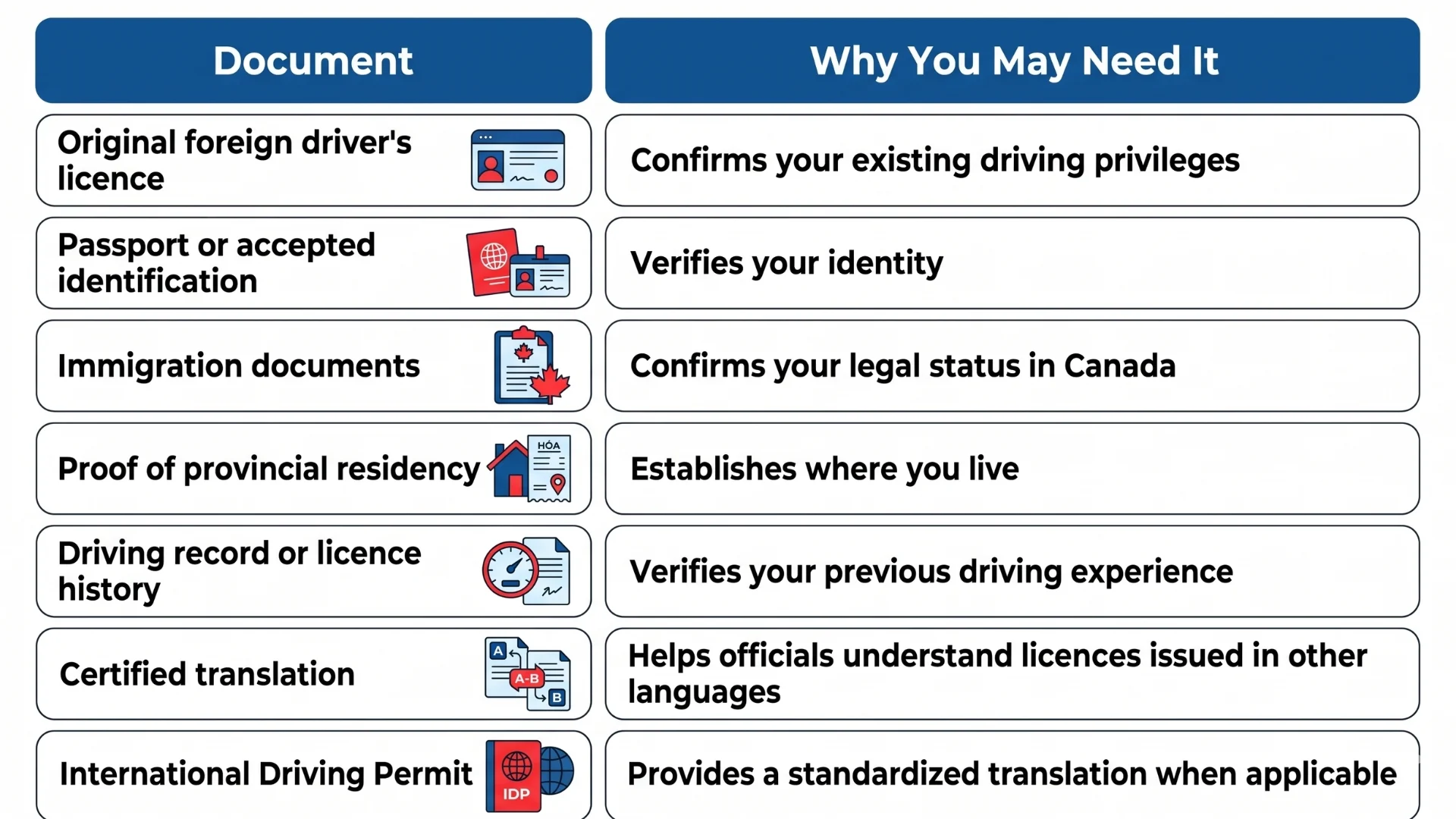
4.3. Step 3: Prepare Your Identification and Driving Records
Before visiting a licensing office, gather the documents required to verify your identity, immigration status, and previous driving experience.
Depending on your circumstances, you may need:
- Your original, valid foreign driver's licence.
- A passport or other accepted identification document.
- Proof of legal status in Canada.
- Proof of residency in your province.
- An official driving record or licence history.
- A certified translation if your documents are not in an accepted language.
If your current licence does not clearly show when you first became licensed, an official driving history document can help establish your previous experience.
4.4. Step 4: Apply Through the Provincial Licensing Authority
Once your documents are ready, submit your application through the appropriate licensing authority. Some provinces require applicants to visit a licensing office in person. Others may require an appointment or additional verification before processing the application.
During the application process, officials may:
- Verify your identity and residency.
- Review your original driver's licence.
- Assess your previous driving experience.
- Check whether your country qualifies for an exchange.
- Determine which licence class you are eligible to receive.
- Collect the applicable fees.
Be prepared to surrender your original licence if your province requires it as part of the exchange process.
4.5. Step 5: Complete Any Required Tests
If your licence qualifies for a direct exchange, you may not need to take additional driving tests. However, applicants from non-reciprocating jurisdictions may need to complete some or all of the following:
- Vision test: Checks whether you meet the required eyesight standards for driving.
- Knowledge test: Evaluates your understanding of road signs, traffic laws, and safe driving practices.
- Road test: Assesses your practical driving skills in real traffic conditions.
The exact requirements depend on your province, previous driving experience, and licence category. Even experienced drivers may need to complete a knowledge or road test if their country does not have a qualifying exchange agreement.
Once you meet all requirements and pay the applicable fees, the licensing authority can issue your provincial driver's licence.
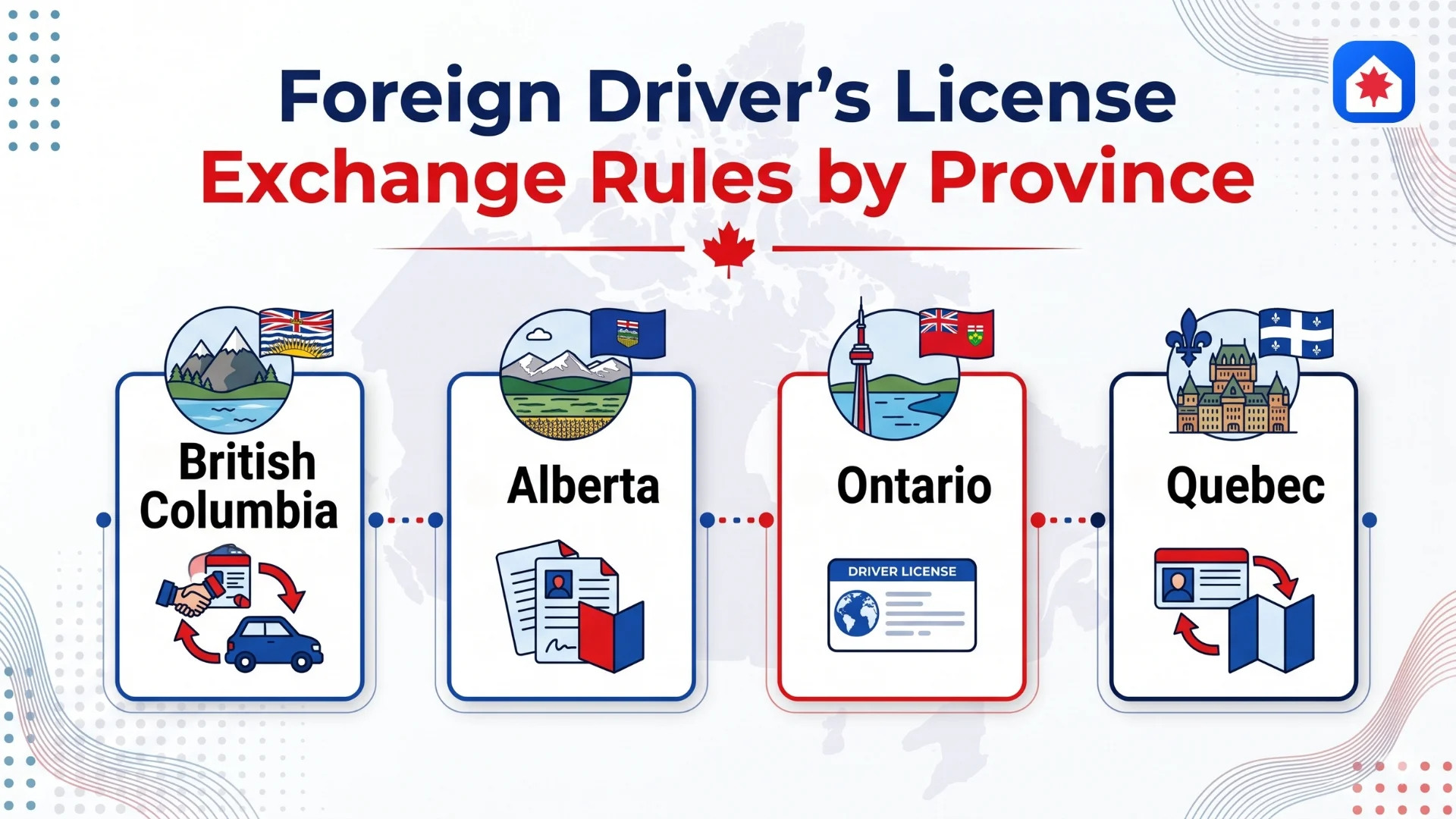
5. Foreign Driver's License Exchange Rules by Province
Although the general process is similar, each province has its own rules for recognizing foreign driving credentials. Before starting your foreign licence exchange, understanding these differences can help you prepare the right documents and avoid unnecessary delays.
5.1. Ontario
Ontario allows new residents to use a valid foreign driver's license in Canada for up to 60 days after becoming residents. If you want to continue driving after this period, you must obtain an Ontario driver's licence.
Ontario has reciprocal exchange agreements with several countries and jurisdictions. Eligible applicants may exchange their licences for an equivalent Ontario licence without completing the usual knowledge and road tests, subject to the applicable requirements.
If your country does not have an exchange agreement with Ontario, you will generally need to:
- Pass a vision test.
- Pass the G1 knowledge test.
- Complete the G2 road test.
- Wait at least 12 months after completing the G2 test.
- Pass the G road test.
5.2. British Columbia
British Columbia gives new residents 90 days to exchange their valid foreign driver's licence for a B.C. licence. Some countries and jurisdictions have licence exchange arrangements with ICBC. Depending on where your licence was issued and the vehicle category, you may qualify for an exchange without taking additional tests.
If your country is not included in the applicable exchange arrangements, you can still apply for a B.C. licence, but you will generally need to pass a knowledge test and a road test.
You should prepare:
- Your current foreign driver's licence.
- Accepted identification documents.
- Proof of driving experience.
- The applicable licensing fee.
One important consideration is your previous driving history. ICBC requires proof of at least two years of non-learner driving experience to qualify for an exemption from its Graduated Licensing Program. If you cannot provide sufficient evidence, you may need to enter the program and receive a licence with certain restrictions.
5.3. Alberta
New residents of Alberta must exchange their existing driver's licence within 90 days of becoming residents. The process depends on where your previous licence was issued and whether it qualifies for an exchange.
When applying, you generally need to provide:
- Your valid driver's licence.
- Proof of Alberta residency.
- Proof of legal status in Canada.
- Any supporting documents required to verify your driving experience.
Eligible applicants may exchange their existing licence without taking a knowledge or road test. However, if you have not held a full Class 5 or Class 6 licence for at least two years, you may be placed in Alberta's Graduated Driver Licensing (GDL) program.
Temporary residents, including some students and visitors, may have different eligibility rules from permanent residents. Alberta also permits eligible visitors to drive for up to one year using a valid licence from their home jurisdiction.
5.4. Quebec
Quebec allows new residents to drive with a valid foreign driver's licence for up to six consecutive months. After that period, you must obtain a Quebec driver's licence to continue driving. The exchange process depends on the country that issued your original licence.
Applicants from eligible jurisdictions may exchange their passenger vehicle licences without completing the usual proficiency tests. If your country does not have a reciprocal agreement with Quebec, you may still qualify for recognition of your previous driving experience. However, you may need to pass both a knowledge test and a road test.
6. Documents Required to Exchange a Foreign Driver's License
Preparing your documents in advance can make the exchange process easier and reduce the risk of having to visit a licensing office multiple times. Although the exact requirements vary by province, the following documents are commonly requested.
7. What If Your Country Does Not Have a Licence Exchange Agreement?
Not having a reciprocal licensing agreement does not mean you cannot obtain a Canadian driver's licence. It simply means you may need to follow a more detailed application process.
Depending on the province, you may need to complete a vision assessment, knowledge examination, and one or more road tests.
You can use CanadaHomeHub's driving knowledge resources to practise Ontario G1 handbook-based questions and review explanations before your knowledge test.
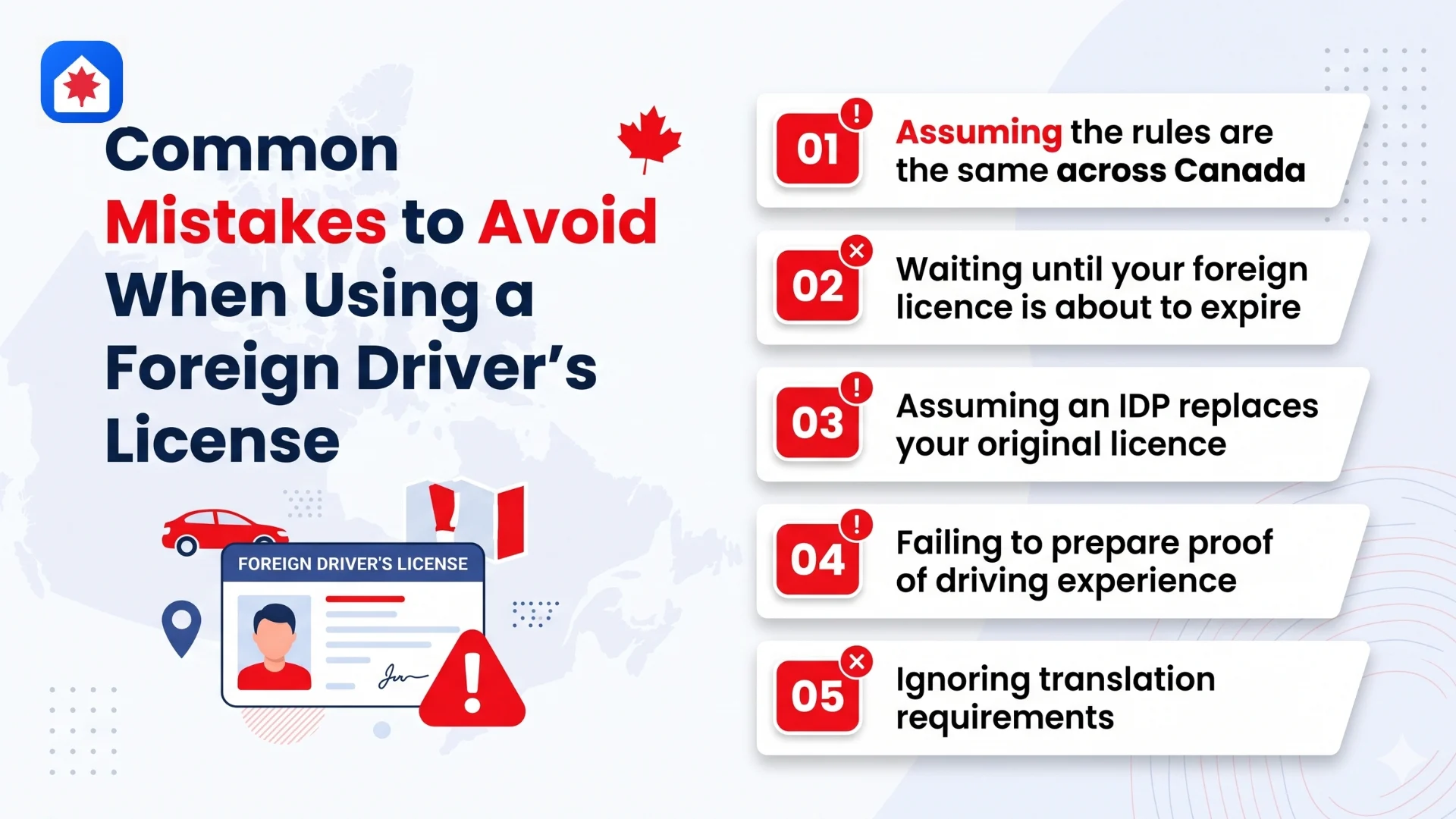
8. Common Mistakes to Avoid When Using a Foreign Driver's License
The process of using or exchanging a foreign driver's license in Canada may seem straightforward, but several common mistakes can create unnecessary problems. Here are some issues to watch out for.
- Assuming the rules are the same across Canada: Each province and territory has its own licensing requirements. Do not rely on information intended for residents of another province.
- Waiting until your foreign licence is about to expire: The permitted period for using your foreign licence may be shorter than expected. Start checking the exchange requirements soon after establishing residency.
- Assuming an IDP replaces your original licence: An IDP is only a supporting translation document. It does not replace your original driver's licence or extend your permitted driving period.
- Failing to prepare proof of driving experience: Your original licence may not show enough information to establish when you first became licensed. Request an official driving record before relocating if possible.
- Ignoring translation requirements: Some provincial authorities require certified translations rather than accepting informal translations or an IDP alone. Confirm the accepted translation process before submitting your application.
Frequently Asked Questions
1. Can I drive in Canada with my foreign driver's licence?
Yes. You can generally drive temporarily with a valid foreign driver's licence if you meet the requirements of the province where you are driving. New residents must usually obtain a provincial licence within a specified period.
2. How long is a foreign driver's licence valid in Canada?
There is no single validity period across Canada. For new residents, the period is 60 days in Ontario, 90 days in British Columbia and Alberta, and six months in Quebec. Visitors and certain temporary residents may have different rules.
3. Do I need an International Driving Permit to drive in Canada?
Not everyone needs an IDP. However, it may be required or recommended if your foreign driver's licence is not written in English or French.
4. Can I exchange my foreign driver's licence without taking a road test?
Yes, if your licence was issued in a country or jurisdiction that has a qualifying exchange agreement with your province and you meet the other eligibility requirements. Otherwise, you may need to complete additional tests.
5. Do I need to surrender my original driver's license?
Some provinces require you to surrender your previous licence when receiving a provincial licence. For example, British Columbia requires applicants to give up their existing driver's licences. Other jurisdictions may have different procedures.
6. Can international students drive in Canada with a foreign licence?
In some provinces, international students may continue using a valid foreign driver's licence under specific exemptions or temporary-resident rules. However, the conditions vary by province and educational status. Check the relevant provincial licensing authority rather than assuming that student status automatically provides an exemption.
Using or exchanging a foreign driver's license Canada depends on where you live, where your original licence was issued, and how much driving experience you can prove. While some newcomers can exchange their existing licence without taking additional tests, others may need to complete knowledge and road examinations before receiving a provincial licence. Understanding the local requirements, preparing the necessary documents, and applying before your permitted driving period expires can help you avoid unnecessary delays.
If you are preparing to drive in Canada, take time to review your province's official licensing guidelines and become familiar with local road rules. You can also explore CanadaHomeHub's resources for additional study guidance as you prepare for the transition.
Thank you for taking the time to read this article.