Moving to Canada is a transformative milestone, but the initial transition often feels like navigating a maze of unfamiliar paperwork, banking rules, and housing markets. Whether you arrive through Express Entry, a Provincial Nominee Program (PNP), an intra-company transfer, or an open work permit, your first 90 days set the foundation for long-term stability. Successfully settling in Canada requires moving past generic advice and following a clear, phased checklist. This comprehensive guide outlines the exact administrative, financial, and logistical steps you need to build your new life in any Canadian province.
1. What to Prepare Before Moving to Canada
Preparing before departure is an important part of settling in Canada for newcomers. Misplacing critical records or making hasty rental commitments from afar can cost you thousands of dollars and months of administrative delays.
Never pack foundational identity records in your checked baggage. Canadian Border Services Agency (CBSA) officers at your port of entry require physical verification of your status. Keep the following in your carry-on:
- Passports and Visas/COPR: Your valid passport along with your Confirmation of Permanent Residence (COPR) and Single Entry Immigrant Visa (if applicable).
- Proof of Funds: Official bank statements, certified drafts, or letters of credit meeting Immigration, Refugees and Citizenship Canada (IRCC) thresholds.
- Vital Statistics Records: Birth certificates, marriage certificates, adoption paperwork, and divorce decrees (officially translated into English or French).
- Professional and Academic Dossiers: Sealed transcripts, educational credential assessments (such as WES reports), professional licenses, reference letters, and up-to-date résumés formatted to Canadian standards.
- Health and Immunization Records: Vaccination passports for school-aged children and dental/medical histories, alongside an adequate supply of essential prescription medications with pharmacy labels intact.
2. Complete Essential Registrations and Documents
Once through customs and settled in your temporary quarters, prioritize the foundational legal records that unlock employment, banking, and public services. These initial steps provide an essential foundation for settling in Canada and managing your everyday responsibilities.
2.1. Applying for Your Social Insurance Number (SIN)
Your Social Insurance Number (SIN) is a confidential 9-digit number required to work in Canada and access government benefits.
- Where to apply: Visit a local Service Canada Centre in person. If you bring your original passport and COPR (or work permit), the officer can verify your documentation and issue your paper SIN confirmation letter across the counter within 20 minutes.
- Online alternative: You can also apply through the Service Canada online portal, though processing and postal delivery can take up to 20 business days.
2.2. Getting a Canadian Phone Number and Internet Service
A Canadian phone number is required immediately. Banks need it for two-factor authentication, prospective landlords use it to verify applicants, and settlement agencies request it for intake.
Bring an unlocked smartphone from your home country to avoid signing multi-year device financing contracts upon arrival. Major Canadian carriers (such as Rogers, Bell, and Telus) along with their flanker brands (Fido, Virgin Plus, Koodo, Freedom Mobile, Public Mobile) offer Bring-Your-Own-Device (BYOD) monthly plans that do not require an established Canadian credit rating.
3. Banking and Credit in Canada
3.1. Choosing a Bank Account for Newcomers
Almost all major institutions run dedicated newcomer packages that waive monthly account maintenance fees for the first 6 to 12 months. When comparing accounts, evaluate:
- Fee Waivers and Transaction Limits: Look for accounts offering unlimited debit transactions and free Interac e-Transfers.
- International Wire Options: Check foreign exchange rates and fees for bringing funds over from your home country.
- Physical Branch and ATM Footprint: Ensure the bank maintains physical branches near your neighborhood, as cash deposits and cashier's checks (bank drafts) often require in-person teller service.
3.2. Building Your Canadian Credit History
Credit histories do not transfer internationally. Regardless of your past wealth or credit standing abroad, you arrive in Canada with a blank credit file.
Canadian landlords, utility providers, auto lenders, and mortgage brokers evaluate your score through Equifax and TransUnion Canada. To build your rating methodically:
- Acquire an unsecured newcomer credit card: Most newcomer banking plans include a credit card with an entry limit of $1,000 to $2,000 without requiring a security cash deposit or Canadian employment history.
- Maintain low credit utilization: Keep your running balance below 30% of your total credit limit. If your limit is $2,000, avoid carrying a balance exceeding $600 at any point during your billing cycle.
- Pay statement balances in full: Paying only the minimum balance accrues interest charges (often 19.99%-24.99%) and slows score improvements. Automate payments to wipe out the balance several days before the statement due date.

4. Healthcare and Insurance
Canada’s universal public healthcare system (Medicare) is managed at the provincial and territorial levels rather than at the federal level. This means your coverage rules, eligibility dates, and card applications depend entirely on where you reside.
4.1. Provincial Health Coverage vs. Private Bridge Insurance
Certain provinces grant public health coverage on your first day of arrival, while others may require a waiting period of up to three months before coverage activates:
- Ontario (OHIP): The 3-month waiting period has historically been waived, but newcomers must apply promptly with identity and residency proofs.
- British Columbia (MSP): Imposes a wait period consisting of the remainder of the month you arrive, plus two full consecutive calendar months.
- Alberta (AHCIP): Coverage begins on the date of your arrival if you submit your application within three months of establishing residency.
- Quebec (RAMQ): Generally enforces a waiting period of up to three months, with exemptions for select reproductive, pregnancy, and domestic violence care.
If landing in a province with a mandated waiting period, purchase private newcomer bridge insurance before departing your home country. Hospitalization and emergency clinic costs for uninsured individuals in Canada can exceed $3,000 to $5,000 per day.
4.2. Finding a Family Doctor or Walk-In Clinic
Canada currently faces a national shortage of family physicians. Most newcomers cannot secure a dedicated general practitioner immediately upon arrival.
Register on your province’s centralized healthcare registry (such as Health Care Connect in Ontario or Health Connect Registry in British Columbia) as soon as your health card arrives. In the meantime, use community health centers and walk-in clinics for routine non-emergency care, and keep track of clinic intake schedules early in the morning.
5. Finding Long-Term Housing

To secure a rental home quickly as a newcomer, follow this practical 5-step process:
5.1. Where to Find Legitimate Listings
- Work with a licensed Realtor: In provinces like Ontario and British Columbia, working with a real estate agent to find a rental is typically free for tenants because the landlord pays the commission. Agents help filter verified MLS listings, arrange viewings, and prepare standard paperwork.
- Search trusted platforms: Use Realtor.ca for verified MLS properties and Rentals.ca for managed apartment buildings.
If you need professional assistance when navigating the Canadian housing market, CanadaHomeHub also provides access to a directory of real estate professionals and other qualified service providers through its professional network.
5.2. Prepare Your Application Dossier in Advance
Units in competitive cities can be rented within 24 to 48 hours. Keep a digital package ready containing:
- Proof of income or savings: A signed Canadian employment letter stating your position and salary. If you do not have a local job yet, provide a bank statement showing liquid savings capable of covering 6 to 12 months of rent.
- Credit alternatives: Since international credit scores do not transfer to Canada, include an international credit report, a letter of good standing from your home bank, or a statement from your new Canadian bank.
- References: Written contact details and recommendation letters from prior landlords abroad or your short-term accommodation host in Canada.
- Guarantor details (if available): Contact information for a Canadian resident willing to co-sign if your application lacks local employment history.
5.3. Tour the Unit and Watch for Red Flags
Never rent a property without seeing it in person or via a live video walkthrough. Test water pressure, inspect heating and cooling controls, check mobile phone reception inside the unit, and clarify which utilities (electricity, water, gas) are included in the rent. If a prospective landlord claims to be abroad and insists on an upfront deposit via wire transfer or cryptocurrency before showing the unit, discontinue communication immediately.
5.4. Sign the Official Provincial Lease
Once your application is approved, insist on signing the official provincial standard lease agreement (such as the Ontario Standard Lease). Do not accept informal handwritten notes or private agreements that attempt to waive basic tenant protections or mandate non-refundable application fees.
5.5. Pay Legal Deposits, Set Up Insurance, and Complete the Move-In Walkthrough
- Pay via traceable methods: Use a certified bank draft or an Interac e-Transfer with the property address noted in the memo. Never pay in cash. In Ontario, landlords can only request first and last month’s rent; in British Columbia and Alberta, security deposits are capped at a maximum of half a month's rent.
- Purchase tenant insurance: Most landlords require proof of tenant insurance ($20 to $35 CAD per month) covering personal contents and liability before releasing the keys.
- Document condition on move-in day: Walk through the unit with the landlord, take date-stamped photos and videos of any existing damage, and record these notes on a move-in inspection sheet to protect yourself against future deposit disputes when moving out.
If you are considering purchasing a home in the future, understanding the costs of buying a house in Canada can help you prepare for down payments, closing costs, and ongoing homeownership expenses.
6. Finding Employment and Building Community Connections
Finding employment and building local connections are essential steps toward establishing a stable life in Canada. Newcomers can take advantage of settlement services Canada offers, including employment assistance, professional networking opportunities, and career development programs. Consider the following steps to improve your job search and integrate into your local community:
- Format your résumé to Canadian standards: Remove photos, age, marital status, gender, and full street addresses. Focus on measurable achievements rather than task lists. Match keywords directly to the target job description to pass Applicant Tracking Systems (ATS).
- Get an assigned Job Developer: Register with free, IRCC-funded settlement agencies. Ask specifically for a dedicated Job Developer who has direct hiring relationships with local employers and access to unadvertised positions.
- Bridge credential gaps in regulated fields: If your profession requires a license, enroll in a provincial bridging program to fast-track certification. Work in intermediate, unregulated roles to gain Canadian work history while your license is processed.
- Conduct informational interviews on LinkedIn: Connect with professionals in your industry who immigrated 5 to 10 years ago. Request a brief 15-minute virtual chat to ask for localized industry advice, not a job opening. Follow up with a note thanking them for their time.
- Volunteer for local references: Commit 2 to 4 hours per week to registered charities, community centers, or food banks. This eliminates résumé gaps, demonstrates local community involvement, and provides verified Canadian supervisors who can act as professional references.
- Use your municipal public library: Sign up for a free library card during your first week to access quiet work spaces, high-speed Wi-Fi, language conversation circles, and free business learning tools like LinkedIn Learning.
7. Language and Settlement Programs for Newcomers
Adjusting to life in Canada involves more than finding housing and securing employment. Newcomers also need to develop communication skills, understand local services, and learn how to navigate everyday situations in an unfamiliar environment. Fortunately, Canada offers government-funded language training and settlement programs to help eligible newcomers adapt more easily and become independent.
7.1. Improve Your English or French
If you are not yet comfortable using English or French, you may qualify for free language training funded by the Canadian government.
Two major programs are Language Instruction for Newcomers to Canada (LINC), which provides English classes, and Cours de langue pour les immigrants au Canada (CLIC), which offers French instruction. These programs are generally available to eligible permanent residents and protected persons. Before enrolling, you may need to complete a language assessment to determine your current proficiency level and find a suitable class.
To get started, contact a local language assessment centre or settlement agency. They can help you check your eligibility, arrange an assessment, and find an appropriate language class.
7.2. Access Settlement Services
Beyond language training, settlement agencies provide practical assistance to help newcomers understand Canadian systems and manage everyday responsibilities. These organizations are valuable newcomer resources Canada offers to support individuals and families during their transition, particularly when they are unfamiliar with local procedures and available services.
Depending on your needs and eligibility, settlement services may include assistance with finding housing, preparing a Canadian-style resume, searching for jobs, understanding healthcare services, enrolling children in school, and accessing government benefits. Some organizations also provide orientation sessions, employment workshops, interpretation services, and opportunities to connect with other newcomers.
You do not need to wait until you encounter a problem to contact a settlement agency. Reaching out early can help you understand which services are available and avoid unnecessary difficulties as you establish your new life in Canada.
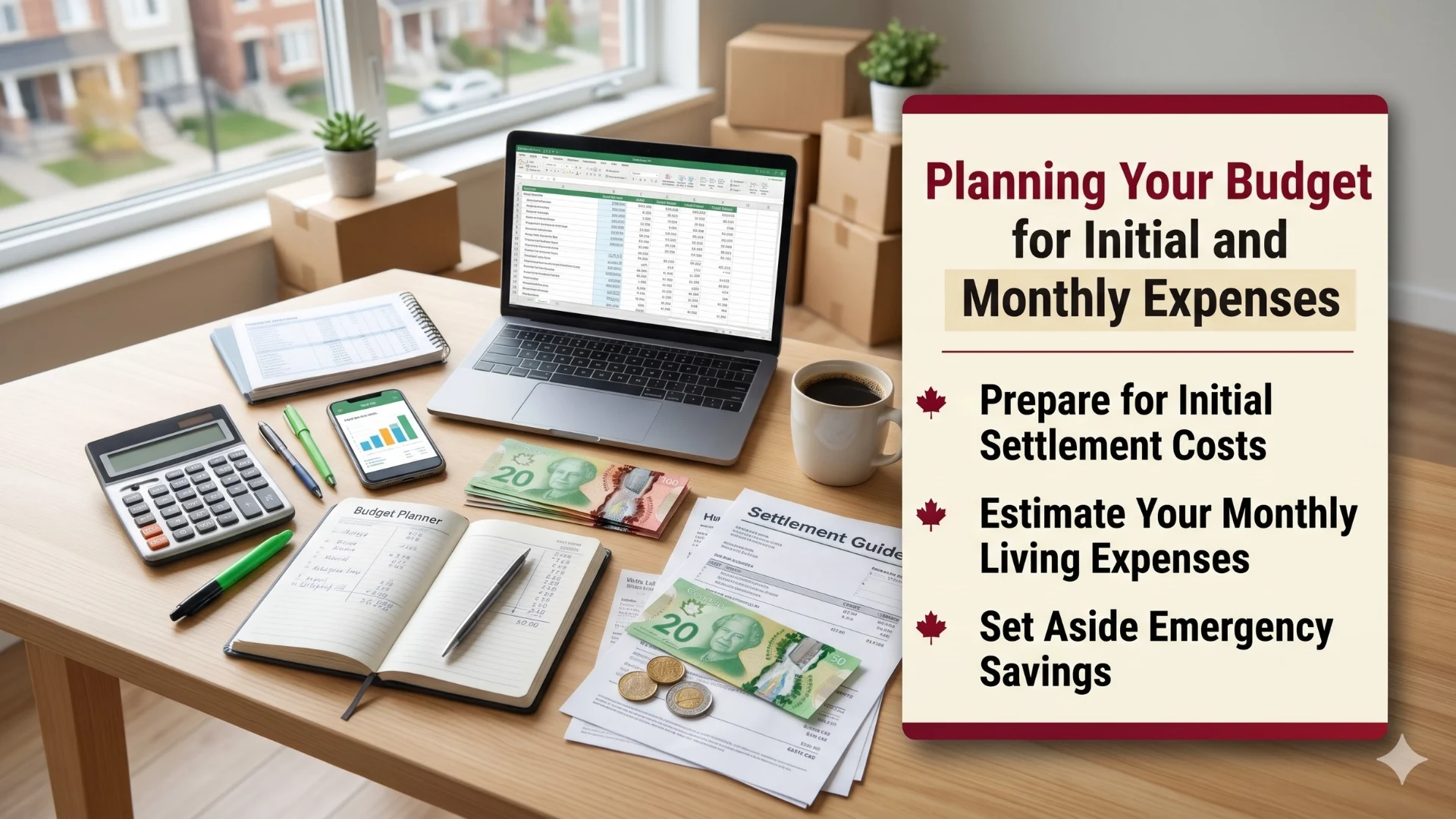
8. Planning Your Budget for Initial and Monthly Expenses
Managing your finances is an important part of settling in Canada. During the first few months, you may face several upfront costs while covering regular living expenses. Preparing a realistic budget can help you avoid financial stress and make better spending decisions.
8.1. Prepare for Initial Settlement Costs
Moving to Canada involves more than paying for your flight. You may need to budget for your first month's rent, a security deposit where permitted, basic furniture, household supplies, a mobile phone plan, and transportation. Prioritize essential purchases rather than furnishing your home all at once. This allows you to preserve savings for other important expenses while adjusting to your new financial situation.
8.2. Estimate Your Monthly Living Expenses
Once you have secured accommodation, calculate how much you need to cover recurring costs. Your monthly budget should generally include:
- Housing: Rent, utilities, internet, and tenant insurance.
- Food: Groceries and household essentials.
- Transportation: Public transit, fuel, parking, or car insurance.
- Communication: Mobile phone and internet plans.
- Personal expenses: Clothing, childcare, healthcare costs not covered by public insurance, and entertainment.
Living costs vary significantly across Canada. So, research local housing and transportation costs before deciding where to settle.
8.3. Set Aside Emergency Savings
Avoid spending all your savings on initial purchases. Unexpected expenses, delayed employment, or a longer job search can create financial pressure during your first few months.
If possible, gradually build an emergency fund covering three to six months of essential expenses. Track your spending with a spreadsheet or budgeting app to identify unnecessary costs and keep your finances under control. Maintaining a reasonable budget will give you greater financial flexibility while establishing your new life in Canada.
For newcomers planning to purchase their first home, exploring available first-time home buyer programs in Canada can also help identify potential savings opportunities and reduce some upfront costs.
Frequently Asked Questions
1. What Should I Do First After Arriving in Canada?
Start by securing your essential documents and applying for a Social Insurance Number (SIN). Next, get a Canadian phone number, open a bank account, apply for provincial health coverage, and arrange suitable long-term housing. These steps will help you access employment, financial services, and essential public programs.
2. How Long Does It Take to Settle in Canada?
The timeline varies depending on your employment, housing situation, location, and personal circumstances. You may complete essential administrative tasks within your first few weeks, but finding stable employment, securing permanent housing, and building a local network can take several months.
3. Can Newcomers Get Free Language Classes in Canada?
Yes. Eligible newcomers, particularly permanent residents and protected persons, may access free government-funded language training. Programs such as Language Instruction for Newcomers to Canada (LINC) provide English classes, while Cours de langue pour les immigrants au Canada (CLIC) offers French instruction.
4. How Much Money Should I Save Before Moving to Canada?
No fixed amount applies to everyone. Your savings should cover initial expenses such as rent, deposits where permitted, transportation, food, phone services, and basic household items. It is also advisable to maintain an emergency fund to support essential expenses while looking for employment.
5. How Can I Find a Job as a Newcomer in Canada?
Start by adapting your résumé to Canadian standards and searching for opportunities through job platforms and professional networks. You can also contact local settlement agencies for employment workshops, résumé assistance, job search support, and connections with potential employers.
6. Where Can I Get Help Settling in Canada?
You can contact local newcomer-serving organizations and settlement agencies for assistance with housing, employment, language training, healthcare information, and community integration. The Canadian government's IRCC-funded settlement services directory is a useful starting point for finding eligible services near you.
Successfully settling in Canada takes time, preparation, and a clear understanding of the steps involved. From securing essential documents and finding housing to accessing healthcare, building credit, and exploring employment opportunities, each decision helps establish a stable foundation for your new life. You do not need to figure everything out immediately. Focus on essential priorities during your first few months, make use of available newcomer resources Canada provides, and manage your finances carefully as you adjust to your new surroundings. With the right preparation and support, you can navigate the challenges of settling in Canada for newcomers and gradually build a comfortable, independent life in your new community.
Thank you for taking the time to read this article.
For more information, please contact us at CANADAHOMEHUB.