Working for yourself in Canada brings unmatched independence. Whether you operate as a freelance digital marketer in Toronto, an independent tradesperson in Calgary, a creative designer in Vancouver, or a consultant working from home in Montreal, controlling your professional destiny is empowering. However, along with independence comes the legal and financial responsibility of managing your own tax obligations. Unlike salaried employees whose income tax, Canada Pension Plan (CPP) contributions, and Employment Insurance (EI) premiums are automatically withheld from every paycheck, self-employed Canadians must navigate the tax system independently. You are required to calculate your gross income, track every operational expenditure, remit sales taxes, and make annual or quarterly tax payments directly to the Canada Revenue Agency (CRA).
This comprehensive guide breaks down everything you need to know about self-employed taxes in Canada - from classifying your business structure and filling out Form T2125 to maximizing legitimate tax write-offs and remaining fully compliant with CRA regulations.
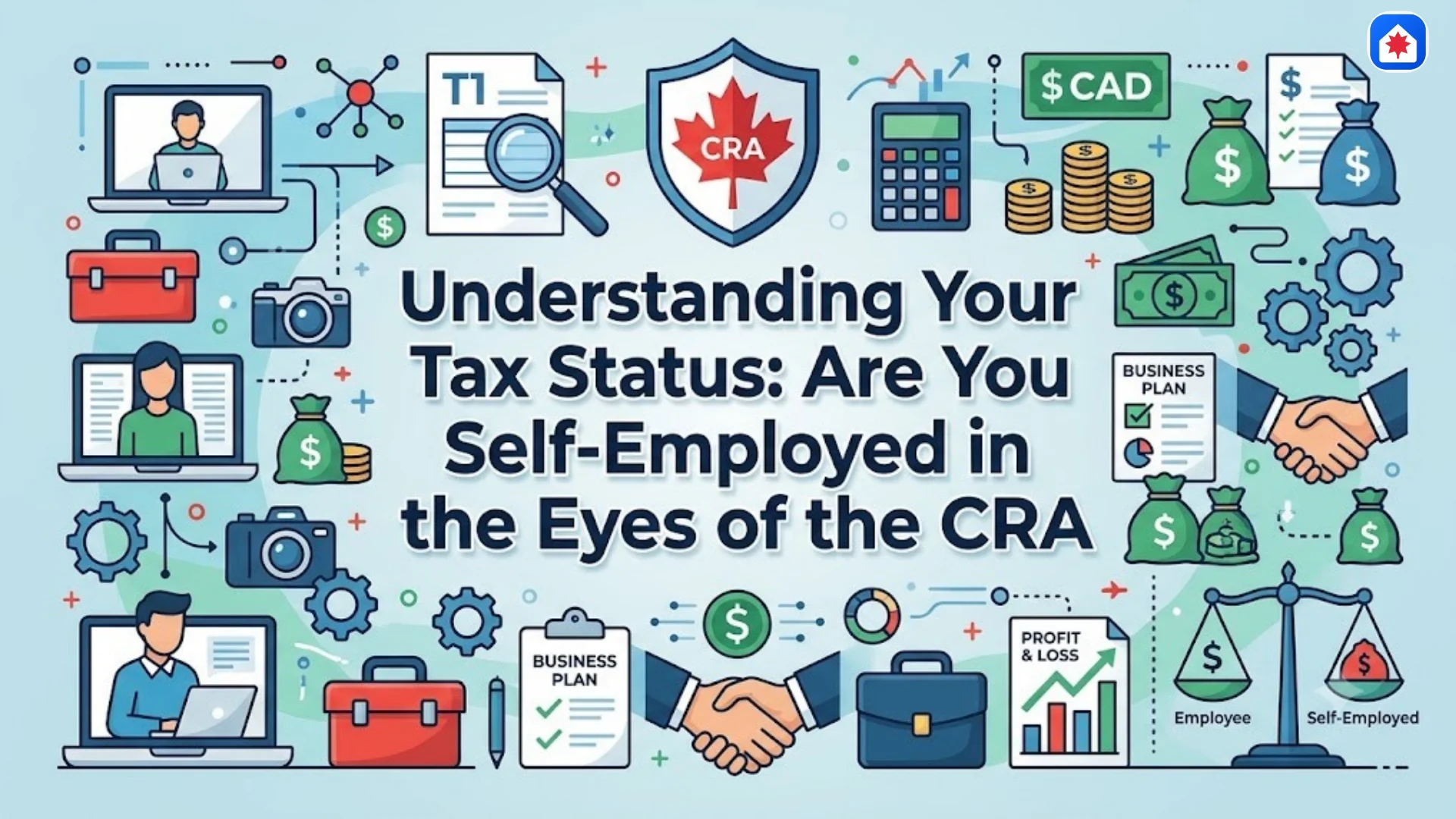
Understanding Your Tax Status: Are You Self-Employed in the Eyes of the CRA?
Before calculating write-offs or filling out tax returns, you must establish whether the CRA considers you an employee or a self-employed individual. The distinction carries major legal implications for tax withholding, expense eligibility, and liability.
Sole Proprietorship vs. Unincorporated Freelancer vs. Incorporation
When you start earning income through independent commercial activities in Canada without forming a separate legal corporation, you automatically operate as a sole proprietor.
- Sole Proprietorship: Your business is legally tied to you personally. Business profits are reported directly on your personal income tax return (T1 General), and you are taxed at individual marginal rates.
- Incorporation: Establishing a federal or provincial corporation creates a separate legal entity. Corporate tax returns (T2) are filed separately, offering potential tax-deferral opportunities and limited liability protection, though accompanied by higher legal and accounting overhead.
CRA Criteria for Determining Employment Status
The CRA uses four primary tests to decide whether a working arrangement constitutes a contract of service (employee) or a contract for services (self-employed contractor):
- Control: Do you set your own hours, dictate your workflow, and choose how tasks are completed?
- Tools and Equipment: Do you supply your own computer, software, vehicles, or physical tools?
- Subcontracting: Can you hire a third party or assistant to fulfill parts of the workload?
- Financial Risk and Profit: Are you personally liable for operational overhead, unpaid invoices, or project expenses?
Reporting Your Business Income: Master Form T2125 (Statement of Business Activities)
Self-employed individuals must report business income using Form T2125: Statement of Business or Professional Activities, which is attached to the annual T1 Personal Income Tax Return.
Breaking Down Form T2125 Line-by-Line
If you operate multiple distinct businesses—for example, a freelance writing service and an e-commerce store—you must complete a separate T2125 form for each enterprise.
Form T2125 captures three essential figures:
- Gross Income (Lines 8000 & 8299): The total monetary value of all goods sold or services delivered during the fiscal year, excluding GST/HST collected.
- Operating Expenses (Part 4): All reasonable current costs incurred to earn that business revenue.
- Net Income / Loss (Line 9946): Gross income minus total eligible operating costs. This final figure represents your actual taxable self-employment income, which flows directly into line 13500 of your T1 return.
Managing T4A Slips and Unreported Income
Corporate clients paying an independent contractor over $500 in a calendar year generally issue a T4A slip (Statement of Real Estate Tax, Royalty, or Other Income) with earnings entered in Box 048 (Fees for services). Even if a client fails to issue a T4A slip, or if you receive cash or electronic transfers from individual clients, Canadian law mandates that 100% of earned business income must be reported to the CRA.
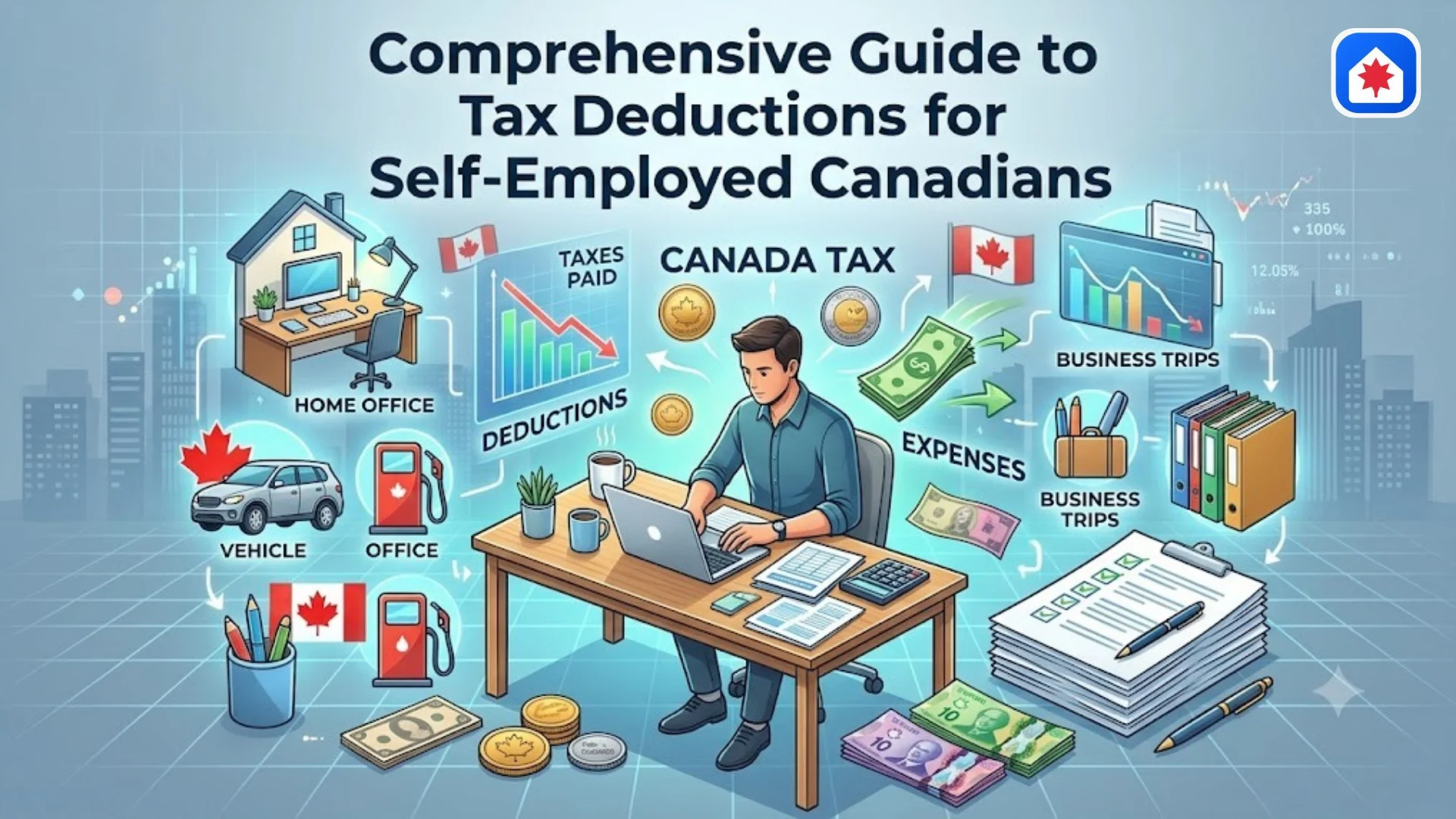
Comprehensive Guide to Tax Deductions for Self-Employed Canadians
The most effective strategy to legally minimize your Canadian tax bill is identifying and claiming every allowable business expense. The CRA stipulates that any "reasonable expense incurred to earn business income" can be deducted.
Business Use of Home Expenses (Home Office Write-Offs)
If you operate your business primarily out of your personal residence, Part 7 of Form T2125 allows you to claim a portion of your housing expenses. To qualify, your home workspace must meet one of two CRA conditions:
- It is your principal place of business.
- It is used exclusively for earning business income and for meeting clients, patients, or customers on a regular, ongoing basis.
Calculation Method: Calculate the square footage of your dedicated workspace relative to the overall finished square footage of your home. For instance, if your dedicated home office is 200 square feet inside a 2,000-square-foot home, your business-use percentage is 10%.
Eligible home expenses to prorate include:
- Rent (if renting your residence).
- Utilities (heating, electricity, water).
- Home insurance and property taxes.
- Mortgage interest (principal payments cannot be deducted).
- General home maintenance and repair costs affecting the full property.
Real Estate Perspective: As flexible remote working arrangements expand across Canada, designing or purchasing properties optimized for dual living and remote professional spaces has become a primary financial consideration. Professionals who prioritize home functionality frequently evaluate dedicated property options through platforms like CanadaHomeHub.Ca to secure housing layouts that maximize both everyday comfort and CRA home office deductions.
Motor Vehicle Expenses and Mileage Tracking Rules
If you use your personal vehicle to meet clients, collect inventory, attend professional events, or run operational errands, you can write off a portion of your vehicle costs.
The Mileage Logbook Obligation: The CRA requires a detailed, daily logbook recording every business trip. You must document the date, destination, business objective, and kilometers driven. At year-end, divide your total business kilometers by total overall kilometers driven to establish your deductible percentage.
Deductible vehicle operating costs include:
- Fuel, oil, and fluid changes.
- Vehicle maintenance, repairs, and tire replacements.
- Auto insurance premiums.
- Provincial vehicle registration fees.
- Interest paid on auto loans or monthly lease payments (subject to CRA statutory caps).
Capital Cost Allowance (CCA) for Equipment and Tech
Major purchases with enduring physical or operational value—such as high-performance computers, office furniture, machinery, or digital cameras—are classified as Capital Property rather than immediate operational expenses.
Instead of writing off the full purchase price in year one, you deduct the asset's cost gradually over several tax years using Capital Cost Allowance (CCA) classes defined by the CRA:
- Class 8 (20% rate): General office furniture, fixtures, and standard machinery.
- Class 50 (55% rate): Computer hardware, laptops, and systems software.
- The Half-Year Rule: Under CRA regulations, in the exact calendar year you acquire a capital asset, you can generally claim CCA on only 50% of the normal allowable rate (the "half-year rule").
Professional Services, Marketing, and Legal Fees
Every dollar spent building your brand presence and ensuring compliance is deductible:
- Legal and Accounting Fees: Costs incurred for bookkeeping, software subscriptions (e.g., QuickBooks, Wave), tax preparation, or business legal contracts.
- Advertising & Marketing: Google Ads, social media campaigns, business card printing, domain registrations, web hosting, SEO consulting, and local promotional activities.
- Educational Development: Tuition for industry courses, workshops, seminars, and reference books directly maintaining or refining your existing business skills.
Meals, Entertainment, and Client Relations
If you treat a client or prospective business partner to lunch, dinner, or an industry event, the expense is deductible - but strictly subject to a 50% limitation cap. You must retain original receipts and annotate the receipt with the name of the client and the core business purpose of the meeting.
Insurance, Bank Charges, and Interest Payments
- Business Insurance: Commercial liability insurance, professional indemnity coverage, and equipment insurance policies are 100% deductible.
- Financial Fees: Monthly bank service fees on dedicated business bank accounts, payment processing fees (Stripe, PayPal), and credit card processing charges.
- Business Borrowing Interest: Interest accumulated on credit lines, commercial loans, or business credit cards utilized exclusively for business operations.
Canada Pension Plan (CPP) Contributions for the Self-Employed
One of the largest adjustments for newly self-employed Canadians is absorbing the double impact of Canada Pension Plan (CPP) contributions.
When working as a traditional employee, your employer pays 50% of your CPP contribution, and you pay the remaining 50% via payroll deduction. When self-employed, you are legally considered both the employer and the employee.
- Calculation Framework: Self-employed CPP contributions are calculated on Schedule 8 during tax preparation.
- Basic Exemption: Contributions apply only to net self-employment earnings above the basic exemption threshold of $3,500.
- Combined Rates: You must remit the full combined rate (11.9% for base CPP) on net earnings between $3,500 and the Year’s Maximum Pensionable Earnings (YMPE) ceiling set annually by the CRA.
- Tax Deduction Credit: Half of your calculated CPP payment acts as a tax deduction on your T1 return, reflecting the employer-equivalent share.
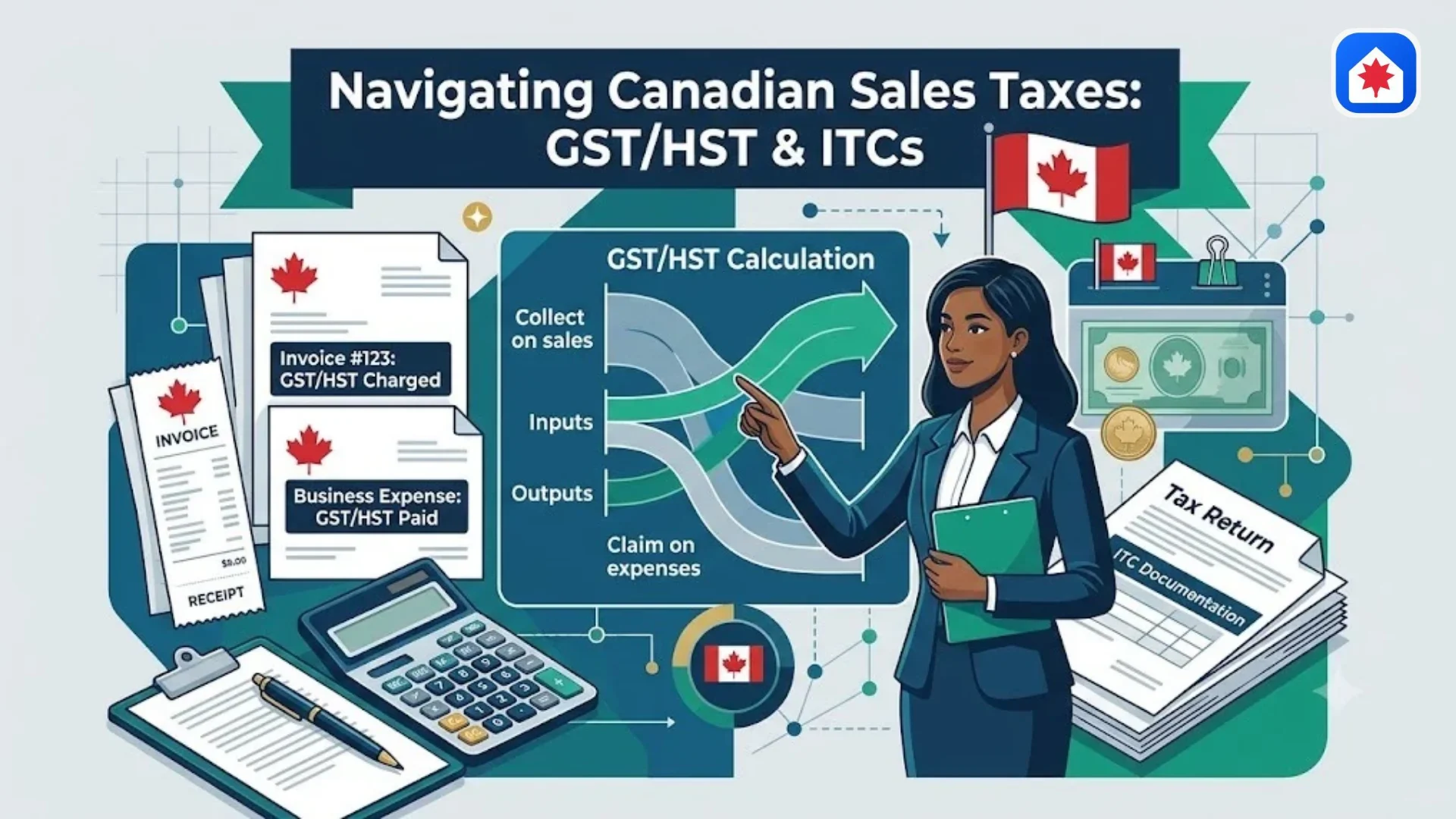
Navigating Sales Taxes: GST/HST Obligations and Input Tax Credits (ITCs)
Understanding Canada's consumption tax system - the federal Goods and Services Tax (GST) and provincial Harmonized Sales Tax (HST) - is critical to avoid severe audit penalties.
The $30,000 Threshold Explained
You are classified as a small supplier and are not legally required to register for GST/HST if your gross worldwide taxable revenues remain at or below $30,000 over any single calendar quarter or four consecutive quarters.
However, the moment your total gross revenues cross $30,000 within four consecutive quarters:
- You lose small-supplier status.
- You must register for a CRA GST/HST account within 29 days of the transaction that pushed you over the limit.
- You must start charging and collecting GST/HST on all subsequent domestic invoices.
Voluntary Registration: Many freelancers voluntarily register for a GST/HST number immediately upon launching. Doing so enables you to recover all sales tax spent on startup equipment and operational software right away through Input Tax Credits.
Place of Supply Rules Across Canadian Provinces
When billing clients across different Canadian provinces, you must charge the sales tax rate corresponding to the location of the customer (the "place of supply"), not your home address. For example, if you live in Alberta (5% GST) but complete a consulting project for a corporate client located in Ontario (13% HST), you must bill 13% HST on that invoice.
Claiming ITCs to Recover Taxes Paid on Business Purchases
Once registered for GST/HST, you can offset sales taxes collected against sales taxes paid. Through Input Tax Credits (ITCs), you deduct every dollar of GST/HST paid for office supplies, software, tools, and professional expenses from the GST/HST collected from clients. You remit only the net difference to the CRA.
Key Deadlines, Quarterly Installments, and CRA Interest Penalties
Failing to meet statutory deadlines can quickly erase hard-earned profit margins through cumulative CRA interest rates and failure-to-file penalties.
The April 30 vs. June 15 Distinction
-
June 15 (Filing Deadline): Self-employed individuals and their spouses have an extended deadline of June 15 to submit their completed T1 return and Form T2125.
- April 30 (Payment Deadline): Crucial Warning! The CRA does not extend the deadline for paying tax balances owed. Any tax liability unpaid by April 30 begins accruing daily compound interest starting May 1, regardless of the extended June filing date.
Quarterly Installments
If your net tax owing (including income tax and CPP) exceeds $3,000 ($1,800 for Quebec residents) in both the current tax year and either of the preceding two years, the CRA requires you to make quarterly installment payments. Payments are due on four fixed dates annually:
- First Quarter: March 15
- Second Quarter: June 15
- Third Quarter: September 15
- Fourth Quarter: December 15
Tax-Saving Strategies and Practical Record-Keeping Best Practices
Staying organized year-round turns tax preparation into an efficient, predictable routine while protecting your assets during potential CRA audits.
- Separate Business and Personal Finances Completely
Never blend personal bank transactions with business operational accounts. Maintain a separate business checking account and a dedicated business credit card. This creates an unambiguous paper trail for CRA verification.
- The 6-Year Record Retention Mandate
The CRA holds legal authority to audit your tax filings up to six years past the date of assessment. You must preserve all original invoices, bank statements, digital receipts, utility bills, and mileage logs for a minimum of six full calendar years.
- Leverage Registered Retirement Savings Plans (RRSPs)
Contributing to a personal Registered Retirement Savings Plan (RRSP) provides one of the most effective tax reduction mechanisms available in Canada. Every dollar contributed reduces your personal net taxable income dollar-for-dollar, shielding profits from high marginal brackets while building wealth for retirement.
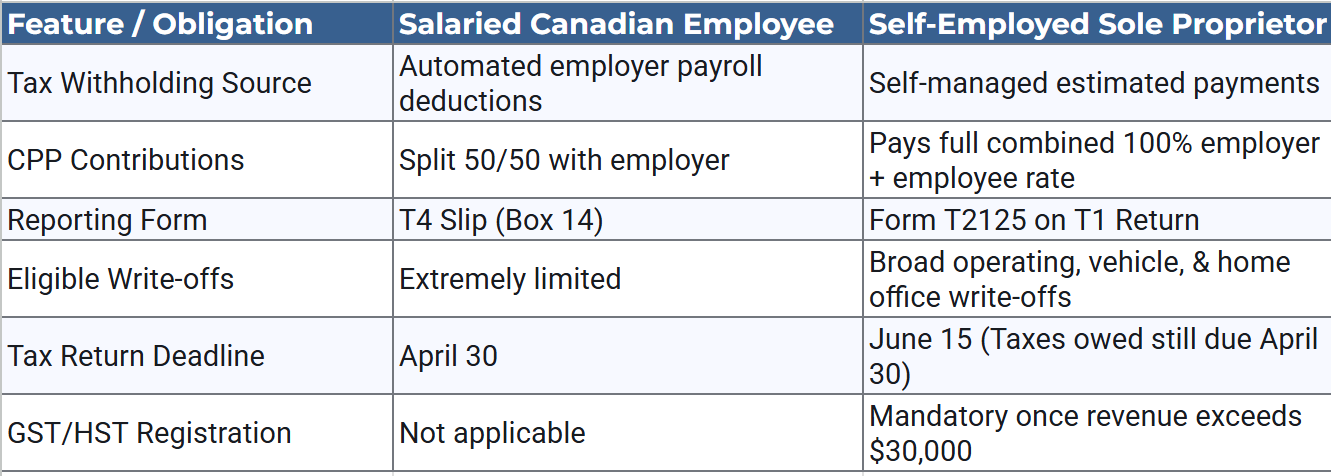
Comparison Summary: Employee vs. Self-Employed Tax Obligations
To highlight how your financial structure shifts when transitioning into self-employment, consider the operational comparisons below:
Frequently Asked Questions (FAQs)
What happens if my self-employed business operates at a net loss?
If your allowable business expenses exceed your gross revenue in a taxation year, you generate a non-capital business loss. You can use this loss to offset other sources of personal income earned in the same year (such as T4 employment income), reducing your overall tax bill. If unused, the loss can be carried back up to 3 years or carried forward up to 20 years to offset future net business profits.
Can I claim home office expenses if I am renting my residence?
Yes. Tenants running a home-based business can deduct a prorated percentage of their monthly rent payment based on the square footage allocated to their dedicated home workspace. However, you cannot claim hypothetical depreciation or full housing costs.
Is Employment Insurance (EI) mandatory for self-employed Canadians?
No. Independent business owners are not required to pay into Employment Insurance (EI). You may voluntarily opt into the CRA's EI Special Benefits for Self-Employed Individuals program, which provides access to maternity, parental, sickness, and compassionate care benefits after paying premiums for at least 12 months.
How does the CRA treat foreign currency income (e.g., payments in USD)?
All foreign currency revenues and expenses must be converted into Canadian Dollars (CAD) for tax reporting. You can convert each invoice using the official Bank of Canada exchange rate on the specific date of the transaction, or apply the official average annual exchange rate published by the Bank of Canada for the taxation year.
Conclusion: Taking Control of Your Financial Future in Canada
Mastering self-employed taxes in Canada is fundamentally about proactive preparation and systematic record-keeping. By understanding your employment classification, utilizing Form T2125 correctly, maximizing allowable deductions for home and vehicle expenses, and keeping up with GST/HST and CPP obligations, you transform tax compliance from a burden into an asset. Maintaining clean finances protects your profit margins and provides the financial stability needed to expand your business long into the future.