Getting a driver's licence in Ontario involves more than passing a single exam. New drivers must complete a graduated licensing process that includes a knowledge test and two practical road tests before receiving a full Class G licence. Whether you are starting with the G1 knowledge test, preparing for your G2 road test, or working toward your full G licence, knowing what to expect makes the process easier to manage. This guide explains Ontario's licensing system, test formats, eligibility requirements, fees, booking procedures, and practical preparation tips to help you move through each stage with confidence.
1. Understanding the Ontario Driving Test
Ontario uses a graduated licensing system to help new drivers develop their knowledge and driving skills before receiving full driving privileges. Instead of granting a full licence immediately, the province requires new drivers to progress through three stages: G1, G2, and G. Each stage provides additional driving privileges and requires drivers to demonstrate a higher level of knowledge or practical ability.
1.1. How Ontario's Graduated Licensing System Works
The graduated licensing system consists of three main stages:
- G1 - Learner's Licence: Pass a vision test and knowledge test to begin learning to drive under supervision. You must follow specific restrictions while gaining experience.
- G2 - Intermediate Licence: Pass your first road test to demonstrate basic driving skills. You can then drive independently, subject to certain restrictions.
- Full G - Full Licence: Pass the second road test to demonstrate more advanced driving skills, including highway driving. You can then obtain full Class G driving privileges.
In most cases, you must hold your G1 licence for 12 months before taking the G2 road test. This period can be reduced to 8 months if you complete an approved beginner driver education course. After receiving your G2 licence, you must generally wait another 12 months before taking the G road test. You have up to five years to complete the entire graduated licensing process. If you do not obtain your full G licence within that period, you will generally need to restart the process.
1.2. The Difference Between G1, G2 and Full G Licences
Understanding the differences between the three licence levels helps you know what each test involves and what you can legally do after passing.
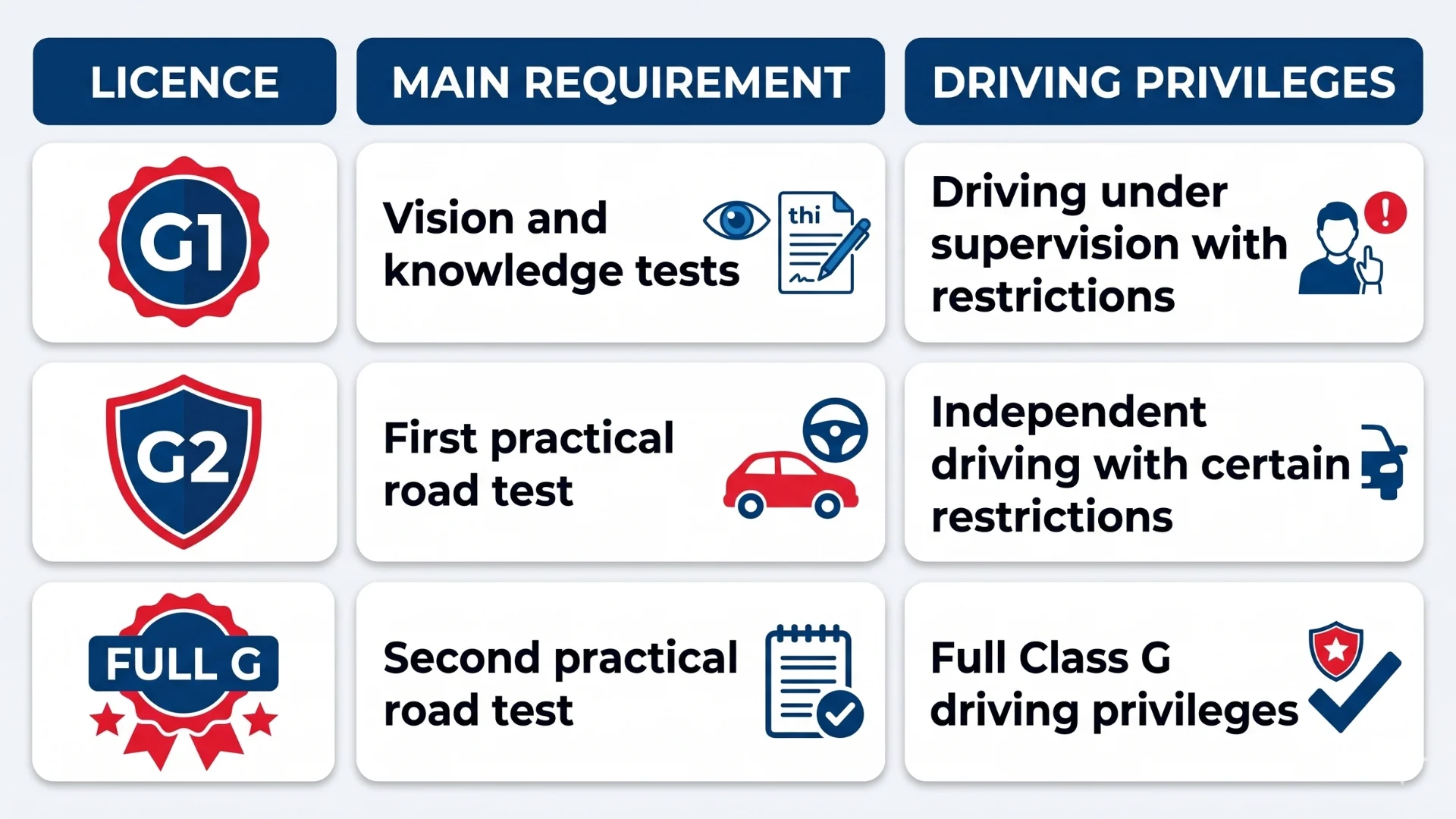
G1 and G2 drivers must maintain a zero blood alcohol level. G1 drivers also need an eligible accompanying driver, while G2 drivers can generally drive without supervision. A full G licence removes the graduated licensing restrictions, although all drivers must still follow Ontario's traffic laws and applicable licensing conditions.
2. Ontario Driving Test Requirements
Before booking an exam, you should understand the basic eligibility conditions and documents required to apply for an Ontario driver's licence.
2.1. Who Can Apply for a G1 Licence?
To apply for a G1 licence in Ontario, you must:
- Be at least 16 years old.
- Be an Ontario resident, rather than a visitor.
- Pass a vision test.
- Pass a knowledge test covering road rules and traffic signs.
- Provide acceptable identification showing your legal name and date of birth.
Applicants must visit a DriveTest Centre or an eligible ServiceOntario location to complete the required tests.
2.2. Documents and Identification You Need
You must provide original, valid identification documents that establish your legal name and date of birth. Photocopies and expired documents are not accepted. The exact documents you can use depend on your circumstances and immigration status. Therefore, check Ontario's official list of accepted identification documents before visiting a test centre.
2.3. Vision and Knowledge Test Requirements
The first stage of the Ontario licensing process involves two assessments.
- Vision test: This checks your visual acuity and horizontal field of vision to determine whether you meet the minimum requirements for driving.
- Knowledge test: This evaluates your understanding of traffic signs, road rules, and safe driving practices. It is a multiple-choice examination based on the Official MTO Driver's Handbook.
You must pass both assessments to receive your G1 licence. You can take the knowledge test at DriveTest Centres, and appointments are generally not required.
3. Ontario G1 Test: Format, Topics and Preparation
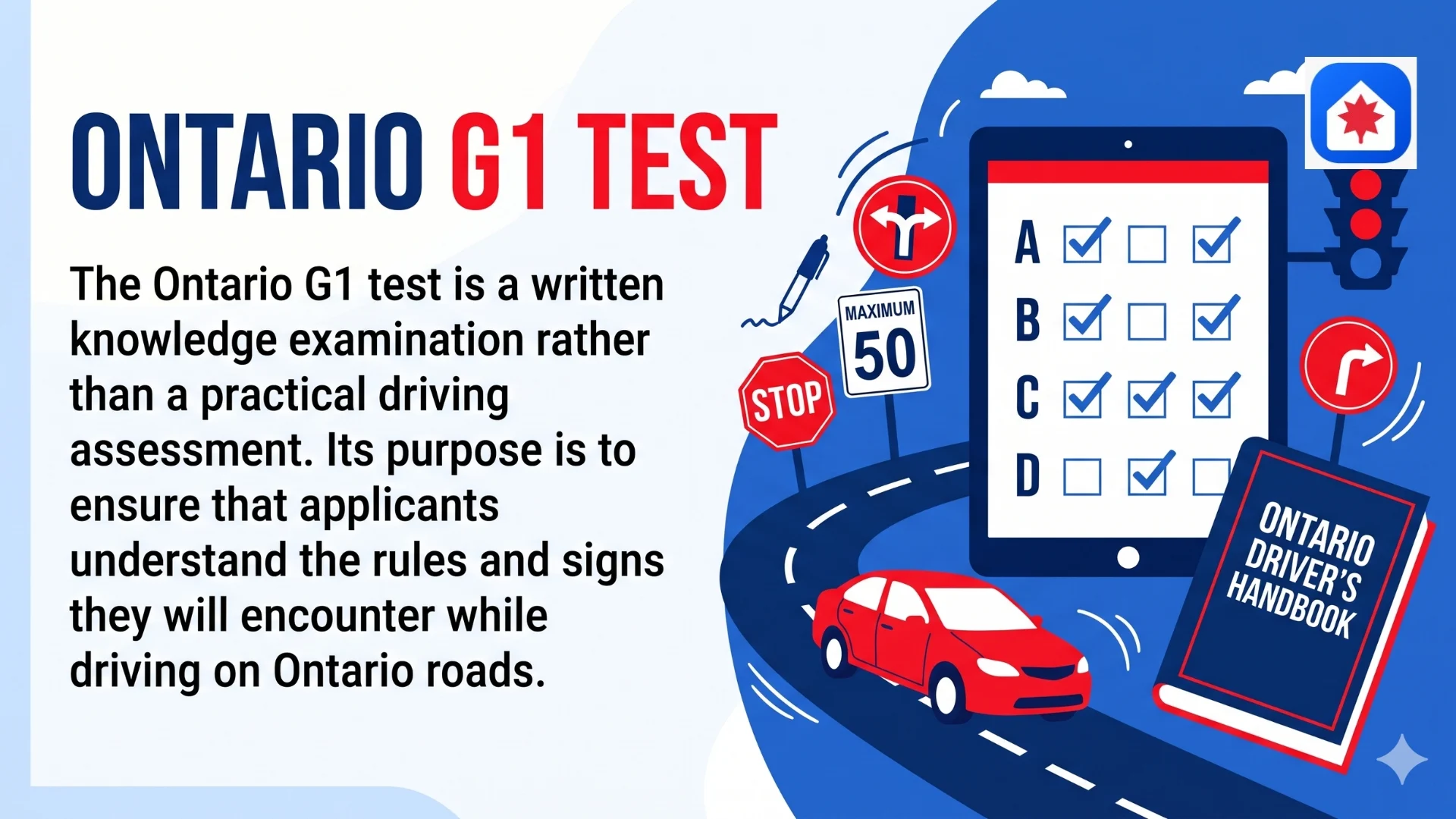
The Ontario G1 test is the first major assessment for new drivers. Unlike the later G2 and G road tests, it is a written knowledge examination rather than a practical driving assessment. Its purpose is to ensure that applicants understand the rules and signs they will encounter while driving on Ontario roads.
3.1. What Is on the Ontario G1 Test?
The G1 knowledge test covers two main areas:
- Road signs: Questions about warning signs, regulatory signs, traffic signals, and other road markings.
- Rules of the road: Questions about right-of-way, speed limits, safe driving practices, intersections, parking, and other traffic regulations.
The examination consists of 40 multiple-choice questions divided into two sections:
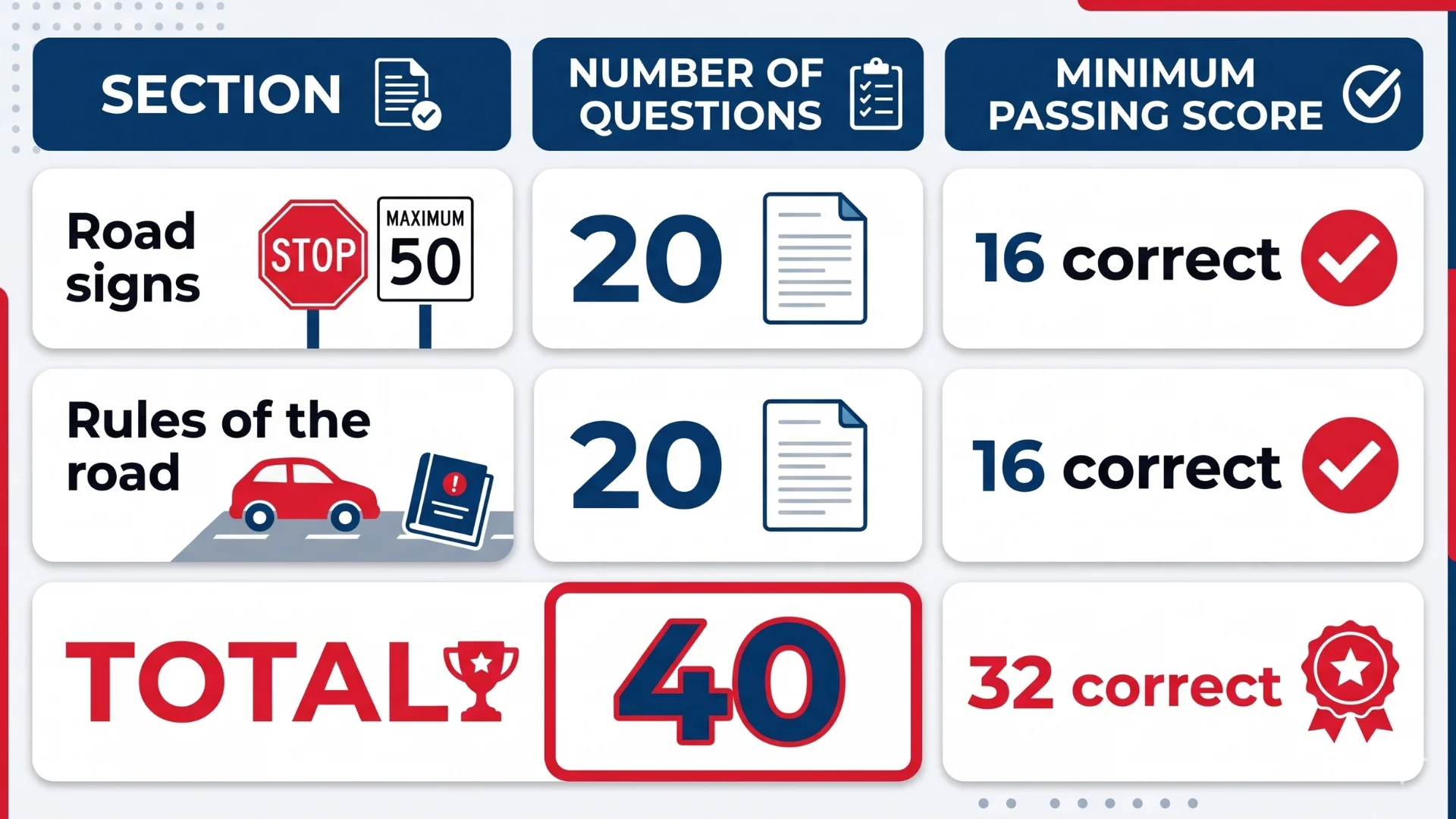
You must score at least 80% in each section to pass. This means you cannot compensate for a low score in one section by getting more questions correct in the other. For example, answering 18 road-sign questions correctly but only 14 road-rule questions correctly would result in a failed test.
3.2. How to Prepare for the G1 Knowledge Test
The most reliable way to prepare is to study the Official MTO Driver's Handbook rather than relying entirely on memorized practice questions. Here are three practical ways to organize your preparation.
- Study road signs by category: Learn the meaning of warning, regulatory, and information signs. Pay attention to signs that indicate speed restrictions, prohibited actions, road conditions, and potential hazards. Instead of memorizing each sign separately, try to understand its shape, colour, and purpose.
- Understand the rules instead of memorizing answers: Focus on common driving situations, including right-of-way at intersections, safe following distances, lane changes, turning, passing, and sharing the road with pedestrians and cyclists. Understanding why a rule exists will help you apply it to different questions.
- Practise with sample questions: After reviewing each topic, use practice questions to identify areas that need more attention. Review incorrect answers and return to the corresponding handbook sections.
You can use the Official MTO Driver's Handbook as your primary study resource. For additional practice, CanadaHomeHub's Ontario driving preparation resources provide access to study topics and practice features.
3.3. What Happens After You Pass or Fail?
If you pass both sections of the G1 knowledge test and meet the vision requirements, you receive a G1 licence. You can then begin practising, provided you follow the restrictions associated with this licence.
If you fail, you can pay the applicable retest fee and try again. You do not necessarily need to repeat the entire examination if you return within the permitted period. According to the G1 Ontario practice-test information, candidates who retake the examination within one year can generally repeat only the sections they failed.
Check the current retesting procedure with DriveTest before your next attempt.
4. G2 Test Ontario: What to Expect
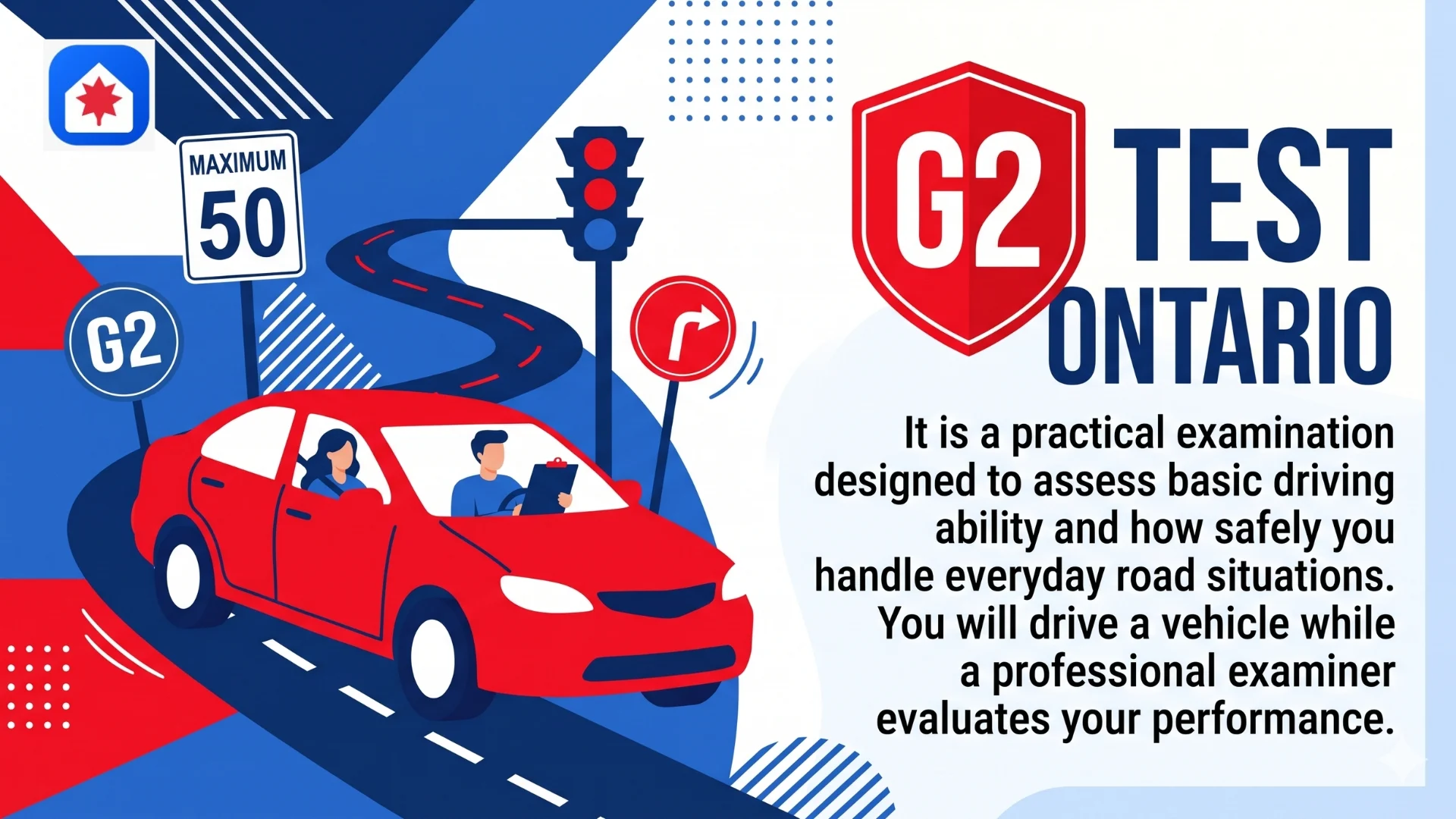
After gaining sufficient experience with your G1 licence, the next step is the G2 road test. It is a practical examination designed to assess basic driving ability and how safely you handle everyday road situations. Unlike the G1 knowledge test, you will drive a vehicle while a professional examiner evaluates your performance.
4.1. When Can You Take the G2 Road Test?
Most new drivers must hold a G1 licence for at least 12 months before taking the G2 road test. However, completing a government-approved beginner driver education course can reduce this waiting period to 8 months. The course must be recognized by the Ministry of Transportation of Ontario (MTO). Simply taking lessons from an unapproved driving school does not automatically qualify you for the shorter waiting period.
4.2. What Skills Are Tested?
The G2 road test usually takes approximately 20 minutes. During this time, the examiner assesses your ability to control the vehicle, follow traffic rules, and respond safely to different driving situations. Common skills include:
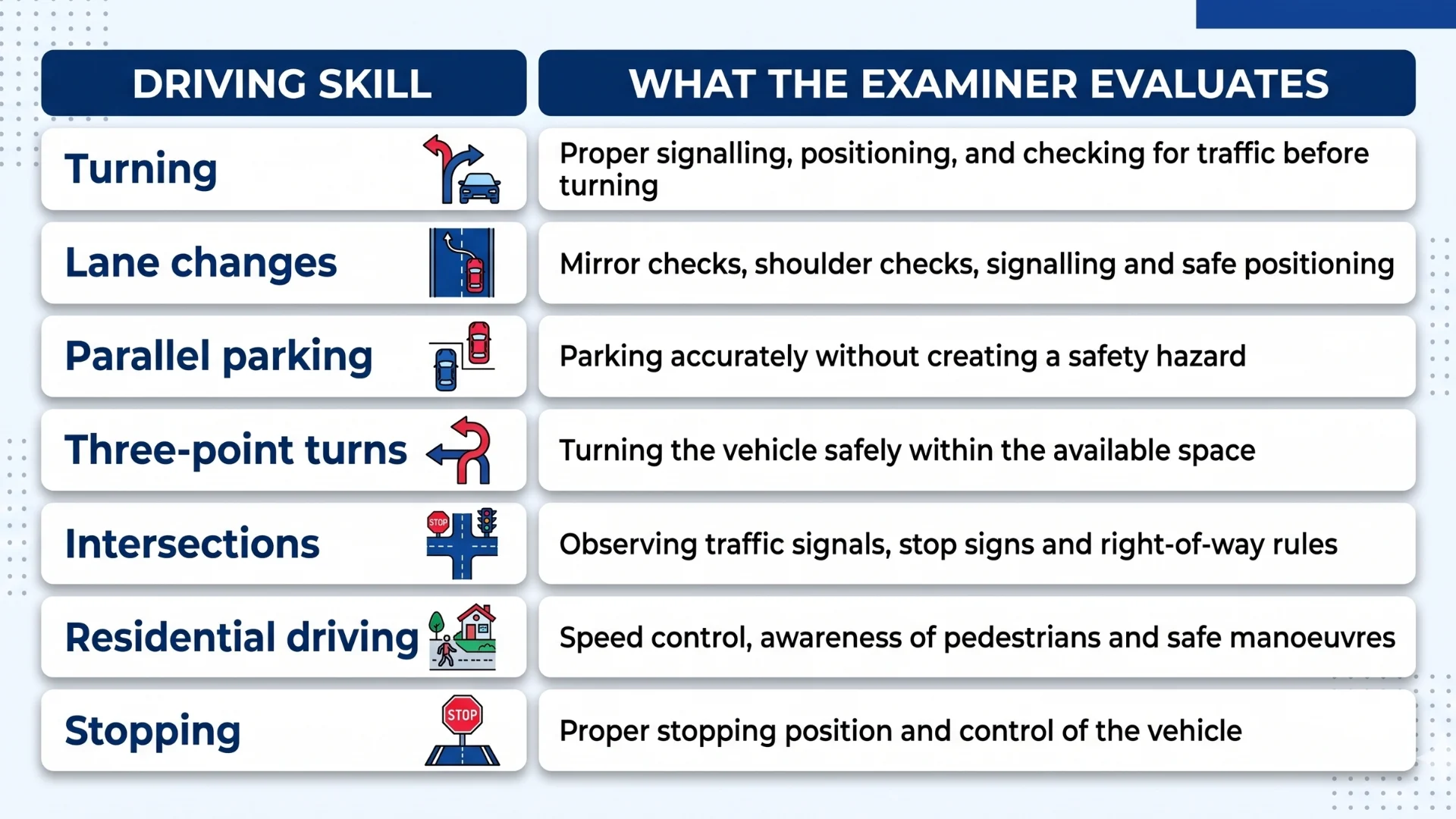
The examiner provides directions throughout the test and observes how you perform each manoeuvre. The goal is not simply to complete the requested actions. You must demonstrate that you can make safe decisions consistently while maintaining control of the vehicle.
4.3. How to Prepare for Your G2 Test
Passing the G2 road test requires regular practice, not just familiarity with individual driving manoeuvres. Start by practising in different environments, including residential streets, busier urban roads, intersections, and areas with different speed limits.
Pay particular attention to the following habits:
- Check your mirrors regularly and perform shoulder checks before changing lanes.
- Signal early enough to communicate your intentions to other drivers.
- Come to a complete stop at stop signs.
- Maintain a safe following distance.
- Observe speed limits and adjust your speed to road conditions.
- Check carefully for pedestrians and cyclists before turning.
- Practise parking and turning manoeuvres until you can perform them smoothly.
It is also useful to practise with a qualified driving instructor who understands the Ontario road-test format. An instructor can identify habits that may be difficult for you to notice on your own. For a more structured approach, you can also refer to CanadaHomeHub's G2 preparation guide alongside the official MTO handbook.
5. Ontario G Road Test: Moving from G2 to a Full Licence
The final stage of the graduated licensing process is the G road test. While the G2 examination focuses on basic driving ability, the G test evaluates more advanced skills, particularly your ability to drive safely on major roads and expressways. Passing this examination allows you to obtain a full Class G licence.
5.1. Eligibility and Highway Driving Experience
You generally need to hold your G2 licence for at least 12 months before taking the G road test. In addition to meeting the waiting period, you must have sufficient highway driving experience.
DriveTest requires applicants to have driven on qualifying highways at least five times within the three months before the G road test. You must also provide information about the average length of those trips through the highway driving experience declaration.
This requirement helps ensure that applicants have practical experience with higher-speed traffic before taking the examination. If you do not meet the experience requirement, your appointment may be cancelled, and you may forfeit part of your test fee.
5.2. What the G Road Test Includes
The G road test usually takes approximately 30 minutes and covers more advanced driving situations.
The examiner generally evaluates the following skills:
- Highway entry and merging: You must enter the highway safely, adjust your speed to match traffic, and choose an appropriate gap when merging.
- Highway driving: The examiner observes your ability to maintain a suitable speed, follow at a safe distance, and remain aware of surrounding vehicles.
- Lane changes: You must check your mirrors, perform shoulder checks, signal, and change lanes when it is safe.
- Intersections and turns: You should demonstrate appropriate positioning, signalling, and awareness of other road users.
- Driving in business areas: The test may involve busier streets where you need to respond to traffic signals, pedestrians, turning vehicles, and changing traffic conditions.
These skills show whether you can handle more demanding driving environments without constant supervision.
5.3. Understanding the Temporary G Road Test Changes
One important detail to know before booking is that Ontario has temporarily modified the G road test at full-time DriveTest Centres. Under this arrangement, the test no longer includes several manoeuvres already assessed during the G2 road test, including:
- Parallel parking.
- Roadside stops.
- Three-point turns.
- Driving in residential neighbourhoods.
However, the test still evaluates essential driving skills, including highway merging, speed and space management, lane changes, intersections, turns and driving in business areas. Part-time Travel Point locations continue to offer the standard G road test.
This distinction matters when preparing for your examination. The exact format may depend on the type of DriveTest location where you book. Check the latest instructions on the official DriveTest road-test page before your appointment, as temporary arrangements may change.
6. Ontario Driving Test Fees and Booking
Understanding the cost and booking process can help you plan and avoid unexpected expenses.
6.1. How Much Does an Ontario Driving Test Cost?
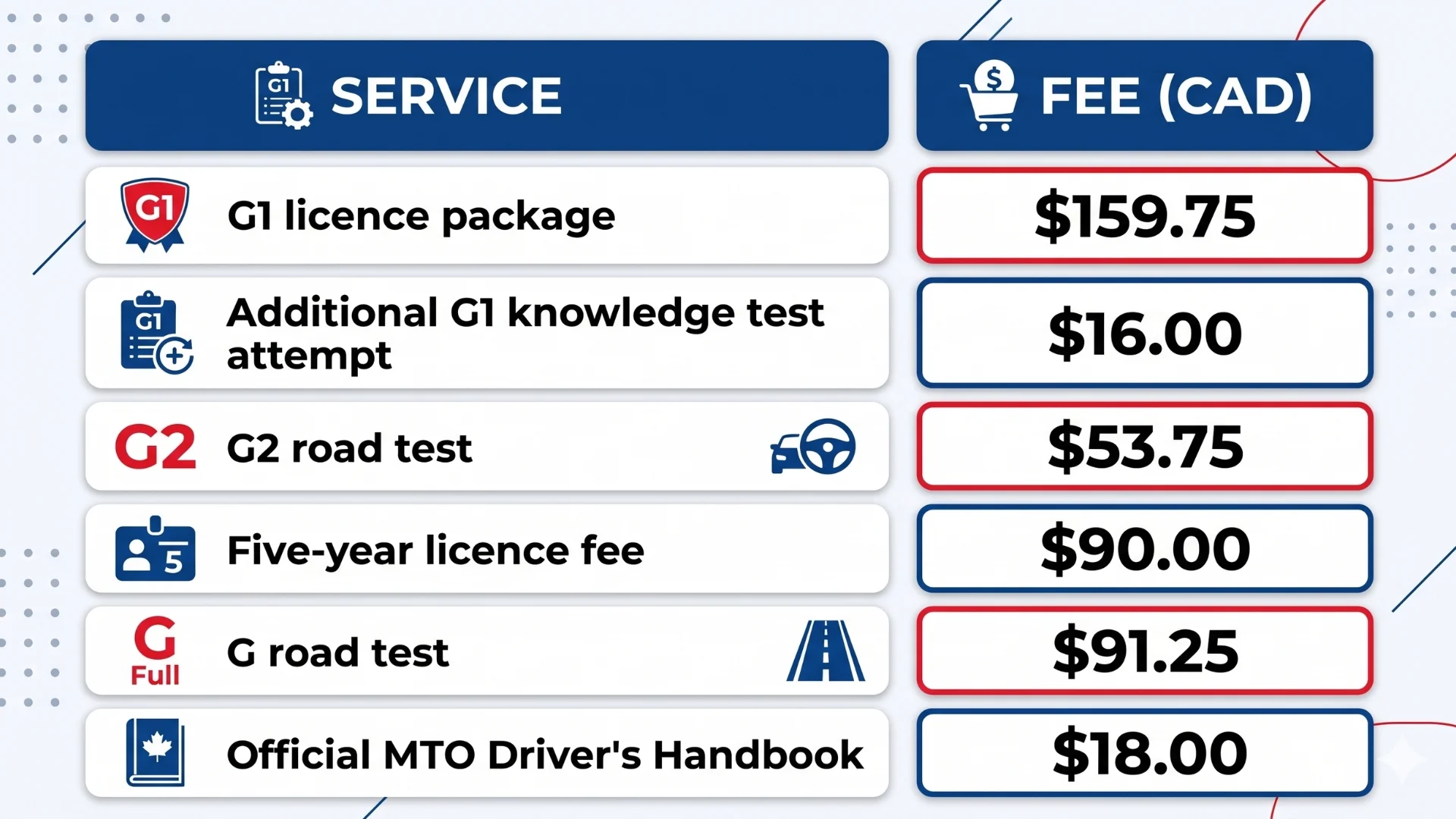
The cost of an Ontario driving test depends on the stage of the licensing process and whether you need to retake an examination. According to DriveTest's published fee schedule, the following fees apply to Class G licensing services:
6.2. How to Book or Reschedule a Road Test
Once you meet the eligibility requirements, you can book your road test through the official DriveTest booking service.
The process generally involves these steps:
- Visit the official DriveTest website.
- Select the appropriate road test for your licence level.
- Enter your Ontario driver's licence number and expiry date.
- Choose your preferred DriveTest Centre.
- Select an available appointment date and time.
- Pay the required examination fee and confirm your booking.
You can also book by phone or in person at a DriveTest Centre. If you need to change your appointment, review the cancellation policy carefully. DriveTest requires at least 48 hours' notice to cancel without a cancellation fee.
6.3. What to Bring on Test Day
Preparing your documents and vehicle before the appointment can help prevent unnecessary delays.
For a road test, make sure you have:
- Your valid Ontario driver's licence.
- Your road-test confirmation details.
- A vehicle in good working condition.
- Enough fuel to complete the examination.
- Glasses or contact lenses if required by your licence conditions.
- Payment if you need to pay any outstanding fees.
You should also arrive at least 30 minutes before your scheduled appointment. The vehicle must be properly registered, insured, plated, and suitable for the test. DriveTest does not provide vehicles, so you must arrange your own car.
Before the examination begins, the examiner will check the vehicle for basic safety and roadworthiness. Issues such as defective brake lights, non-functioning turn signals, damaged windshields, or unsafe tyres can result in the test being declared out of order.
7. Common Ontario Driving Test Mistakes to Avoid
Even drivers who understand traffic rules and have plenty of practice can make mistakes during an examination. Many problems arise from inconsistent habits rather than a lack of technical driving ability. Here are several common issues to watch for:
- Failing to check blind spots: Looking only at your mirrors before changing lanes or moving away from the curb can put other road users at risk. Make shoulder checks part of every relevant manoeuvre.
- Rolling through stop signs: Slowing down without coming to a complete stop is a common mistake. Always stop fully at the appropriate stopping position and check for traffic before proceeding.
- Incorrect speed management: Driving too fast for the conditions or unnecessarily slowly can affect safety. Pay attention to posted speed limits, road conditions, and surrounding traffic.
- Forgetting to signal: Failing to signal before turning or changing lanes makes your intentions less predictable. Signal appropriately and give other road users enough time to respond.
- Poor positioning: Incorrect lane positioning, wide turns, or approaching intersections without enough preparation can make your driving less predictable.
- Insufficient observation: Focusing only on the vehicle ahead can cause you to miss pedestrians, cyclists, approaching vehicles, and changing traffic conditions.
- Nervous or rushed decisions: Anxiety can make drivers react too quickly, forget routine checks, or hesitate unnecessarily. Practise until basic manoeuvres become consistent and controlled.
8. Practical Tips to Improve Your Chances of Passing
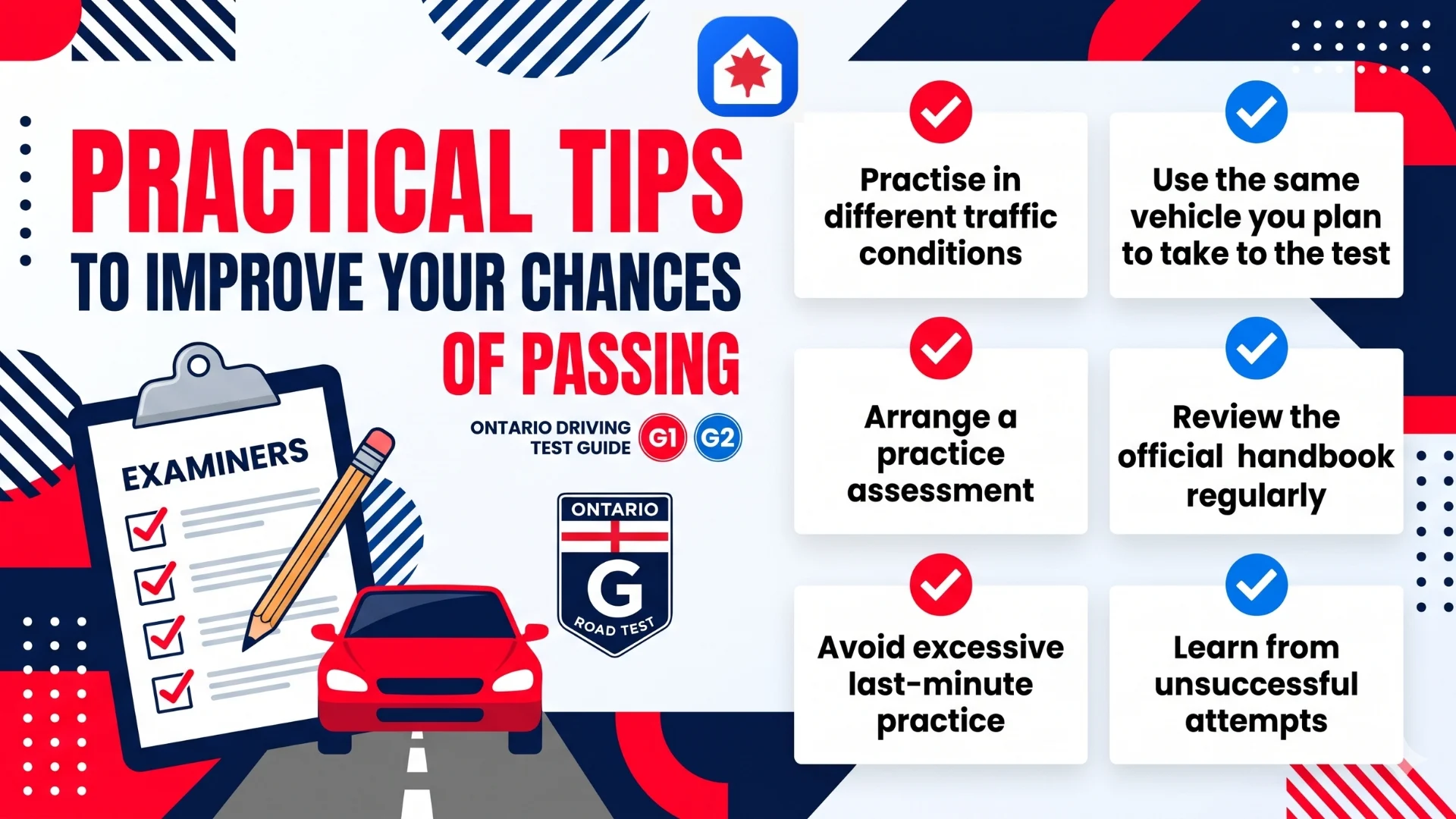
Preparing for an Ontario road test involves more than learning the examination route. You need to demonstrate safe driving habits consistently, even when the examiner asks you to perform unfamiliar manoeuvres. Consider these practical preparation strategies:
- Practise in different traffic conditions: Do not limit your experience to quiet residential streets. Practise on busier roads, at intersections, and in areas with different speed limits. G2 candidates should become comfortable with everyday urban driving, while G candidates need enough highway experience.
- Use the same vehicle you plan to take to the test: Familiarity with the mirrors, controls, braking response, and vehicle dimensions can make it easier to concentrate on driving.
- Arrange a practice assessment: Ask a qualified instructor to observe your driving as if you were taking the actual test. This can help identify habits that need improvement before your appointment.
- Review the official handbook regularly: Even after passing the G1 knowledge test, reviewing road rules and safe driving practices can help reinforce the knowledge required during practical examinations.
- Avoid excessive last-minute practice: Practising too much when you are tired or stressed can affect your concentration. Focus on consistent preparation and get enough rest before test day.
- Learn from unsuccessful attempts: If you fail, review the examiner's feedback carefully. Identify the specific skills that need improvement instead of repeating the same practice routine without making adjustments.
Frequently Asked Questions
1. How many questions are on the Ontario G1 test?
The Ontario G1 knowledge test contains 40 multiple-choice questions divided into two sections: 20 questions about road signs and 20 questions about rules of the road. You must answer at least 16 questions correctly in each section, equivalent to an 80% passing score per section.
2. How long does it take to get a full G licence in Ontario?
For most new drivers, the process takes at least 20 months. You generally need to hold a G1 licence for 12 months before taking the G2 road test, followed by another 12 months with a G2 licence before taking the G road test. Completing an approved beginner driver education course can reduce the initial G1 waiting period to eight months, bringing the minimum overall timeline to approximately 20 months.
3. Can I take my G2 test without attending driving school?
Yes. Completing driving school is not mandatory for taking the G2 road test. However, you must generally hold your G1 licence for 12 months before becoming eligible.
4. How many times can I retake the Ontario driving test?
You can retake a knowledge or road test if you do not pass. However, you must pay the applicable retest fee and meet the required waiting period.
5. How long should I wait before retaking a failed road test?
You must wait at least 10 days before taking another road test. This gives you time to practise the skills you need to improve and prepare for another attempt.
6. Do I need to bring my own car for the road test?
Yes. DriveTest Centres do not provide vehicles for road tests. You must bring an appropriate vehicle that is properly registered, insured, and in safe working condition.
Getting a driver's licence in Ontario is a gradual process that requires preparation, practical experience, and an understanding of provincial driving rules. From passing the G1 knowledge test to demonstrating your skills in the G2 and G road tests, each stage helps you become a safer and more confident driver. Before booking your next examination, make sure you meet the eligibility requirements, understand the test format, and have enough practice with the relevant driving skills. With consistent preparation and a clear understanding of each stage, you can approach the Ontario driving test with greater confidence and work toward obtaining your full Class G licence.
For additional study support, visit CanadaHomeHub's Driving Test resources to explore materials that can help you prepare for the Ontario driving test.