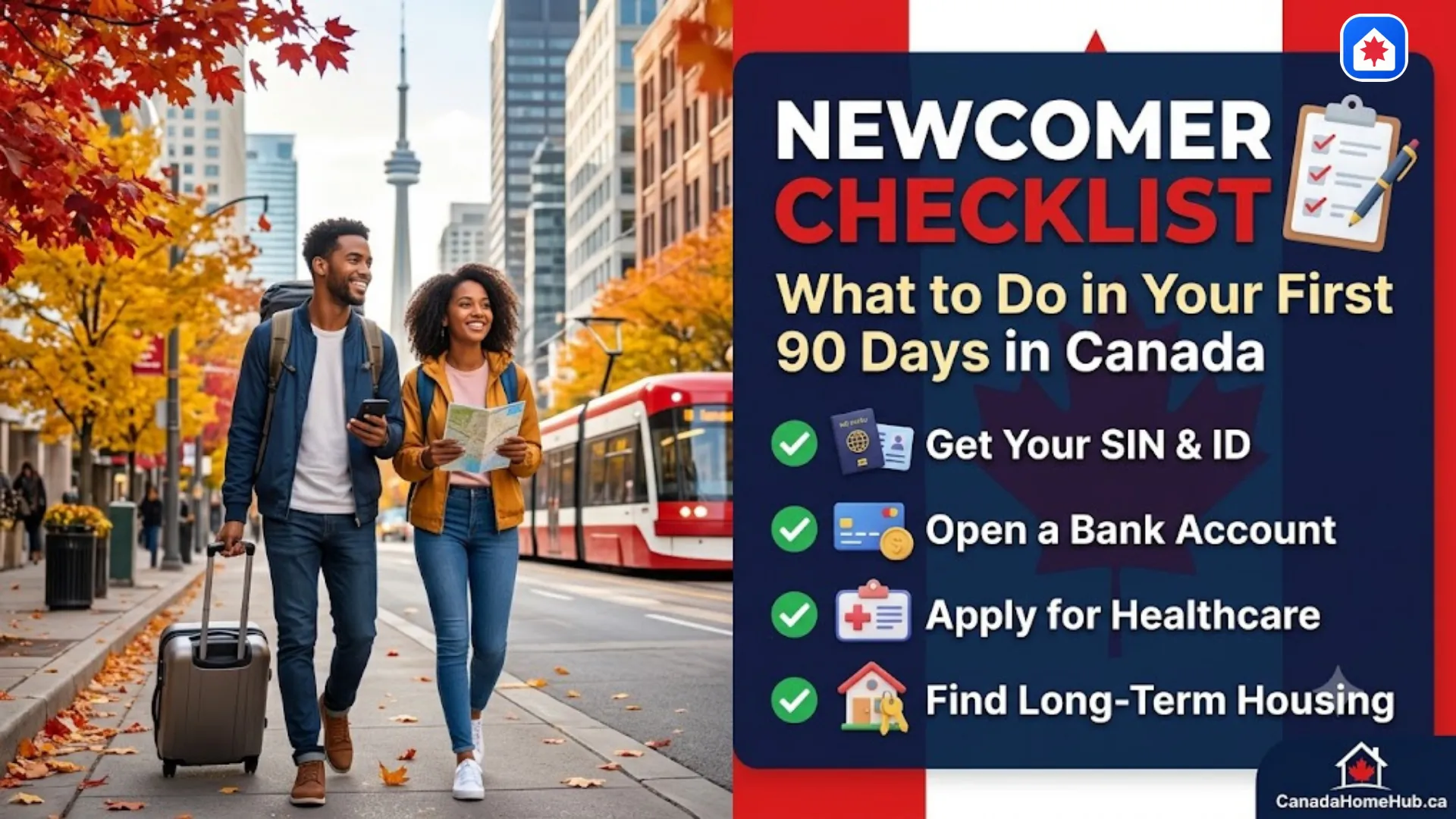
Landing in Canada marks the beginning of an exciting life chapter, but the initial transition can easily feel overwhelming. Between navigating immigration checkpoints, deciphering provincial healthcare systems, and establishing everyday life, new arrivals face a steep learning curve. A successful transition is not about doing everything at once - it is about doing the right things in the correct sequence.
This comprehensive newcomer checklist Canada provides a structured, chronological roadmap for your first 90 days in Canada. By breaking critical settlement steps into manageable phases—from your first 72 hours through your first three months—you can protect your legal status, safeguard your finances, secure stable housing, and establish roots in your new community with confidence.
Preparing for Landing: Immediate Essentials (Days 1–3) - Newcomer Checklist Canada
The first 72 hours after arriving in Canada involve administrative necessities that unlock virtually every other settlement milestone.
Customs Clearance and Landing Documents
When you pass through the Canada Border Services Agency (CBSA) checkpoint at your port of entry (such as Toronto Pearson, Vancouver International, or Montréal-Trudeau), keep all primary identification in your carry-on luggage:
- Valid foreign passports for all arriving family members.
- Confirmation of Permanent Residence (COPR) documents and immigrant visas, or approved Work/Study Permits.
- The CBSA Declaration Form and Goods to Follow list (Form BSF186 / B4), itemizing belongings arriving via international shipping at a later date.
- Proof of settlement funds (recent official bank statements or bank drafts).
Ensure border officers stamp your documents correctly. Your COPR serves as primary legal proof of permanent resident status inside Canada until your plastic PR Card arrives at your Canadian residential address (typically 45–90 days).
Securing a Canadian SIM Card and Local Phone Number
A Canadian phone number is mandatory for opening a bank account, setting up residential utility profiles, and receiving identity verification codes from government agencies.
- Many international airports host telecommunications kiosks where you can pick up a local SIM or activate an eSIM immediately.
- Major national carriers include Rogers, Bell, and Telus, alongside their regional or mid-tier subsidiaries like Fido, Virgin Plus, Koodo, Freedom Mobile, and Public Mobile.
- Monthly prepaid or "bring your own phone" (BYOP) plans offer flexibility without long-term contract lock-in while you assess your monthly data requirements.
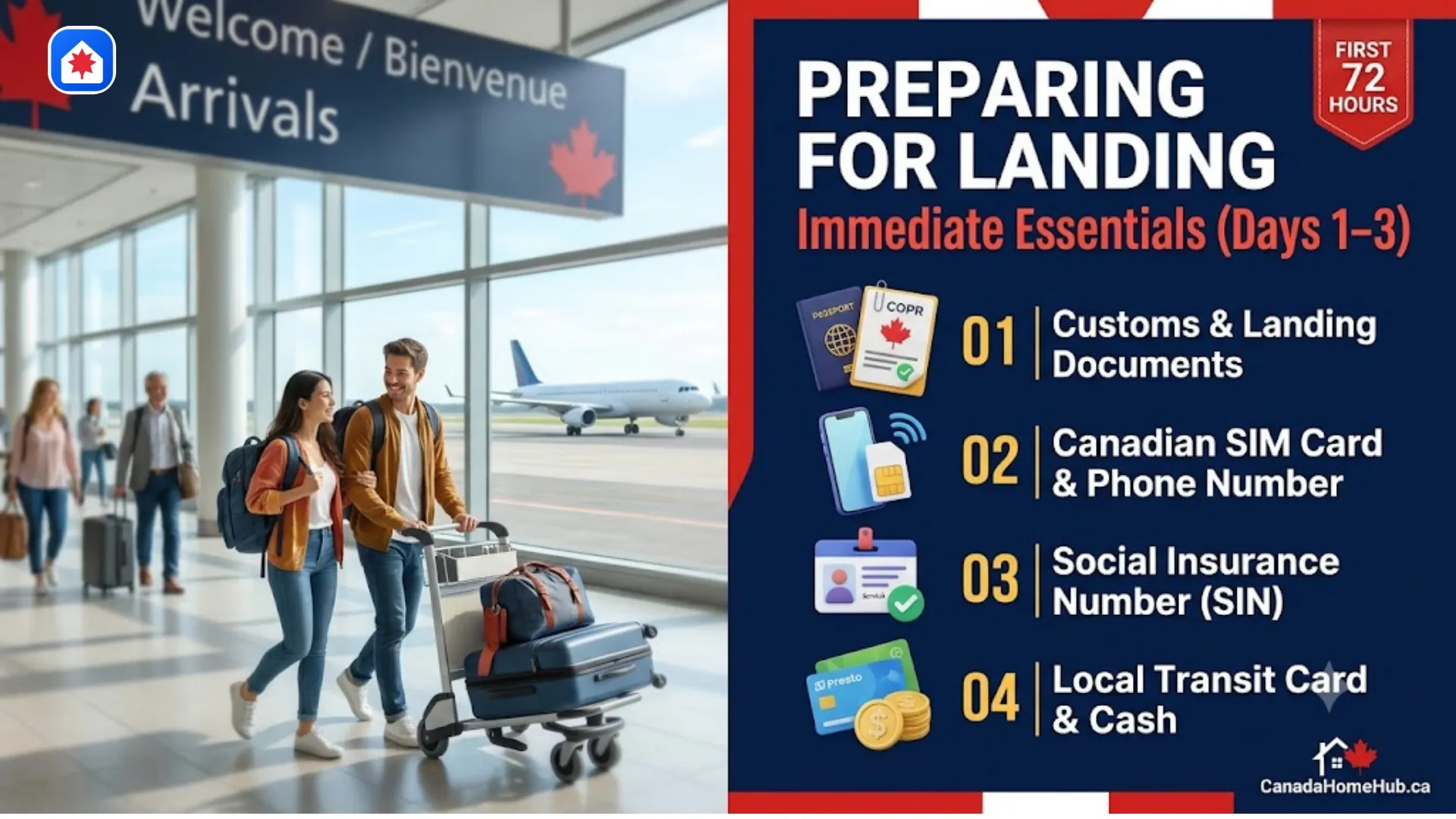
Getting a Social Insurance Number (SIN) at Service Canada
Your Social Insurance Number (SIN) is a confidential nine-digit number required to work in Canada, access government benefit programs, and pay income taxes.
While you can submit an application online, visiting a Service Canada Centre in person is significantly faster. If your documents are in order, an officer will print your official SIN letter on the spot.
Privacy Warning: Your SIN is sensitive personal information. Guard it closely. Never carry your physical SIN document in your wallet on a daily basis, and do not provide it to landlords, rental applications, or utility providers—they are not legally entitled to demand it.
Local Transit Cards and Immediate Currency Exchange
Before stepping out of your temporary lodging, obtain the transit card appropriate for your metropolitan area:
- Presto Card: Greater Toronto Area, Hamilton, and Ottawa.
- Compass Card: Metro Vancouver.
- Opus Card: Greater Montréal.
Load your card using automated station kiosks or mobile apps. Avoid converting large sums of foreign currency at airport currency booths due to high transaction spreads; instead, use bank ATMs to withdraw small amounts of Canadian dollars (CAD) until your domestic accounts are active.
Building Your Foundation: The First 30 Days in Canada - Newcomer Checklist Canada
Your first 30 days in Canada should focus on establishing legal entitlements, financial infrastructure, and reliable accommodation.
Opening a Newcomer Bank Account
The Canadian banking system is stable and heavily regulated. The country’s largest retail financial institutions—collectively known as the "Big Five"—all offer dedicated newcomer packages that waive monthly account maintenance fees for the first 12 to 24 months:
- Royal Bank of Canada (RBC)
- Toronto-Dominion Bank (TD)
- Bank of Nova Scotia (Scotiabank)
- Bank of Montreal (BMO)
- Canadian Imperial Bank of Commerce (CIBC)
Schedule an in-person appointment with a personal banking advisor. Bring your passport, COPR/work permit, Canadian phone number, temporary address, and your SIN.
Request two fundamental accounts:
- Chequing Account: For day-to-day purchases, bill payments, direct payroll deposits, and Interac e-Transfers (the standard method for transferring money between individuals in Canada).
- Savings Account: An interest-bearing account for emergency funds.
During this appointment, request an entry-level, unsecured newcomer credit card (often issued with a modest credit limit between $1,000 and $2,000 without requiring domestic credit history).
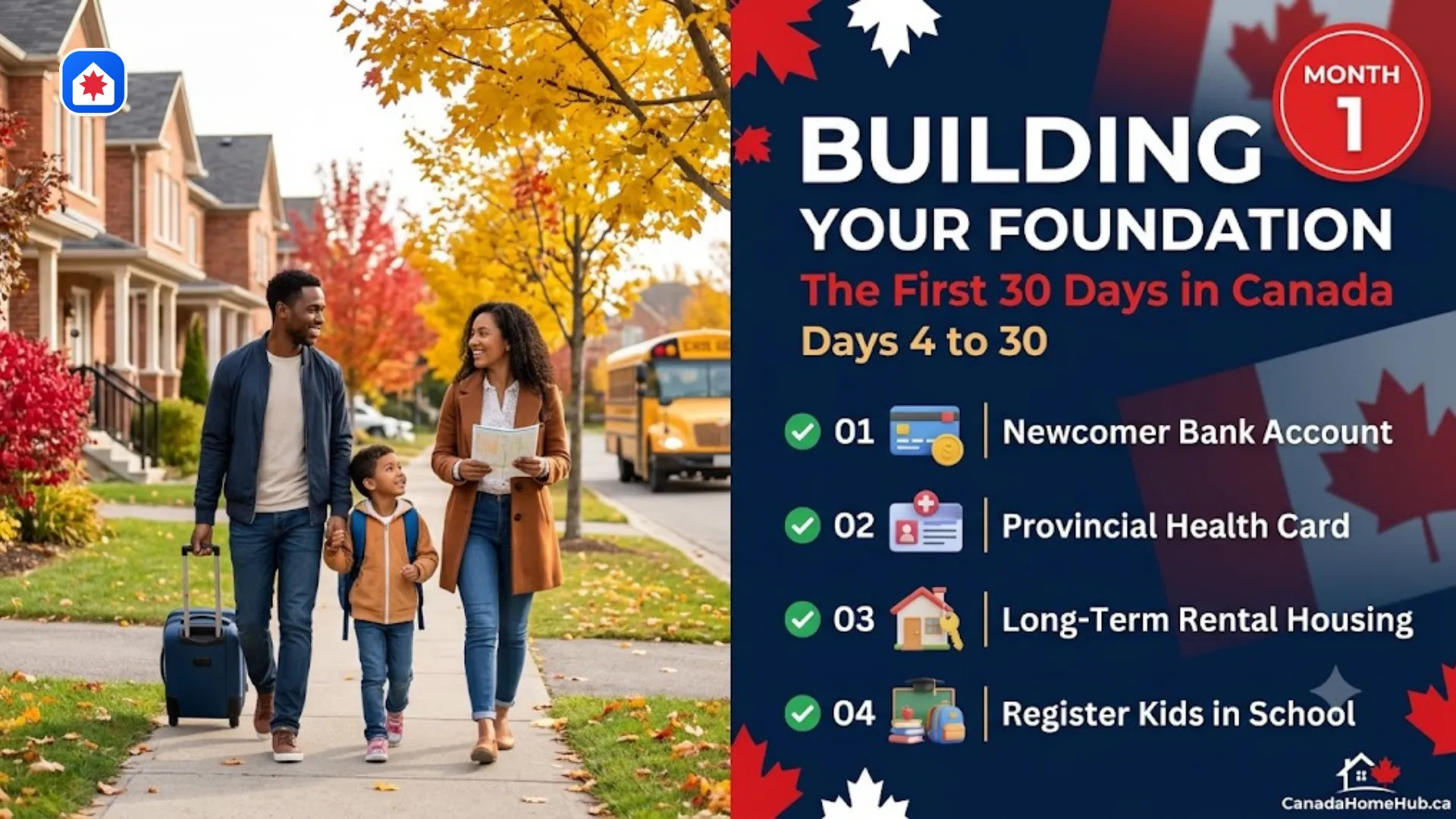
Applying for Your Provincial Health Card - Newcomer Checklist Canada
Healthcare in Canada is publicly funded, but it is delivered and managed at the provincial and territorial levels rather than by the federal government.
Apply for your provincial health card as soon as you have proof of residence:
- Ontario (OHIP): ServiceOntario handles registrations.
- British Columbia (MSP): Administered via Health Insurance BC.
- Alberta (AHCIP): Administered through authorized Alberta registry agent locations.
- Quebec (RAMQ): Administered by the Régie de l'assurance maladie du Québec.
Because some jurisdictions enforce eligibility waiting periods or backlogs in card distribution, purchase third-party emergency travel medical insurance to protect your family during any initial coverage gap.
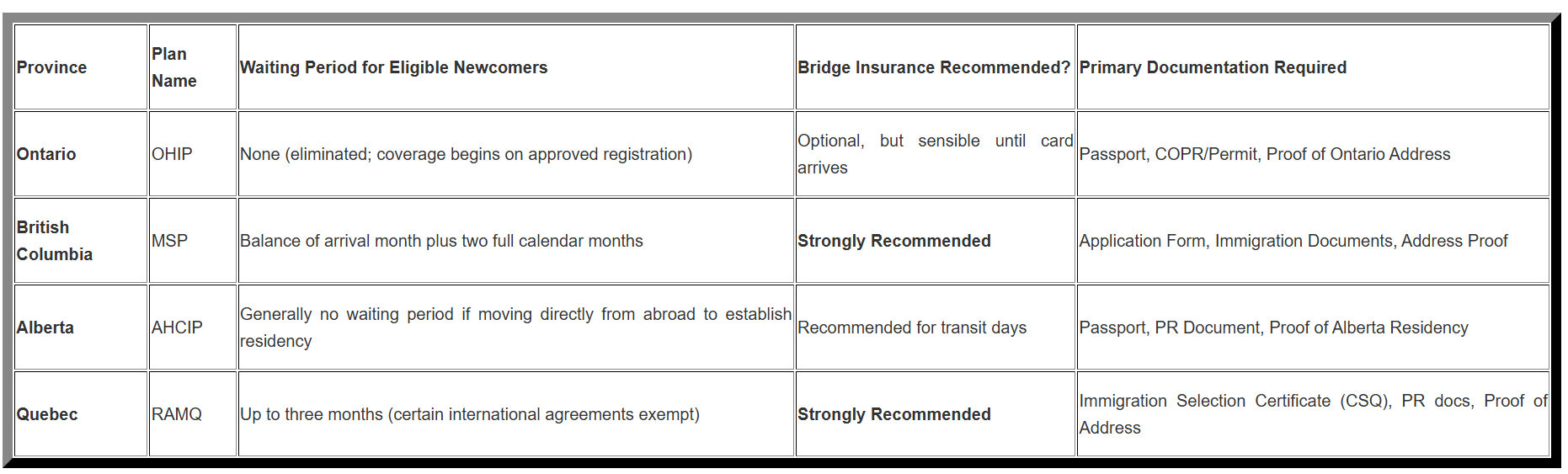
Provincial Healthcare Comparison for Newcomer Checklist Canada
Understanding your province’s specific coverage parameters helps avoid unexpected out-of-pocket medical expenses.
Transitioning from Temporary Stays to Long-Term Housing
Securing a long-term rental property represents one of the most challenging things to do after arriving in Canada, especially in competitive urban centres like Toronto, Vancouver, Calgary, and Ottawa.
Most residential tenancies in Canada require a formal 12-month lease agreement. However, landlords routinely ask for Canadian credit scores, employment references, and domestic rental histories—assets newcomers have not yet had time to build.
To overcome these barriers:
- Prepare an organized tenant portfolio: Include your employment offer letter, proof of liquid funds, immigration paperwork, and character reference letters.
- Know your provincial tenancy rights: In Ontario, for example, landlords cannot legally ask for more than first and last month’s rent up front, nor can they mandate post-dated cheques or pet deposits. In British Columbia and Alberta, standard security deposits equal one-half of one month's rent.
- Understand total housing costs: In addition to base rent, budget for tenant insurance (typically $20 to $40 per month, often mandatory under lease terms) and residential utilities (electricity/hydro, heating, and home internet).
- Leverage specialized relocation resources: Rather than relying exclusively on unregulated classified boards where rental scams can occur, consult dedicated settlement and housing platforms such as CanadaHomeHub.Ca to understand neighbourhood profiles, benchmark realistic rental budgets, and learn how Canadian residential leases work.
Registering Children in Local Schools - Newcomer Checklist Canada
Under Canadian law, all children between the ages of 5 or 6 (depending on the province) and 18 are entitled to free public elementary and secondary education, regardless of their parents' immigration citizenship status.
Contact your local public or Catholic school board’s Newcomer Reception Centre. They will schedule a welcoming assessment for language proficiency (English or French) and math placement. You will need:
- The child’s passport, birth certificate, and immigration paperwork.
- Immunization/vaccination records translated into English or French.
- Official proof of your residential address within the school district (e.g., signed lease agreement or residential utility bill).
Deepening Your Roots: Days 31 to 60
Once primary documentation and living arrangements are settled, the second month centres on daily independence, community resources, and financial habits.
Exchanging or Obtaining Your Canadian Driver’s Licence
Driving privileges fall under provincial jurisdiction. In most provinces, you can legally drive using your valid foreign driver’s licence for a limited grace period (typically 60 to 90 days following residency establishment).
- Reciprocal jurisdictions: If your licence originates from a country with a reciprocal agreement (such as the United States, the United Kingdom, Australia, or France), you can typically complete a direct exchange for a full provincial licence (e.g., Ontario Class G or BC Class 5) by completing an eye exam and identity verification.
- Non-reciprocal jurisdictions: If no agreement exists, you must enter the province's graduated licensing program. Obtain an official Letter of Authentication or driving abstract from your home country's licensing body prior to departure; this document can help credit your past driving experience, bypassing mandatory graduated waiting periods before your road tests.
Establishing and Building Canadian Credit History
Canada operates on an active credit reporting framework dominated by two bureaus: Equifax and TransUnion. Your credit score directly impacts your future ability to secure personal loans, competitive car financing, and residential mortgages.
Because credit scores from foreign countries do not transfer to Canada, you begin with a clean slate:
- Use your credit card routinely: Charge recurring household expenses (such as grocery purchases or phone bills) to your card.
- Keep credit utilization below 30%: If your credit limit is $2,000, keep your running balance below $600.
- Pay balances in full every cycle: Carrying a balance does not boost your score; it merely accrues compounding interest at retail rates (often 19.99% to 24.99% annually).
- Avoid excessive credit inquiries: Do not apply for multiple credit cards, retail store financing, or unsecured personal loans in your first six months.

Accessing Government-Funded Settlement Services
Immigration, Refugees and Citizenship Canada (IRCC) funds an extensive network of community-level settlement agencies nationwide. These services are completely free for Permanent Residents and protected persons:
- Language Training: Language Instruction for Newcomers to Canada (LINC) provides government-funded language assessment and classes.
- Employment Support: Specialized workshops covering the Canadian workplace culture, resume restructuring, and industry-specific mentoring.
- Community Connection: Local volunteer networks that pair newcomers with long-time residents to assist with cultural adjustment.
Major service providers include organizations such as ACCES Employment, YMCA Immigrant Services, MOSAIC (BC), and Immigrant Services Calgary.
Preparing for Canadian Weather and Household Basics
If you arrive between October and April, winter conditions require deliberate preparation. Temperatures across inland and eastern Canada routinely drop well below freezing:
- The Layering Principle: Invest in a thermal base layer (merino wool or technical synthetics), a fleece or down mid-layer, and a windproof, waterproof exterior winter coat rated for temperatures between -15°C and -30°C.
- Insulated Winter Boots: Footwear must feature non-slip rubber outsoles and water-resistant membranes to navigate snow, slush, and street salt.
- Winter Tires for Vehicles: In Quebec, winter tires are legally mandatory from December 1 to March 15. In other provinces, winter tires are heavily encouraged and can qualify you for discounts on auto insurance policies.
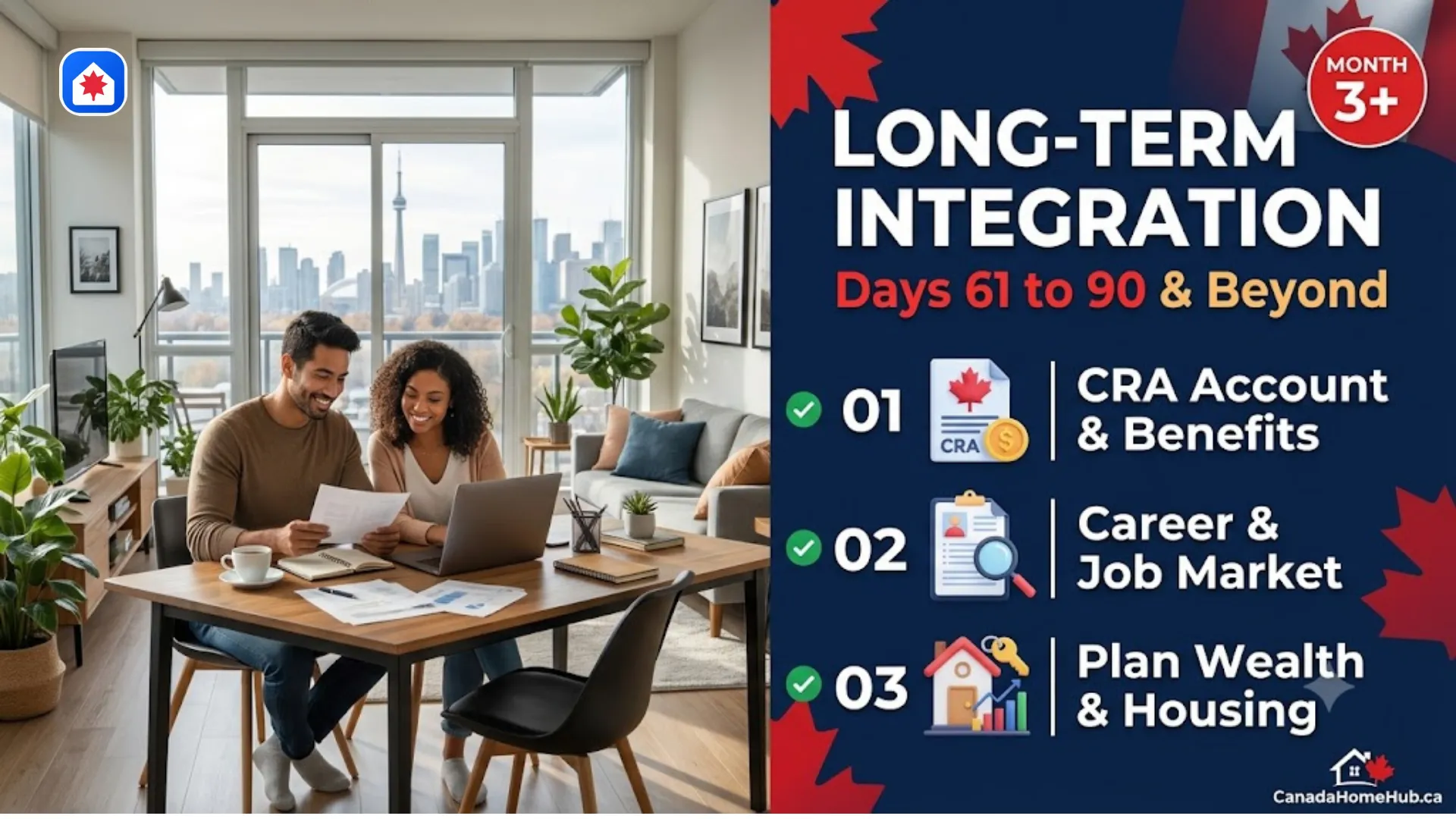
Long-Term Integration: Days 61 to 90 and Beyond - Newcomer Checklist Canada
The final stretch of your first three months shifts your focus from initial setup toward sustained career growth and forward-looking financial management.
Registering for a CRA Account and Newcomer Benefits
The Canada Revenue Agency (CRA) oversees the federal tax system. Even if you arrive mid-year and earned zero domestic income in Canada during your first months, you should apply for tax-sheltered credits and income-tested social benefits:
- Canada Child Benefit (CCB): A tax-free monthly payment made to eligible families to assist with the cost of raising children under 18 years of age.
- GST/HST Credit: A quarterly tax-free payment that helps individuals and families with modest incomes offset the sales taxes they pay.
Submit Form RC66 (Canada Child Benefits Application) and Form RC151 (GST/HST Credit Application for Individuals Who Become Residents of Canada) through mail or through a CRA My Account profile once your initial income tax assessment is processed.
Tailoring Your Resume to the Canadian Job Market
A standard international curriculum vitae (CV) rarely aligns with North American hiring customs. Canadian hiring managers expect a concise, achievement-focused resume tailored to specific role requirements:
- Exclude personal data: Never include photographs, age, date of birth, marital status, religion, nationality, or your Social Insurance Number on a Canadian resume. Anti-discrimination employment legislation renders these details inappropriate.
- Emphasize measurable outcomes: Structure your work history using active verbs and metrics (e.g., "Managed a cross-functional engineering team of 12 to deliver an enterprise cloud migration 15% under budget").
- Cultivate professional connections: A substantial portion of professional vacancies in Canada belong to the "hidden job market"—filled through internal references rather than public job boards. Attend industry association meetups, join local chambers of commerce, and connect respectfully with peers on LinkedIn.
Planning Long-Term Housing and Financial Milestones
By Day 90, your household routine will start feeling familiar. This is the ideal time to evaluate your long-term wealth building, investments, and homeownership objectives.
┌────────────────────────────────────────────────────────┐
│ Tier 1: Emergency Fund (3-6 Months Living Expenses)
│ Tier 2: Tax-Free Savings Account (TFSA) Utilization
│ Tier 3: First Home Savings Account (FHSA) for Buyers
│ Tier 4: Long-Term Real Estate & Wealth Planning
└────────────────────────────────────────────────────────┘
Begin exploring Canada's registered savings vehicles:
- TFSA (Tax-Free Savings Account): Allows your investment gains, dividends, and interest to grow completely tax-free throughout your life.
- FHSA (First Home Savings Account): A dedicated registered plan designed for first-time home buyers in Canada. Contributions are tax-deductible (like an RRSP), and qualifying withdrawals for purchasing your first home are entirely tax-free (like a TFSA).
When transitioning from leasing an apartment toward purchasing residential property, learning local market dynamics is paramount. Using independent settlement and real estate resources like CanadaHomeHub.Ca allows you to examine price-to-rent ratios across different provinces, evaluate mortgage qualification rules, and follow regional market trends as you build equity in your new country.
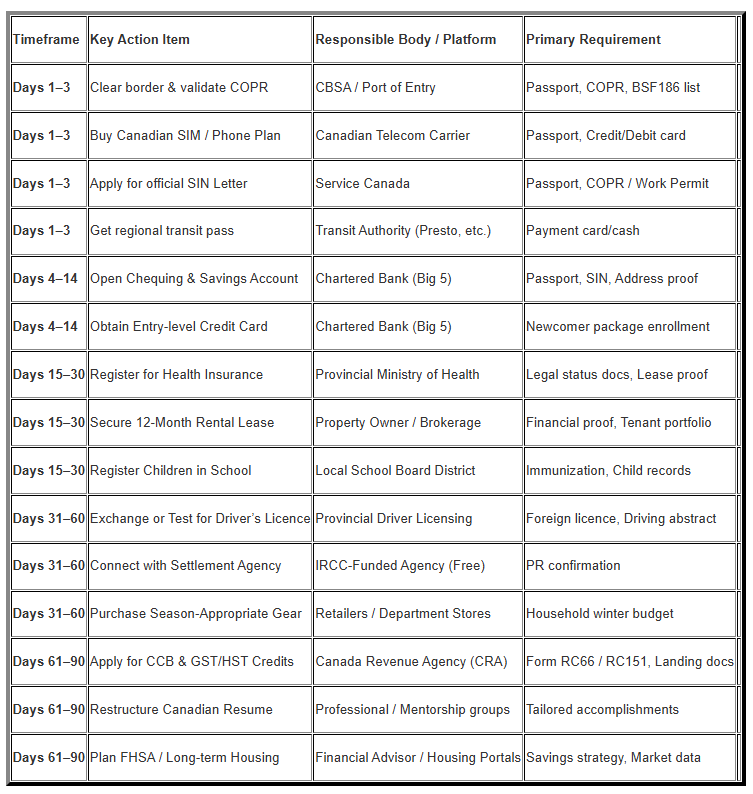
First 90 Days Summary - Newcomer Checklist Canada
Keep this operational checklist on hand to track your settlement progress week by week.
Frequently Asked Questions About Settling in Canada
Can I rent an apartment in Canada without a Canadian credit score?
Yes, but it requires thorough preparation. Because property managers rely on Canadian credit reports to evaluate financial reliability, you must offset this lack of history. Provide a formal employment verification letter showing income in Canadian dollars, recent bank statements demonstrating adequate savings, and personal references from past employers. Some landlords may accept an eligible Canadian guarantor or co-signer. Never accept informal arrangements requiring cash-only transactions or excessive illegal upfront rent payments.
How long does it take to receive a provincial health card?
Processing times vary by province and application volume. In Ontario and Alberta, eligible residents who submit all required identity and residency documentation in person typically receive their physical health card in the mail within 4 to 6 weeks, though interim paperwork may verify coverage earlier. In British Columbia, where a two-month waiting period applies, your Medical Services Plan (MSP) coverage takes effect on the first day of the third month following your arrival date.
What is the fastest way to get a Social Insurance Number (SIN)?
Visiting an official Service Canada Centre in person is the fastest approach. If you bring your original valid passport and landing paperwork (such as your signed COPR or valid temporary work permit), an officer will verify your identity and hand you your official nine-digit SIN letter during the same visit. Online applications, by contrast, generally take between 10 and 20 business days to process and arrive via postal mail.
Do I have to pay Canadian taxes if I arrived halfway through the year?
Canada taxes residents on their worldwide income starting from the specific date they become tax residents (usually the day they land and establish significant residential ties, such as a home, spouse, or dependents in the country). You are not taxed on foreign income earned prior to your official landing date. However, filing an annual personal tax return with the CRA for your arrival year is essential, as it calculates your eligibility for provincial and federal tax credits regardless of your earnings.
What is the difference between a chequing and a savings account in Canada?
A chequing account is built for your day-to-day transactions: it connects directly to your debit card, allows you to withdraw cash at ATMs, handles direct payroll deposits, and facilitates Interac e-Transfers and pre-authorized utility debits. It generally earns zero interest. A savings account is meant for accumulating capital; it pays modest compound interest on your balance and restricts frequent debit card transactions, making it suitable for housing deposits and emergency funds.
Should I buy private health insurance before arriving in Canada?
Yes. Purchasing emergency travel medical insurance covering your family’s first 30 to 90 days in Canada is strongly advised. Even in provinces without official waiting periods, unexpected administrative backlogs or lost documentation can delay the activation of your public health coverage. Private bridge insurance shields your family from out-of-pocket hospital fees, emergency room visits, and ambulatory services, which can cost thousands of dollars per day for uninsured patients.
Final Thoughts: Taking Settlement One Step at a Time
Relocating to Canada is a profound undertaking that rewards patience, organization, and informed decision-making. Attempting to finalize every legal, personal, and financial detail in a single week will only lead to exhaustion.
Focus on the essentials: establish your legal identity with a SIN, protect your household with primary healthcare and a secure banking package, and build a dependable foundation for your credit history. As your first 90 days unfold, your comfort with Canadian systems will grow, turning what once felt unfamiliar into a predictable, welcoming routine.
Thank you for reading our article!