Buying a home in Canada - whether in bustling Toronto, scenic Vancouver, or growing Calgary - is one of the most significant financial milestones you will ever achieve. However, navigating complex mortgage rates, down payment requirements, and hidden ownership expenses can quickly feel overwhelming. That is where our intuitive mortgage calculator Canada comes in to simplify your home-buying journey.
Whether you are a first-time homebuyer testing purchase scenarios or a current homeowner preparing for mortgage renewal, using an accurate mortgage interest calculator Canada provides the clarity needed to budget wisely. Explore our guide below and take full control of your real estate financing today!
How to Use Our Mortgage Payment Calculator Canada
To successfully plan your finances and purchase a home in the Canadian real estate market, understanding how our tool works is essential for both first-time homebuyers and seasoned investors. The user-friendly interface of the CanadaHomeHub mortgage calculator makes it effortless to leverage our mortgage payment calculator Canada to accurately project your monthly obligations through five core input fields:
- Home Purchase Price ($): Enter the total estimated purchase price of the property (e.g., $650,000). This serves as the foundation for determining your total loan amount.
- Down Payment Amount ($): Input your upfront out-of-pocket cash commitment (e.g., $65,000). In Canada, minimum down payment requirements follow tier-based government regulations.
- Annual Interest Rate (%): Enter the applicable mortgage rate (e.g., 4.50%). You can adjust this value to reflect fixed or variable rate offers from lenders.
- Amortization Period (Years): Select the overall timeline to pay off the mortgage. For example, 25 Years (Standard) is a common choice to minimize total interest.
- Payment Frequency: Choose your preferred payment schedule (Monthly or Bi-weekly) to align with your personal cash flow.
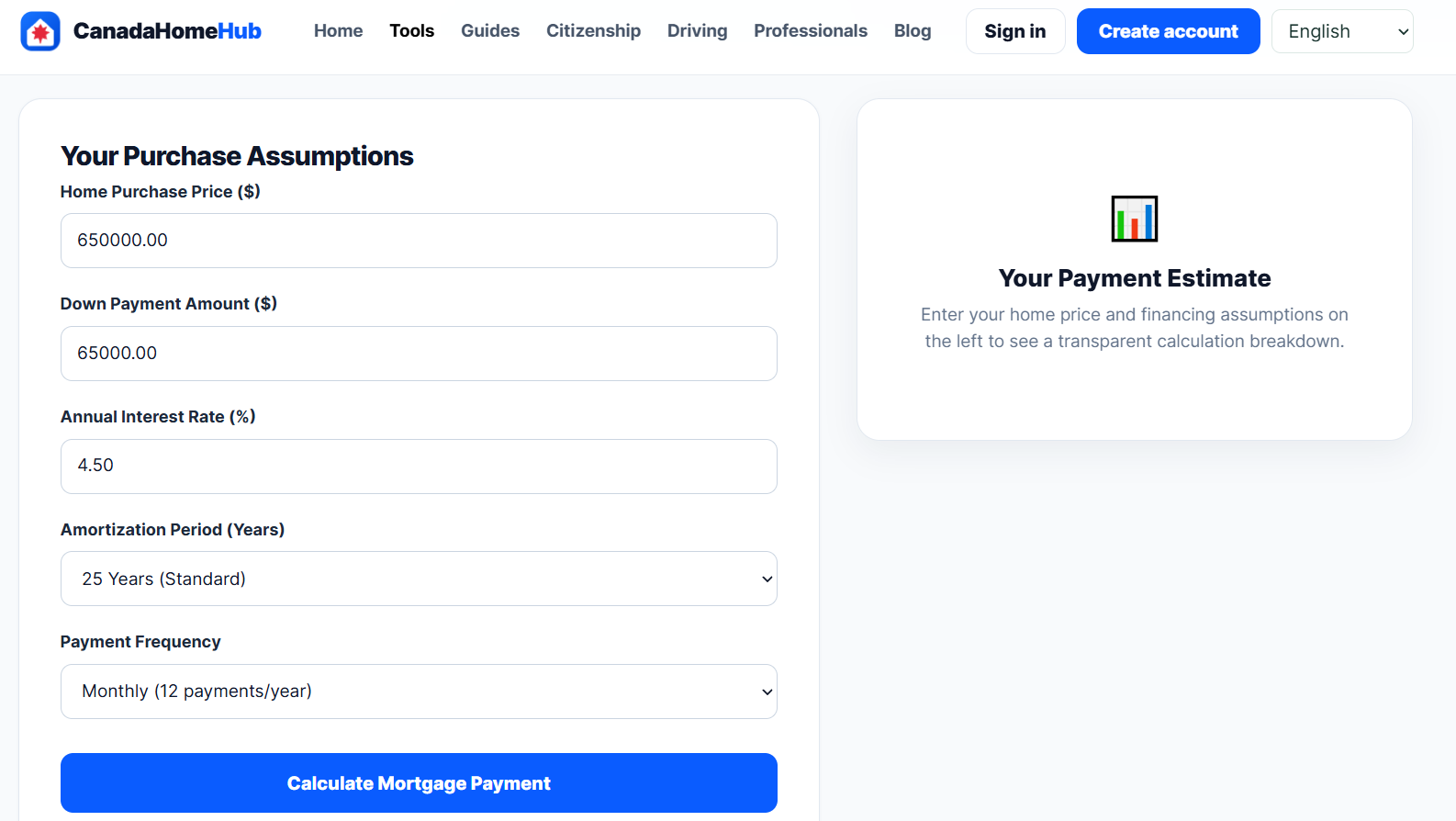
Once you enter your financial details and click "Calculate Mortgage Payment", the calculator instantly processes the data to generate a complete cost breakdown, empowering you to take full control of your Canadian homeownership journey.
Mortgage Payment Calculator Canada: What Determines Your Monthly Mortgage Payment?
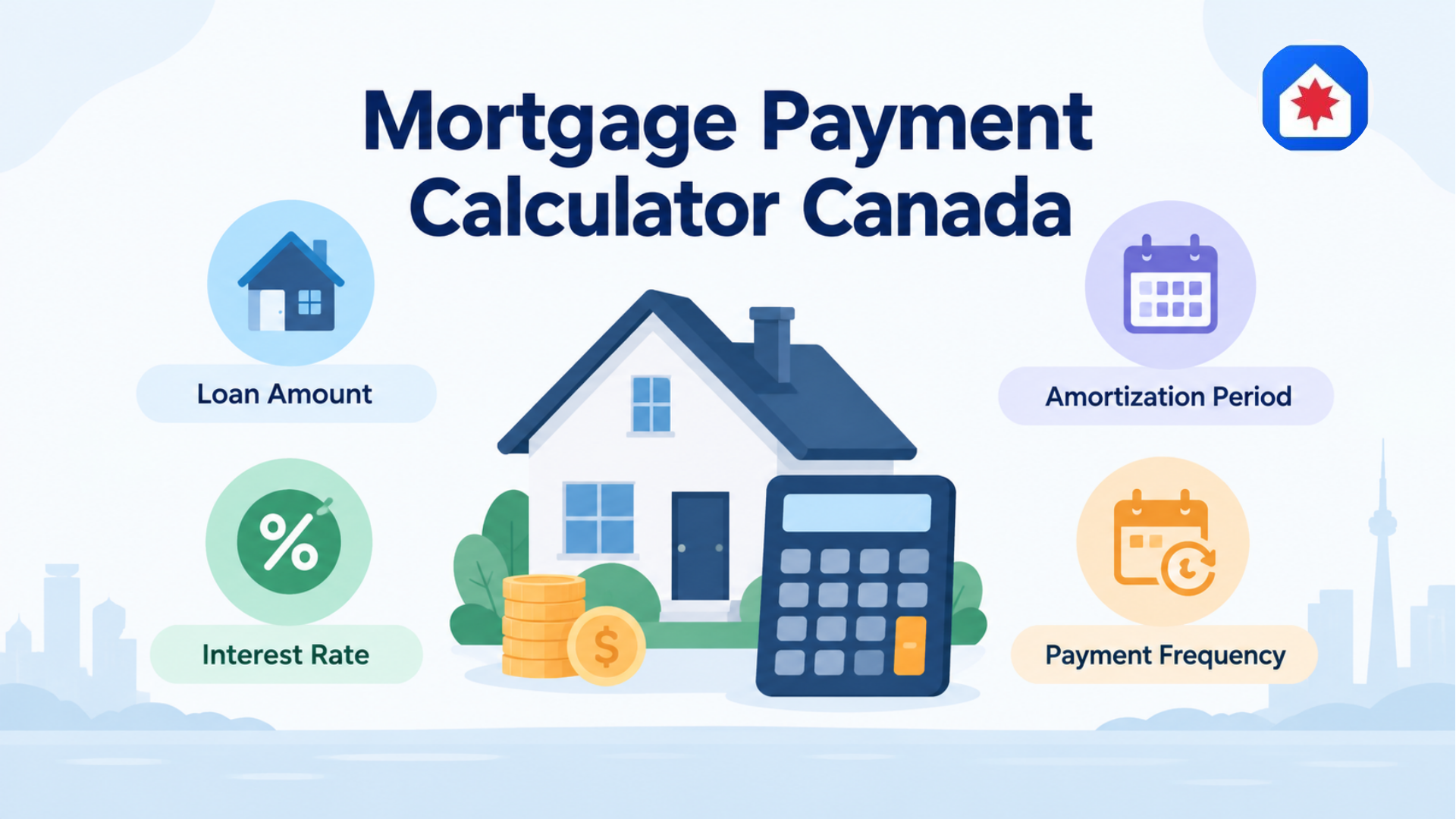
Your monthly mortgage payment depends on several factors. Understanding them helps you compare loan options and choose a payment that fits your financial situation. A mortgage payment calculator Canada makes it easier to see how changing one variable affects your monthly costs.
1. Mortgage amount: The amount you borrow has a direct impact on your payment. A larger down payment usually reduces your mortgage principal. However, keep enough savings for closing costs, emergencies, and ongoing home expenses.
2. Interest rate: A higher mortgage interest rate generally means higher payments and more interest over time. Even a small rate difference can make a significant difference on a large mortgage.
3. Amortization period: A longer amortization period usually lowers your regular payment but increases the total interest paid. A shorter period typically means higher payments and lower total interest, assuming other factors remain the same.
4. Payment frequency: Monthly payments are made once a month. Standard biweekly payments are made every two weeks. Accelerated biweekly payments are usually calculated as half the monthly payment every two weeks, resulting in the equivalent of approximately one extra monthly payment each year.
Consider a $480,000 mortgage with a 25-year amortization period. The following estimates illustrate how interest rates affect monthly payments.
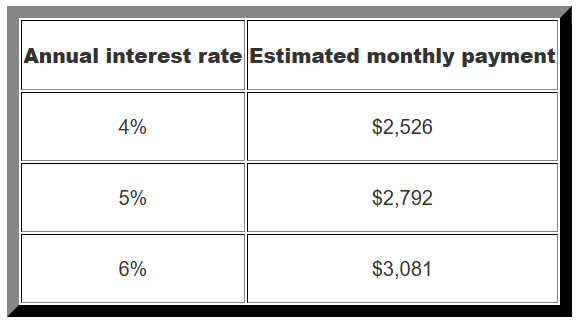
These estimates assume a constant rate, monthly payments, and a standard Canadian mortgage calculation using semi-annual compounding. They exclude insurance and other housing costs.
Use a mortgage calculator Canada to test different rates and loan amounts. Comparing several scenarios can help you prepare for rate changes and avoid committing to a payment that stretches your budget too far.
Understanding Mortgage Interest in Canada
When planning a home purchase in Canada, understanding how your loan is structured is crucial for long-term financial success. Every standard payment you make is split into two components: the principal (the actual borrowed amount used to purchase the property) and the mortgage interest (the cost charged by the lender for borrowing the money). Using a reliable mortgage interest calculator Canada allows you to project your total mortgage interest across your entire borrowing period.
Focusing solely on the monthly payment is a common mistake among homebuyers. A manageable monthly figure does not mean a mortgage is financially optimal. Even a slight increase in your mortgage rate significantly shifts the balance between principal and interest, drastically inflating your total borrowing costs over time.
For instance, consider a $480,000 mortgage amortized over 25 years:
- At a 4.50% mortgage rate, your monthly payment is roughly $2,657, resulting in approximately $317,100 in total interest paid over 25 years.
- At a 5.50% mortgage rate, your monthly payment rises to about $2,930, pushing your total interest cost to around $399,000.
That 1% rate difference adds over $81,000 in total mortgage interest for the exact same loan amount.
Furthermore, choosing between a fixed-rate mortgage (which offers payment predictability) and a variable-rate mortgage (which fluctuates with market benchmark rates) heavily influences your interest risk exposure. Using an accurate mortgage interest calculator Canada helps you analyze these variables and evaluate whether a mortgage structure truly aligns with your long-term wealth strategy.
Mortgage Amortization Calculator Canada: How Long Should Your Mortgage Be?
Selecting the right amortization period is one of the most critical decisions when structuring your Canadian home loan. While your mortgage term is simply the duration of your current legal contract (typically 3 to 5 years), the amortization period represents the total mortgage repayment period required to pay off the entire loan balance. Utilizing a mortgage amortization calculator Canada allows you to visualize how varying repayment timelines directly impact your monthly cash flow and total interest.
In Canada, federal regulations stipulate that down payments under 20% require mortgage default insurance and are legally capped at a maximum 25-year amortization. A 30-year option is generally reserved for uninsured buyers with 20% or more down, or eligible first-time homebuyers purchasing new builds under recent government guidelines.
20 vs. 25 vs. 30-Year Amortization Comparison
To illustrate the financial trade-offs, consider a $500,000 mortgage at a fixed 4.50% interest rate: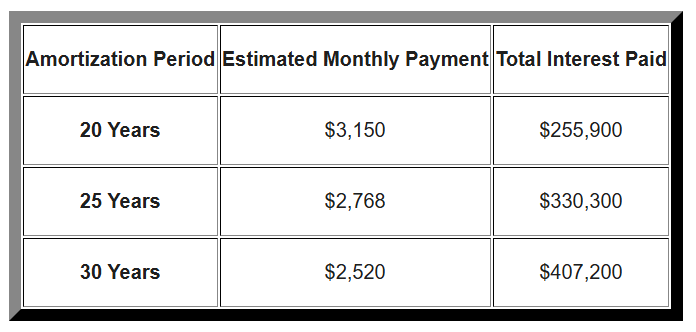
Strategic Trade-Offs
- Shorter Amortization (20 Years): Requires higher monthly payments but dramatically reduces your total interest (saving over $74,000 compared to a 25-year schedule) and accelerates equity growth.
- Longer Amortization (30 Years): Provides lower, more manageable monthly obligations—improving monthly cash flow—but results in significantly higher lifetime interest costs (costing nearly $77,000 more than a 25-year schedule).
Running these scenarios through our mortgage calculator Canada helps you strike the optimal balance between budget flexibility today and long-term interest savings tomorrow.
Smart Strategies to Save Thousands on Your Canadian Mortgage
Paying off your home loan early can save you tens of thousands of dollars in interest and bring you years closer to financial freedom. By making a few strategic adjustments to your mortgage repayment strategy, you can significantly accelerate your timeline:
-
Increase Your Down Payment: Aim for a down payment of 20% or more to completely eliminate the requirement for CMHC mortgage default insurance. On a typical home purchase, avoiding these insurance premiums saves you anywhere from 2.8% to 4.0% of your total loan balance upfront.
-
Switch to Accelerated Bi-Weekly Payments: Rather than paying monthly, select an accelerated bi-weekly payment schedule. By making 26 half-payments a year, you effectively make 13 full monthly payments annually—paying down your principal balance much faster without significantly straining your routine cash flow.
-
Maximize Your Prepayment Privileges: Most Canadian mortgage agreements allow you to pay down 10% to 20% of your original principal balance each year without incurring penalty fees. Applying annual work bonuses, tax refunds, or extra savings directly toward your principal balance drastically reduces lifetime interest charges.
To see how much time and money these strategies could save on your specific mortgage, test different prepayment scenarios using our mortgage payment calculator Canada.
Frequently Asked Questions (FAQ)
1. What is the minimum down payment required to buy a home in Canada?
In Canada, the minimum down payment depends on the home's purchase price:
- $500,000 or less: Minimum 5% of the purchase price.
- $500,001 to $999,999: 5% on the first $500,000 and 10% on the portion above $500,000.
- $1,000,000 or more: Minimum 20% down payment required.
2. Is mortgage interest tax-deductible in Canada?
For a primary residence, mortgage interest is generally not tax-deductible in Canada. However, if you generate rental income from the property or use a portion of the home strictly for income-producing business activities, you may be eligible to deduct a proportional amount of mortgage interest on your tax return.
3. What is the difference between regular bi-weekly and accelerated bi-weekly payments?
A regular bi-weekly payment takes your annual payment total and divides it by 26. An accelerated bi-weekly payment takes your regular monthly payment, divides it by two, and withdraws that amount every two weeks. Because there are 52 weeks in a year, accelerated bi-weekly results in 26 half-payments—the equivalent of making 13 full monthly payments per year, reducing your principal balance significantly faster.
4. What is CMHC mortgage default insurance, and do I have to pay it?
CMHC (Canada Mortgage and Housing Corporation) insurance protects lenders in case a borrower defaults. It is legally mandatory in Canada if your down payment is less than 20% of the purchase price. The premium ranges from 2.8% to 4.0% of your total loan amount and is typically added directly to your mortgage balance.
5. What happens when my mortgage term ends?
At the end of your mortgage term (typically 3 to 5 years), your remaining principal balance is not fully paid off yet. You must either renew your mortgage with your current lender, switch to a new lender offering better rates, or pay off the remaining balance in full.
6. Can I pay off my mortgage early without penalties in Canada?
Yes, most Canadian lenders offer prepayment privileges that allow you to pay off a certain percentage of your original loan balance (usually 10% to 20%) each year without penalty. However, exceeding these limits or breaking your mortgage contract before the term expires can result in significant prepayment penalty fees.
Calculate Your Canadian Mortgage Payments Today
Taking control of your home-buying journey begins long before you start viewing properties. Understanding your exact monthly commitments, down payment requirements, and long-term interest expenses ensures you make confident, financially sound decisions in the competitive Canadian real estate market.
Don't leave your housing budget to guesswork. Test different financial scenarios, model payment frequencies, and create an accurate home-buying plan today with mortgage payment calculator Canada at canadahomehub.ca.
Thank you for reading our article!