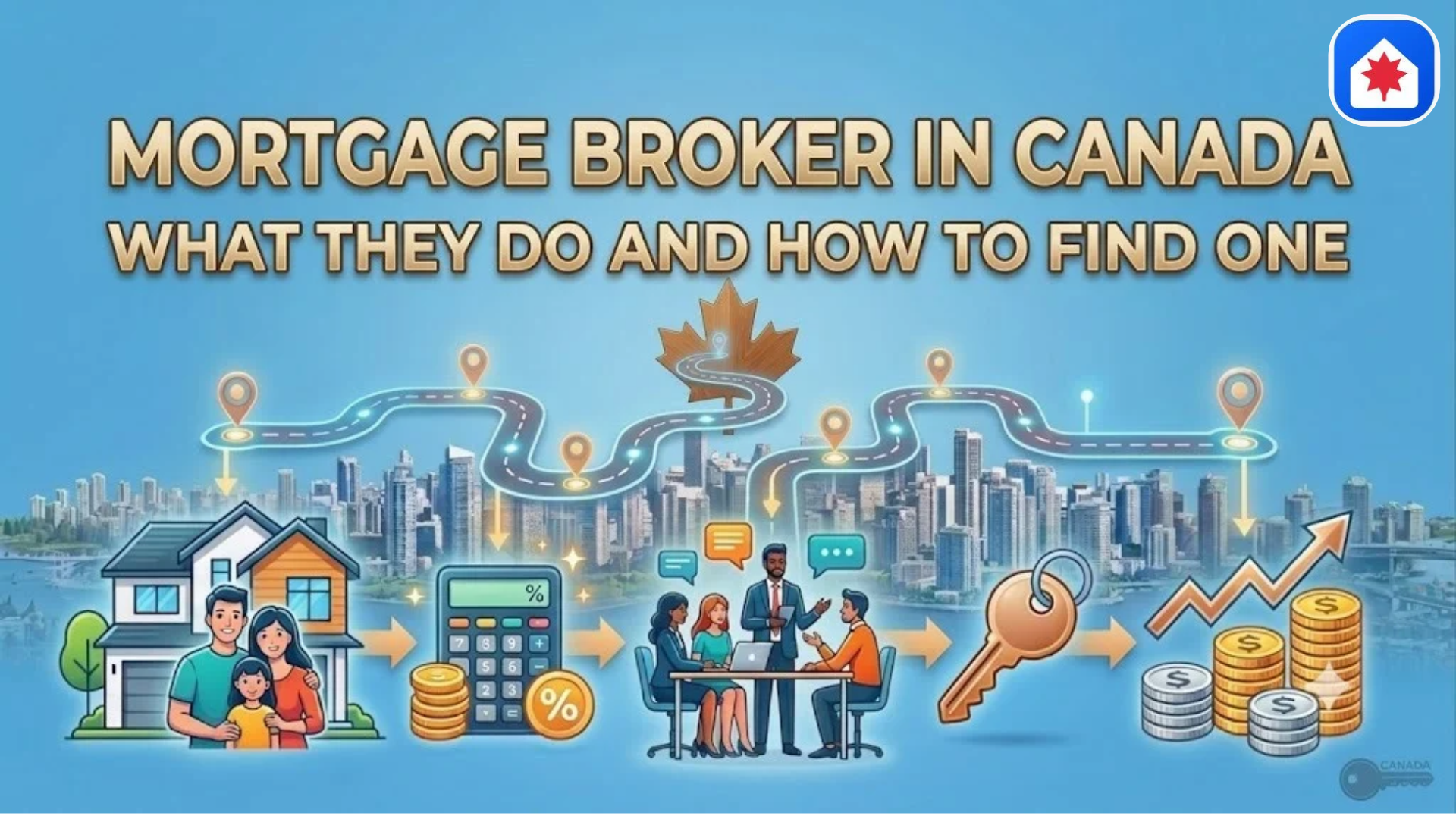
Buying a home in Canada is one of the most significant financial milestones you will ever undertake. However, navigating the Canadian mortgage landscape - with changing interest rates, strict stress test regulations, and hundreds of lending options - can feel overwhelming. Whether you are a first-time homebuyer, renewing your mortgage, or purchasing an investment property, securing the right mortgage terms can save you tens of thousands of dollars over time. This is where a professional mortgage broker Canada comes into play. In this comprehensive guide, we will break down how mortgage brokers work Canada, how they differ from traditional banks, provincial licensing requirements, and how to find the top-rated mortgage broker near me to achieve your homeownership goals.
How Mortgage Brokers Work in Canada: Step-by-Step
Understanding how mortgage brokers work Canada is essential before starting your home buying journey. A mortgage broker acts as a licensed financial intermediary between you (the borrower) and various lenders (such as banks, credit unions, monoline lenders, and private lenders).
Unlike a bank mortgage specialist who only offers their institution's specific financial products, an independent mortgage broker works on your behalf to analyze the market and negotiate the best rates and terms for your specific financial situation.
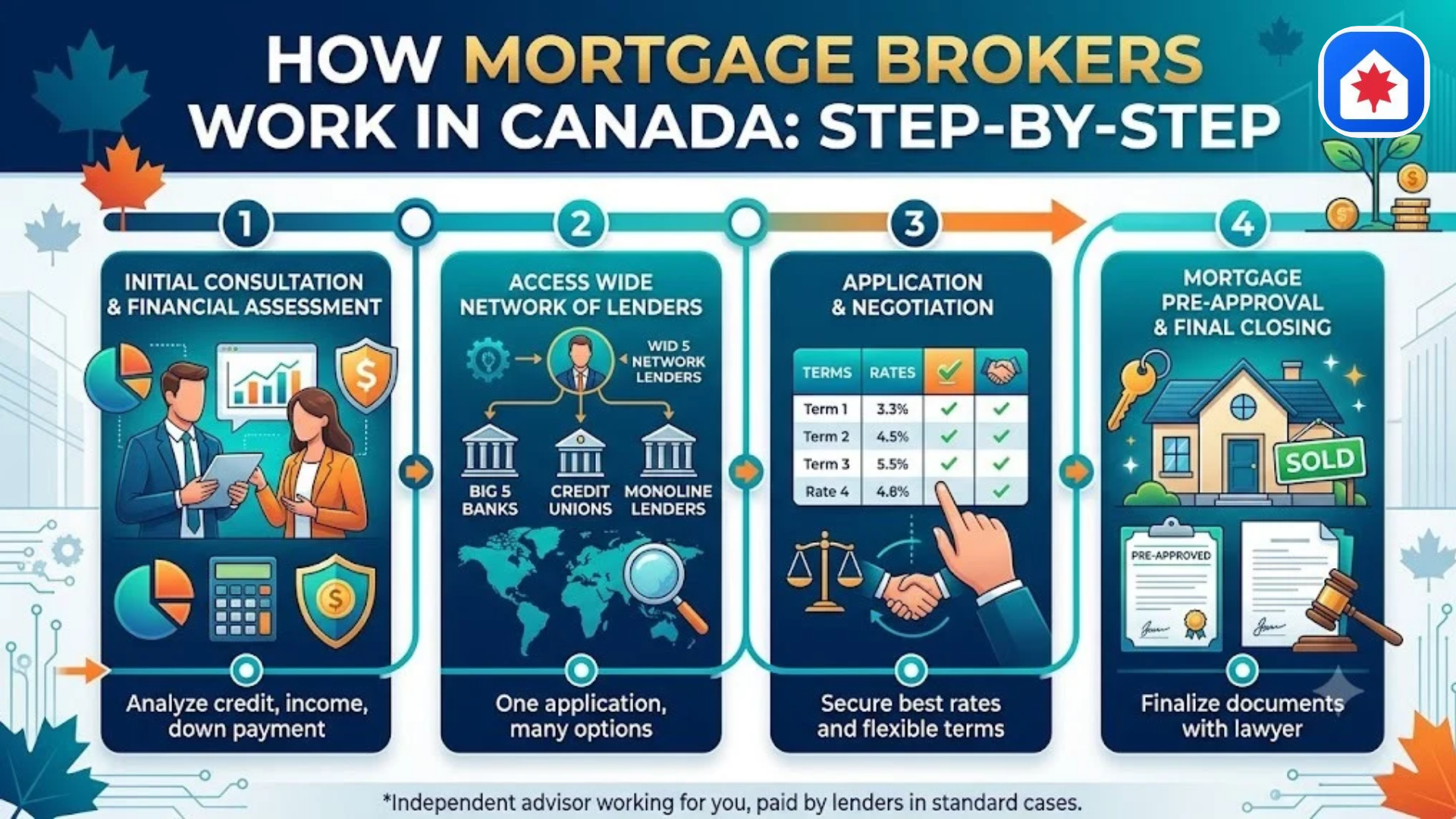
The 4-Step Mortgage Broker Process
-
Initial Consultation & Financial Assessment:
Your broker will review your income, employment status, credit score, debt-to-income ratios (GDS and TDS ratios), and available down payment. They will evaluate your overall financial health to determine your purchasing budget under the Canadian Mortgage Stress Test.
- Accessing the Lender Network & Comparing Options:
Once your financial profile is established, the broker submits your application to multiple lenders simultaneously. Instead of applying individually to ten different places, your broker uses one centralized application and credit pull to gather competing offers.
- Negotiating Rates & Customizing Terms:
Brokers do not just look at the lowest interest rate; they analyze crucial contract clauses such as prepayment privileges, portability, penalty calculations for early termination, and refinancing flexibility.
- Pre-Approval & Final Closing:
After you select a mortgage product, your broker secures the pre-approval, helps gather required verification documents (pay stubs, NOAs, bank statements), and coordinates directly with your real estate lawyer to finalize funding on closing day.
How Do Mortgage Brokers Get Paid in Canada?
For the vast majority of residential borrowers, working with a mortgage broker is completely free.
- Prime/A-Lending: Mortgage brokers receive a finder’s fee or commission directly from the lender once the mortgage closes. The commission rate is standard across lenders to avoid conflicts of interest.
- Alternative/B-Lending & Private Mortgages: If you have severe credit challenges or unconventional income that requires a private lender or B-lender, a broker fee may apply. This fee is always disclosed upfront in writing before you commit.
Mortgage Broker vs Bank Canada: Which Is Better for You?
When financing a home, Canadian buyers usually face a fundamental choice: Should you deal directly with a major financial institution or hire an independent broker? Let's compare mortgage broker vs bank Canada to help you make an informed decision.
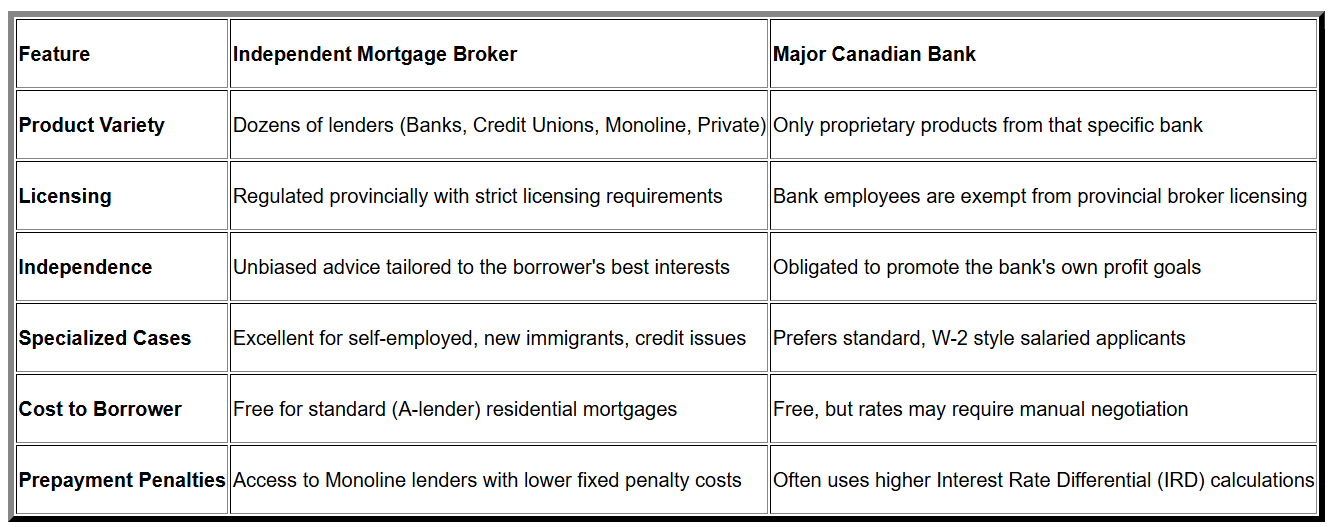
Comparison Table: Mortgage Broker vs. Bank
Key Advantages of Working with a Mortgage Broker
- Access to Monoline Lenders: Monoline lenders are mortgage-only financial institutions (such as First National or MCAP) that do not have retail bank branches. They frequently offer lower interest rates and significantly lower fixed-rate prepayment penalties compared to the "Big 5" Canadian banks.
- Save Time and Protect Your Credit Score: Applying to multiple banks individually results in multiple "hard" credit inquiries, which can temporarily lower your credit score. A broker performs a single credit pull to shop across dozens of financial institutions.
- Customized Solutions for Non-Standard Applicants: If you are self-employed, a newcomer to Canada without an established credit history, or working through credit recovery, a broker knows precisely which alternative lenders specialize in your situation.
When Should You Deal Directly with a Bank?
Dealing directly with your current primary bank might make sense if:
- You have a long-standing, high-net-worth relationship that unlocks exclusive relationship discounting or bundled banking perks.
- You prefer having your mortgage, checking accounts, credit cards, and investments managed under a single online banking portal.
Mortgage Broker Requirements Canada: Licensing & Regulations
To maintain consumer trust and financial stability, the mortgage brokering industry in Canada is governed by strict regulatory frameworks. Reviewing mortgage broker requirements Canada ensures you are working with a legitimate, fully qualified professional.
Mortgage brokers are regulated at the provincial level rather than federally. Each province has a dedicated regulatory body tasked with licensing and compliance.
Provincial Regulatory Bodies
- Ontario: Regulated by the Financial Services Regulatory Authority of Ontario (FSRA). Ontario operates under a two-tier system: Mortgage Agent (Level 1 and Level 2) and Mortgage Broker.
- British Columbia: Regulated by the BC Financial Services Authority (BCFSA).
- Alberta: Regulated by the Real Estate Council of Alberta (RECA).
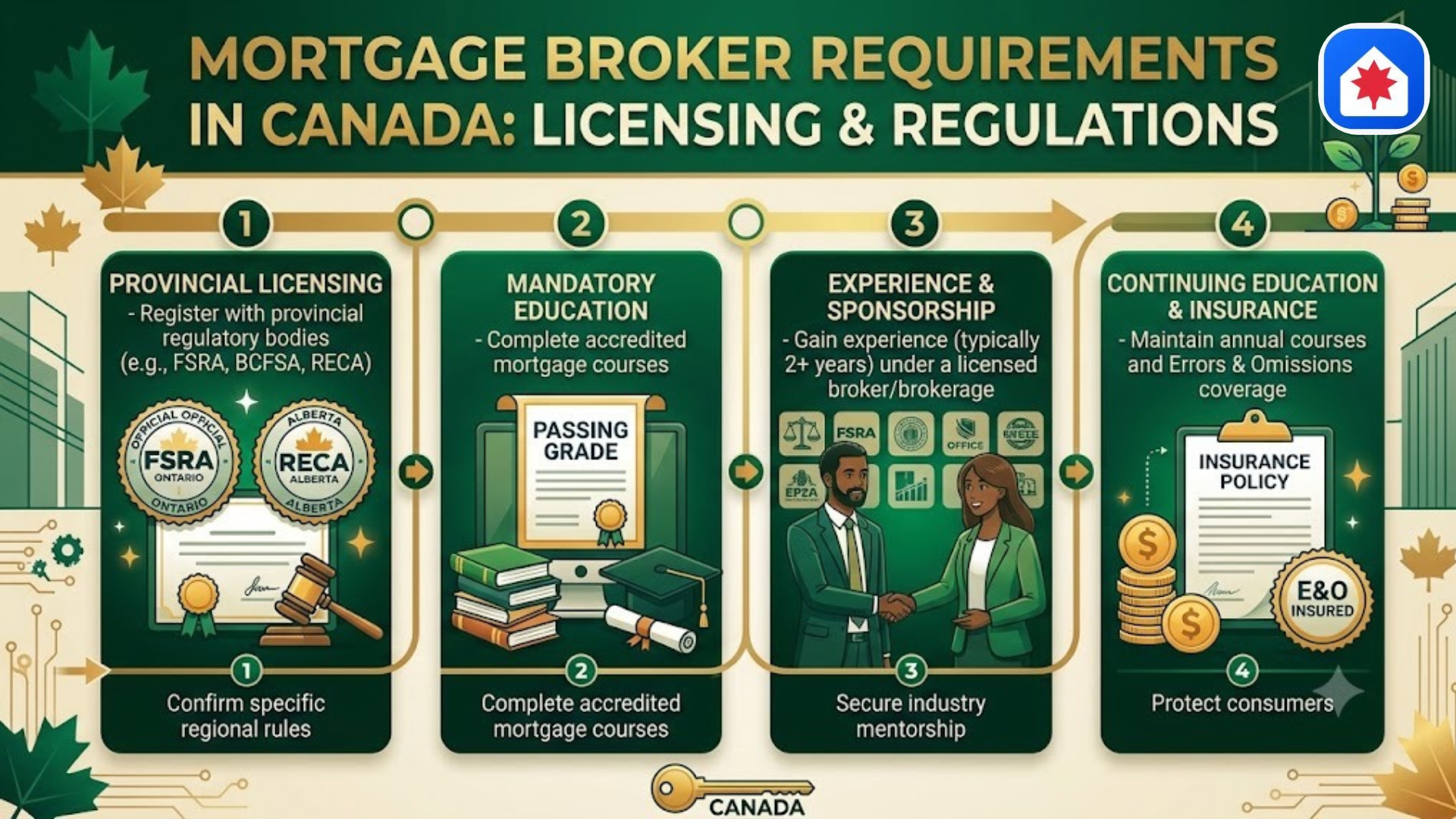
Mortgage Broker Requirements Canada Licensing & Regulations.png
Mandatory Requirements to Become a Licensed Broker
To legally practice as a mortgage broker Canada, professionals must meet the following mandatory benchmarks:
- Educational Qualification: Completion of accredited provincial mortgage brokerage courses and passing comprehensive licensing examinations.
- Background & Criminal Record Checks: Passing rigorous background checks to verify financial integrity and legal standing.
- Sponsorship & Experience: New agents must work under the direct supervision of an established licensed brokerage for a specified period (typically 24 months) before qualifying for a full broker designation.
- Continuing Education (CE): Brokers must complete annual continuing education credits to keep up with statutory changes, stress test updates, and anti-money laundering (AML) protocols.
- Errors & Omissions (E&O) Insurance: Licensed brokerages are required by law to maintain professional liability insurance to protect consumers.
How to Find the Best "Mortgage Broker Near Me"
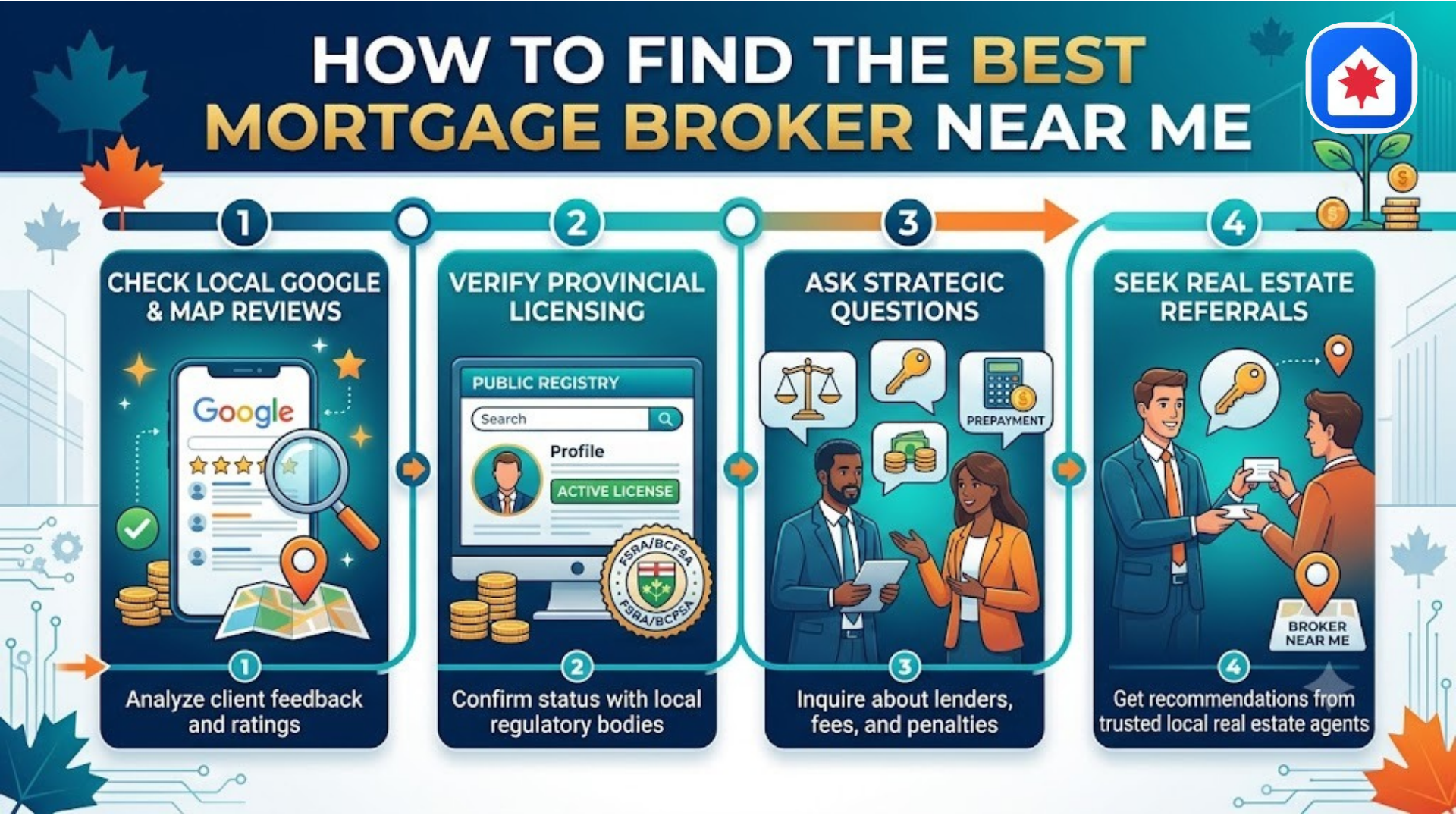
Finding a qualified mortgage broker is simple, but finding the right broker who understands your neighborhood market and financial priorities requires a methodical approach. Follow these practical steps when searching for a mortgage broker near me.
Step-by-Step Guide to Finding Local Mortgage Experts
-
Utilize Local Search and Maps: Searching for mortgage broker near me on Google Maps displays local specialists along with client reviews, office locations, and direct contact details. Local brokers often have established relationships with local real estate appraisers and lawyers, streamlining your transaction.
- Verify Licensing Credentials: Before disclosing personal financial details, verify the broker’s license status on their provincial regulator’s public registry (e.g., FSRA in Ontario or BCFSA in BC). Ensure their status is listed as "Active" with no disciplinary actions.
- Check Client Reviews & Case Studies: Look for Google Reviews, Trustpilot feedback, and Better Business Bureau (BBB) ratings. Focus on reviews from clients with financial profiles similar to yours (e.g., first-time home buyers, real estate investors, self-employed borrowers).
- Seek Recommendations from Real Estate Professionals: Ask your real estate agent, lawyer, or accountant for trusted local references. Industry professionals frequently collaborate with reliable brokers who deliver results on tight closing schedules.
5 Essential Questions to Ask Before Hiring a Broker
When scheduling your initial consultation, ask these critical questions to gauge expertise and transparency:
- "How many different lenders do you actively deal with?"
Why it matters: A top-tier broker should have active relationships with A-lenders, credit unions, monoline lenders, and alternative institutions.
- "How are you compensated for my specific transaction?"
Why it matters: Transparency is key. Ensure there are no hidden administrative or processing fees charged to you as the borrower.
- "What is the penalty structure if I need to break this mortgage early?"
Why it matters: Many borrowers focus strictly on the interest rate while ignoring penalty terms. Ask the broker to calculate penalty scenarios for both fixed and variable options.
- "Do you have experience handling applications similar to my financial situation?"
Why it matters: If you are self-employed, newly arrived in Canada, or refinancing multiple investment properties, you need an advisor experienced in structuring those specific files.
- "Will you assist me throughout the mortgage term or only until closing day?"
Why it matters: The best brokers provide long-term advisory services, helping you monitor market rate movements for refinancing opportunities down the road.
Frequently Asked Questions (FAQs)
1. Will using a mortgage broker affect my credit score?
Initial conversations with a broker do not impact your credit score. When you submit a formal application, the broker performs a single hard credit inquiry. This single inquiry allows them to present your file to dozens of potential lenders without repeatedly damaging your credit score.
2. Can a mortgage broker help if I have bad credit or self-employment income?
Yes. One of the greatest advantages of working with an independent mortgage broker Canada is their ability to access alternative (B-Lenders) and private lenders. These institutions specialize in equity-based lending rather than relying exclusively on traditional credit scores or standard T4 tax slips.
3. What is the difference between a mortgage agent and a mortgage broker in Canada?
In provinces like Ontario, a Mortgage Agent is licensed to arrange mortgages under the supervision of a licensed broker. A Mortgage Broker has completed advanced education, gained additional years of industry experience, and possesses the authority to manage a brokerage and supervise agents. Both can assist you with securing a home loan.
Conclusion & Next Steps
Navigating the Canadian housing market does not have to be stressful. Choosing a knowledgeable, fully licensed mortgage broker Canada gives you access to a broader selection of financial products, competitive interest rates, and tailored advice that aligns with your financial goals.
By taking time to understand how mortgage brokers work Canada, reviewing mortgage broker requirements Canada, and asking key strategic questions when searching for a mortgage broker near me, you can make well-informed decisions for your future home purchase.
Ready to get started? Gather your income documentation, check your credit report, and book a consultation with a local licensed mortgage broker today to secure your pre-approval!
Thank you for reading our article!