
Hiring the right specialist—whether you are buying your first home, arranging a mortgage, navigating an immigration application, or planning a major renovation—can protect tens of thousands of dollars and months of stress. Yet tracking down the best professionals in Canada is rarely as simple as picking the first five-star listing in an online search. Because professional oversight in Canada is divided across federal, provincial, territorial, and municipal jurisdictions, the rules governing who can legally advise you, charge a fee, or carry insurance vary sharply depending on where you live and what service you need.
The short answer to finding trusted professionals in Canada comes down to a two-part discipline: first, independently confirming that a candidate holds an active, in-good-standing licence with the proper Canadian regulatory body; and second, vetting their practical experience, fee transparency, and communication style before signing any contract. This guide walks you through how Canadian professional regulation works, which official registries to check across major provinces, a six-step hiring framework, and the warning signs that should make you walk away.
Why Finding the Best Professionals in Canada Requires Local Verification
Many newcomers—and even lifelong Canadians moving from one province to another—assume that a professional credential earned in Toronto automatically applies in Vancouver, Calgary, or Montreal. In most industries, it does not. Understanding how jurisdiction and credentials work is the foundation of smart hiring in Canada.
Federal vs. Provincial vs. Municipal Oversight
Canada splits consumer and professional protection across three levels of government:
- Federal regulation applies to nationally governed fields such as immigration and citizenship consulting. For example, anyone charging a fee to provide Canadian immigration advice as a consultant must be licensed by the College of Immigration and Citizenship Consultants (CICC), regardless of which province—or even which country—they operate from.
- Provincial and territorial regulation governs most high-stakes consumer professions, including real estate agents, mortgage brokers, lawyers, notaries, accountants, and, in some provinces, home inspectors and construction contractors. A lawyer licensed in Alberta is not automatically entitled to practise law in Ontario, and a real estate licence issued in Ontario does not authorise trading in British Columbia.
- Municipal oversight typically covers local business licences, building permits, zoning bylaws, and certain local trade or renovation permits. Even when a profession does not have a mandatory provincial licence, municipal business registration and provincial consumer protection statutes still apply.
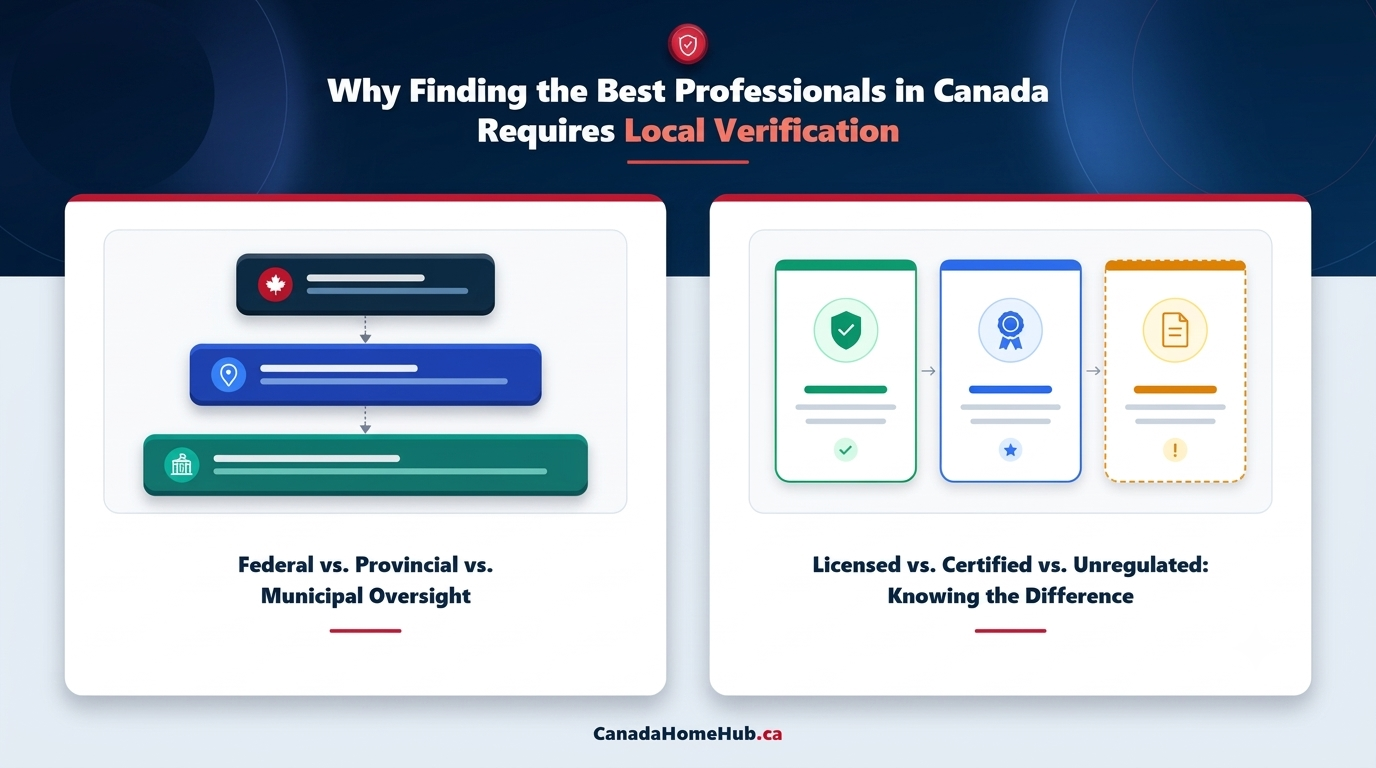
Licensed vs. Certified vs. Unregulated: Knowing the Difference
Marketing bios often blur words like licensed, certified, accredited, and registered. Knowing the exact distinction helps you separate mandatory legal standing from voluntary credentials:
- Licensed (Regulated): Issued by a government agency or statutory regulator under provincial or federal law. Practising without a required licence is illegal. Licensing generally requires approved education, exams, criminal background checks, continuing education, and errors and omissions (E&O) insurance, alongside a formal public complaints process.
- Certified (Voluntary Designation): Granted by an industry association or training institute. Voluntary certifications—such as those from recognized home inspection associations in provinces without mandatory licensing—can signal strong training and adherence to a code of ethics, but the association does not carry government enforcement powers.
- Unregulated: Some fields require only general business registration. In these sectors, written contracts, proof of commercial general liability insurance, workers' compensation clearance, and verifiable references become your primary line of defence.
Provincial and Federal Registries: How to Verify Key Canadian Professionals
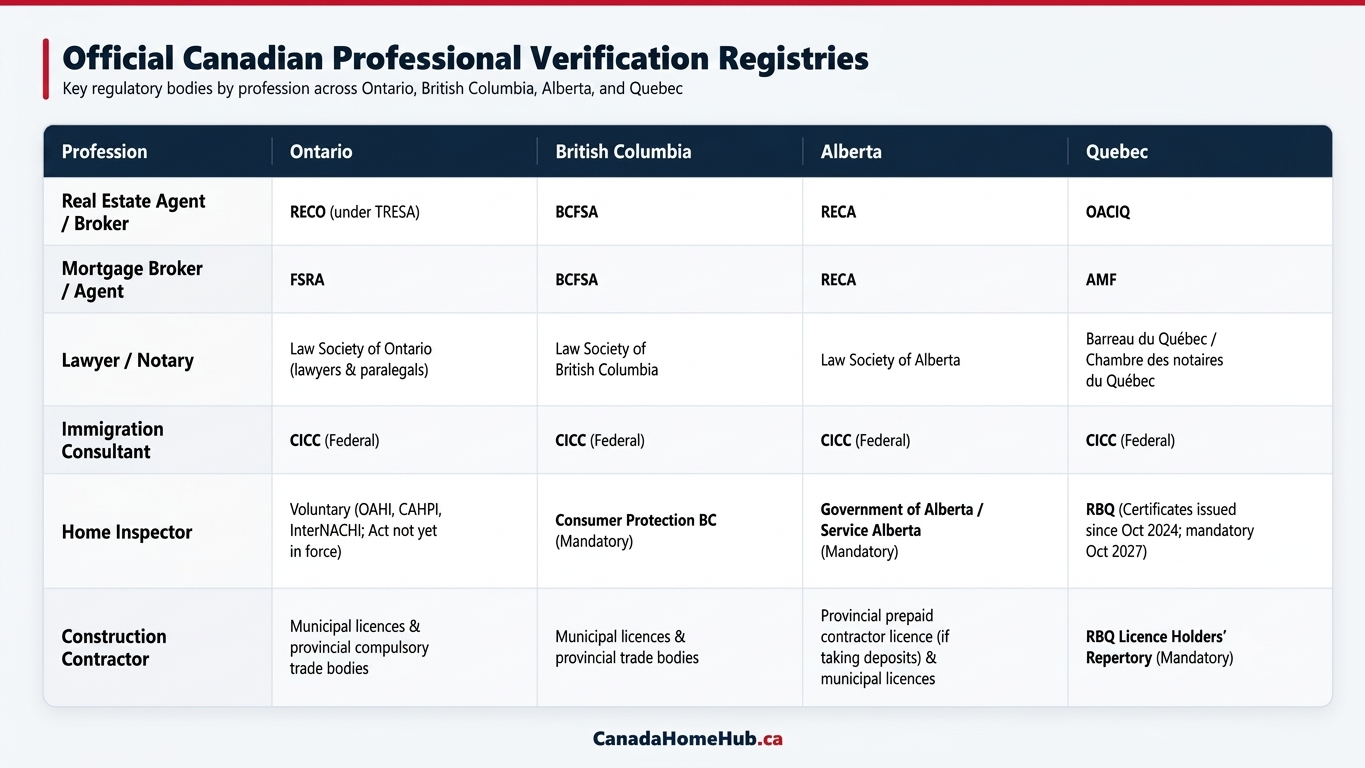
Before you share sensitive financial records, sign a representation agreement, or send a deposit, take two to five minutes to check the person's name directly on the official public register. Never rely solely on a screenshot, business card, or website badge.
Real Estate Agents and Brokers
Canada has no national real estate licence; each province and territory operates its own regulatory body. When searching a provincial register, confirm that the agent's registered legal name matches the name they use with you and that their brokerage is active.
- Ontario: Regulated by the Real Estate Council of Ontario (RECO) under the Trust in Real Estate Services Act (TRESA). Note that multiple representation (where one brokerage represents both buyer and seller) is permitted in Ontario only with the informed consent of all clients involved.
- British Columbia: Regulated by the BC Financial Services Authority (BCFSA). Unlike Ontario, dual agency is generally prohibited in B.C., except in extremely remote or rural locations.
- Alberta: Regulated by the Real Estate Council of Alberta (RECA), where real estate licences renew annually on September 30 and licensees must meet RECA's Good Character Policy.
- Quebec: Regulated by the Organisme d'autoréglementation du courtage immobilier du Québec (OACIQ) under Quebec's civil law system, using mandatory OACIQ-prescribed brokerage forms.
- Other Provinces and Territories: Verify through the Saskatchewan Real Estate Commission (SREC), the Manitoba Securities Commission, the Nova Scotia Real Estate Commission, New Brunswick's Financial and Consumer Services Commission (alongside NBREA), Digital Government and Service NL, or the relevant territorial regulator.
Mortgage Brokers and Agents
Arranging a mortgage without a valid licence is an offence under provincial law. Public registries allow you to confirm licence status ("Active" or "In Good Standing"), the licence class (mortgage agent vs. senior mortgage broker), the associated brokerage, and any public disciplinary orders or licence conditions.
- Ontario: Financial Services Regulatory Authority of Ontario (FSRA)—under FSRA rules, brokers and agents are required to provide their licence number upon demand.
- British Columbia: BCFSA public licensee search (licences are granted for two-year periods and every brokerage must have a principal broker responsible for supervision).
- Alberta: RECA public registry.
- Quebec: Autorité des marchés financiers (AMF) public register.
Lawyers, Paralegals, and Quebec Notaries
Whether you are closing a real estate purchase, drafting a will, or resolving an employment dispute, you should verify your legal counsel through the law society for the exact province or territory where your legal matter sits. The Federation of Law Societies of Canada lists all 13 provincial and territorial regulators, almost all of which provide free online lookup tools showing practising status (practising, non-practising, suspended, or former member), practice restrictions, and public discipline records.
- In Ontario, the Law Society of Ontario regulates both lawyers and licensed paralegals.
- In Alberta, the Law Society of Alberta online Lawyer Directory lets the public confirm practising status and view discipline history dating back to January 1, 2015.
- In Quebec, lawyers are regulated by the Barreau du Québec, while notaries—who play a central role in Quebec real estate closings and estate matters—are regulated by the Chambre des notaires du Québec.
Immigration and Citizenship Consultants
Immigration is one of the highest-risk areas for fraud in Canada. Under Immigration, Refugees and Citizenship Canada (IRCC) rules, only specific authorized representatives are legally allowed to charge a fee for immigration or citizenship advice:
- Regulated Canadian Immigration Consultants (RCICs) in good standing with the CICC (each holds a unique licence number beginning with "R" followed by six digits).
- Lawyers in good standing with a Canadian provincial or territorial law society.
- Licensed paralegals who are members of the Law Society of Ontario.
- Notaries who are members in good standing of the Chambre des notaires du Québec.
Always look up an RCIC on the CICC Public Register to confirm their status is "Active" and "Entitled to Practise," and verify whether they hold an RCIC-IRB class licence if your case involves representation before the Immigration and Refugee Board.
Home Inspectors
Home inspection rules illustrate why checking provincial law is essential. Canada has no national home inspector licence, and provincial oversight varies dramatically:
- British Columbia: Mandatory licensing through Consumer Protection BC, requiring at least 150 hours of approved education, 50 hours of supervised inspections, a criminal record check, and at least $1 million each in E&O and general liability insurance.
- Alberta: Mandatory licensing for both the home inspection business and the individual inspector through the Government of Alberta (Service Alberta) under the Home Inspection Business Regulation, including E&O insurance minimums ($1 million per claim and $2 million annual aggregate), a security/bond, and a police information check.
- Quebec: The Régie du bâtiment du Québec (RBQ) began issuing residential building inspector certificates on October 1, 2024, aligned with Quebec's BNQ 3009-500 standard; certification becomes mandatory across Quebec on October 1, 2027.
- Ontario: Although Ontario passed the Home Inspection Act, 2017, the statute had not been proclaimed into force as of late 2026, meaning there is no mandatory provincial licence yet. Buyers in Ontario—as well as in Manitoba, Saskatchewan, and the Atlantic provinces—should verify voluntary credentials through associations such as the Canadian Association of Home & Property Inspectors (CAHPI), the Ontario Association of Home Inspectors (OAHI), or InterNACHI, and request direct proof of E&O insurance.
General Contractors and Skilled Trades
Construction and renovation rules are heavily localized. In Quebec, for instance, renovation and construction contractors must hold a valid RBQ licence, which consumers can verify in the RBQ's public repertory to inspect licence subclasses, financial guarantees, and any paid or outstanding claims. In other provinces, compulsory skilled trades (such as electricians, plumbers, and HVAC technicians) require provincial trade certification or Red Seal credentials, while general contractors may require municipal business licences, provincial consumer protection registration (such as prepaid contractor licensing when taking deposits), and active workers' compensation coverage (WSIB in Ontario, WorkSafeBC in B.C., WCB in Alberta).
How to Evaluate and Hire the Best Professionals in Canada: A 6-Step Framework
Confirming an active licence clears only the first hurdle—it proves a professional meets minimum legal standards, not that they are the right match for your specific situation. Use this structured six-step process to choose with confidence.
Step 1: Clarify Your Exact Scope and Budget First
Before reaching out to anyone, define the exact problem you need solved, your timeline, and your financial boundaries. For instance, if you are preparing to purchase a property, running your own numbers beforehand helps you have far more productive conversations with mortgage brokers and real estate agents. Free Canadian planning tools—such as the mortgage payment, OSFI stress-test affordability, CMHC down payment, and closing cost calculators on CanadaHomeHub.Ca—let you model realistic monthly payments and upfront cash needs before you commit to working with an advisor.
Step 2: Build a Shortlist Through Trusted Channels
Avoid hiring the very first person who answers an ad or cold-calls you. Aim to gather three to five candidates from reliable sources:
- Curated Canadian directories: A dedicated professional services directory in Canada narrows your search by location, service category, and language. For example, if you are searching for housing or settlement support, you can browse CanadaHomeHub.ca, which allows filtering by service, location, language, or name while reminding users to verify credentials independently.
- Personal referrals: Ask colleagues, neighbours, or other trusted advisors (such as your accountant or real estate lawyer) who they have personally worked with on a similar transaction.
- Industry association directories: Organizations such as Mortgage Professionals Canada (MPC), CAHPI, or provincial trade associations offer member lookup tools as a helpful starting point.
Step 3: Verify Active Licensing and Disciplinary History
Look up every shortlisted candidate on the relevant provincial or federal registry from the table above. Check four details carefully:
- Exact legal name match: Ensure the person you are speaking with is the exact individual listed on the register—not an unlicensed assistant using someone else's credentials.
- Current standing: Look for "Active," "Practising," or "In Good Standing." Walk away from any expired, suspended, revoked, or cancelled listing.
- Brokerage or firm affiliation: Confirm that the brokerage or firm name on the register matches their website, email signature, and contract.
- Conditions or disciplinary records: If a regulator lists a past disciplinary decision, read the full decision rather than just the headline to understand what occurred, when it happened, and whether conditions remain on their licence.
Step 4: Interview at Least Two or Three Candidates
A brief 15- to 30-minute consultation reveals how well a professional communicates and whether they truly understand cases like yours. Prepare targeted questions:
- "How many matters or transactions similar to mine have you handled in this province over the past 12 months?"
- "Who will actually handle my file day to day—you personally, or an associate or clerk?"
- "What are the biggest risks or hidden costs I should watch out for in my situation?"
- "How do you prefer to communicate, and what is your typical response time?"
- "Can you provide a clear written breakdown of your fees and disbursements?"
Pay close attention to whether the candidate listens carefully, explains Canadian rules in plain language, and gives balanced answers rather than making effortless promises.
Step 5: Confirm Insurance, Fee Structures, and Potential Conflicts of Interest
Understanding how a professional is paid protects you from misaligned incentives:
- Commission-based models: Real estate agents typically earn commission paid out of the property sale proceeds, and prime residential mortgage brokers in Canada are usually compensated by the lender upon funding (though alternative/private mortgages may involve lender or broker fees that must be disclosed in writing). Ask directly how they are paid and whether any referral fees exist.
- Flat-fee vs. hourly billing: Real estate closings, standard wills, and home inspections often use flat fees plus disbursements (such as title search or land registration charges), whereas complex litigation or advisory work is typically billed hourly against a retainer.
- Insurance coverage: Even in regulated professions, confirm active E&O insurance (for advisors, inspectors, and brokers) or commercial general liability insurance and workers' compensation clearance (for contractors). Ask what exclusions apply—for instance, standard home inspections generally exclude mould testing, radon measurement, sewer scoping, and anything concealed behind finished walls.
Step 6: Review the Written Agreement Before Paying a Retainer or Deposit
Never proceed on a handshake or text message. A trustworthy Canadian professional will provide a clear, written service agreement or retainer before starting work. Read every clause—especially scope of work, cancellation terms, exclusivity periods (common in buyer representation agreements), dispute resolution clauses, and payment schedules. Keep signed copies of all agreements, receipts, and correspondence for your records.
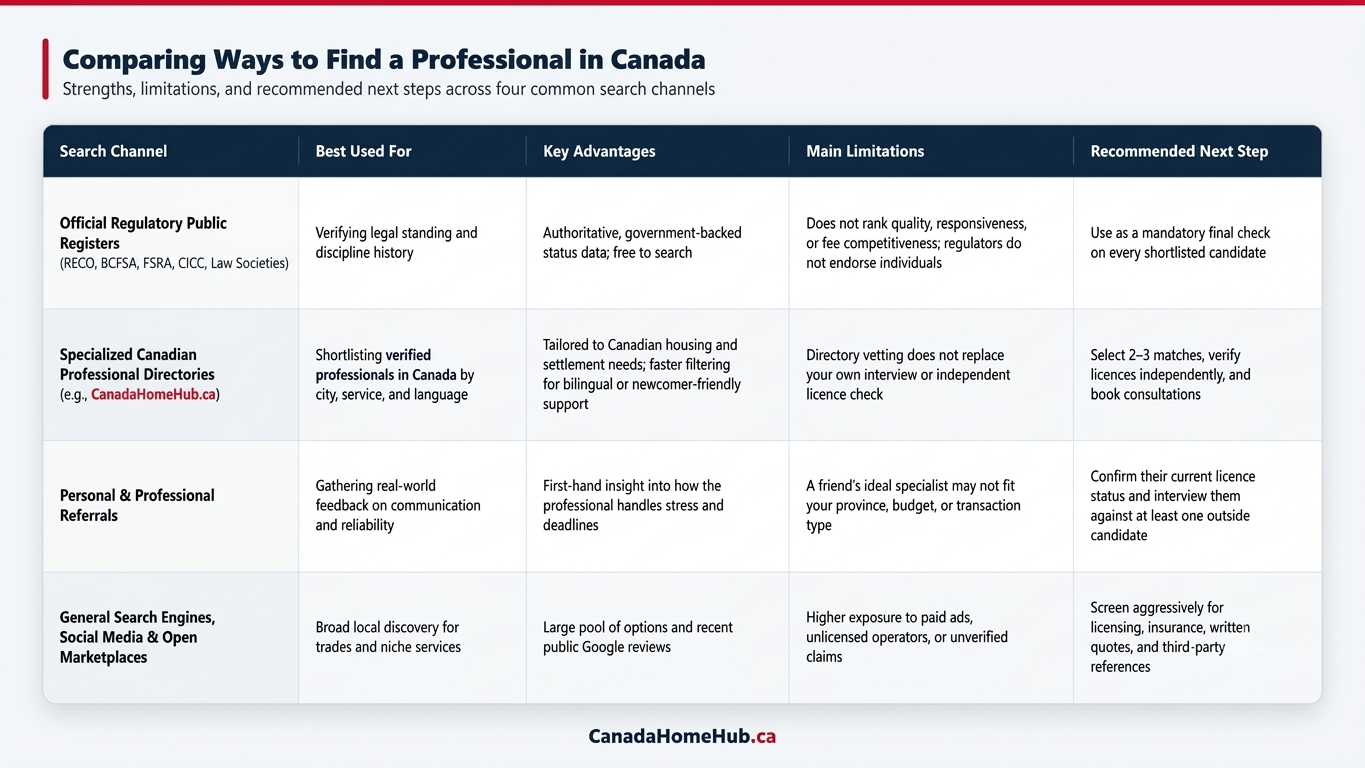
Comparing Ways to Find a Professional in Canada
Not every search channel delivers the same level of reliability. Understanding the strengths and limitations of each method helps you combine them effectively when you need to find a professional in Canada.
Practical Scenarios: Applying the Verification Process in Real Life
Seeing how the rules operate in everyday situations makes it easier to apply them to your own plans. The following illustrative examples highlight how Canadian provincial differences shape your hiring checklist.
Scenario 1: A First-Time Homebuyer Assembling a Team in Ontario vs. British Columbia
Suppose a couple is deciding whether to buy a condo in Toronto, Ontario, or Burnaby, British Columbia. In both cities, they will typically need four core professionals: a mortgage broker, a real estate agent, a home inspector, and a real estate lawyer.
- In Ontario, they verify their mortgage broker on FSRA, their real estate agent on RECO, and their lawyer through the Law Society of Ontario. Because Ontario's Home Inspection Act, 2017 is not yet in force, they cannot check a provincial home inspector licence; instead, they shortlist inspectors holding voluntary OAHI or CAHPI credentials, ask for a sample inspection report, and confirm E&O insurance coverage in writing. They also review Ontario's multiple representation disclosure rules before signing a buyer representation agreement.
- In British Columbia, they check both their mortgage broker and real estate agent through BCFSA—noting that B.C. strictly limits dual agency and includes provincial rules such as the Home Buyer Rescission Period. For their home inspection, they verify a mandatory licence directly through Consumer Protection BC, and they check their real estate lawyer through the Law Society of British Columbia.
Scenario 2: A Newcomer Seeking Paid Immigration and Settlement Advice
Imagine a skilled worker preparing a permanent residence application who sees a social media ad promising "guaranteed approval" from an agency that offers to submit forms without listing a representative on the file.
Applying Canadian verification standards immediately exposes three major red flags:
- No legitimate RCIC or Canadian immigration lawyer can guarantee an IRCC outcome.
- Asking an applicant to omit a paid advisor's name from the Use of a Representative form is the hallmark of an illegal "ghost consultant". Under IRCC rules, applicants remain legally responsible for everything submitted in their file, and misrepresentation can lead to refusal or a five-year ban from Canada.
- Only the licensed RCIC, lawyer, or authorized paralegal/notary—not an unlicensed sales agent—can sign the representation agreement.
Instead, the applicant looks up candidates directly on the CICC Public Register (verifying an active "R" licence number) or a provincial law society directory, requests a written retainer naming the specific licensed professional, and keeps official receipts for every payment.
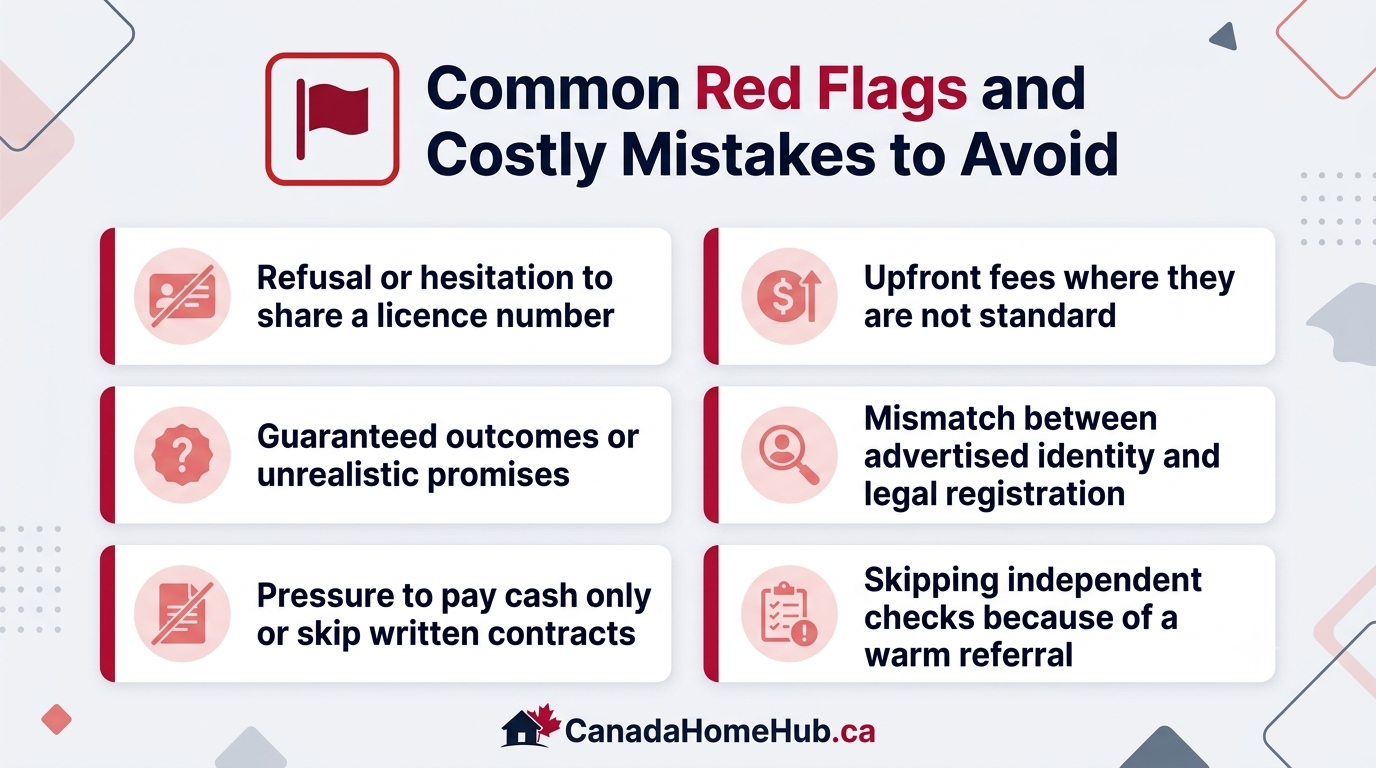
Common Red Flags and Costly Mistakes to Avoid
No matter which sector you are hiring in, dishonest or incompetent operators tend to show recurring warning signs. Pause or walk away immediately if you encounter any of the following:
- Refusal or hesitation to share a licence number: Regulated Canadian professionals are accustomed to credential checks and often display their registration details openly. Evasiveness is a major warning sign.
- Guaranteed outcomes or unrealistic promises: Whether it is a mortgage broker promising an ultra-low rate before reviewing your income documents, a contractor guaranteeing zero permit delays, or an immigration advisor guaranteeing visa approval, guaranteed results in regulated fields are a red flag.
- Pressure to pay cash only or skip written contracts: Cash-only demands with no receipts eliminate your paper trail, void many consumer protections, and make it nearly impossible to pursue recourse if work goes wrong.
- Upfront fees where they are not standard: Be cautious if a prime residential mortgage broker demands an upfront fee before closing without a clear, legitimate written explanation for specialized or private lending work, or if a renovation contractor demands the full project price before materials arrive.
- Mismatch between advertised identity and legal registration: In provinces such as Ontario and B.C., real estate advertising rules require licensees to use their registered names and prominently identify their brokerage. Unexplained name discrepancies or unregistered team names warrant immediate scrutiny.
- Skipping independent checks because of a warm referral: Even well-meaning friends can recommend someone whose licence has since lapsed or whose expertise does not match your current needs. Always run your own two-minute check.
Frequently Asked Questions
Are professional licences valid across all Canadian provinces?
Generally, no. Aside from federally regulated roles like CICC-licensed immigration consultants, most professions—including realtors, mortgage brokers, and lawyers—are regulated provincially. Always verify registration in the exact province where your transaction takes place.
Does a valid licence guarantee quality service?
No. Licensing confirms minimum legal, educational, and insurance standards, not service quality. Treat verification as your baseline, then assess experience, fee clarity, references, and communication during an interview.
What is the difference between a real estate agent, broker, and REALTOR®?
A real estate agent is provincially licensed under a brokerage, while a broker holds extra qualifications to manage or own one. REALTOR® is a trademarked title for licensed Canadian Real Estate Association (CREA) members following its Code of Ethics.
Who can legally charge for Canadian immigration advice?
Under IRCC rules, only active CICC-licensed consultants (RCICs), Canadian lawyers, licensed Ontario paralegals, and Quebec notaries may charge fees. Paid "ghost consultants" are unauthorized and can trigger refusal or a five-year ban.
Do home inspectors need a licence everywhere in Canada?
No. Licensing is mandatory in B.C. and Alberta, and becomes mandatory in Quebec on October 1, 2027. Elsewhere, including Ontario, look for voluntary credentials (OAHI, CAHPI, or InterNACHI) and proof of E&O insurance.
Should I pay an upfront fee to a mortgage broker?
Usually not for prime residential mortgages, since lenders pay the broker at closing. Private or alternative mortgages may involve broker fees, which must be disclosed in writing and typically paid upon closing.
Conclusion
Knowing how to find trusted professionals in Canada comes down to combining smart discovery with disciplined verification. Because Canadian regulations differ across provinces and industries, checking the right public register, comparing at least two or three qualified candidates, asking clear questions about fees and insurance, and insisting on a written agreement will protect you far more reliably than star ratings alone.
If you are planning a major milestone such as buying a home, arranging financing, or settling into a new Canadian city, you can start by exploring independent calculators, guides, and the verified professional directory on CanadaHomeHub.Ca—then follow the verification checklist in this guide before making your final hire.