Buying a home in Montreal is a major financial commitment, and finding the right mortgage can make a significant difference to your long-term budget. However, comparing lenders, understanding mortgage conditions, and determining how much you can afford can be challenging without professional guidance. Working with a mortgage broker in Montreal can help you explore financing options from different lenders and identify a mortgage that suits your financial situation. The challenge is knowing which professional to trust, especially when brokers differ in experience, lender relationships, fees, and areas of expertise. So, this article is for you. We will explain how to find and evaluate a mortgage broker Montreal. Let's dive in.
1. Why Choosing the Right Mortgage Broker in Montreal Matters
A mortgage broker acts as an intermediary between borrowers and mortgage lenders. Rather than lending money directly, they assess your financial situation, identify potential financing options, and help arrange a mortgage with a suitable lender.
A qualified mortgage broker can help you:
- Compare mortgage options: Explore products from different lenders instead of relying on a single financial institution.
- Understand mortgage conditions: Review interest rates, payment schedules, mortgage terms, amortization periods, and prepayment privileges.
- Prepare your application: Understand which financial documents lenders require and identify potential issues before submitting an application.
- Explore alternative financing: Learn whether other lenders may consider your application if your financial circumstances do not fit traditional lending criteria.
- Navigate mortgage renewal or refinancing: Compare available options when your existing mortgage approaches maturity, or you want to change its structure.
However, working with a broker does not automatically guarantee the lowest interest rate or mortgage approval. Different brokers have access to different lenders, and the final decision rests with the lender. The AMF also recommends asking brokers how many lenders they work with and whether they will present options from more than one financial institution.
2. 7 Key Factors to Consider When Choosing a Mortgage Broker in Montreal
Finding a professional who offers a competitive rate is important, but it should not be your only consideration. The following factors can help you evaluate potential candidates more carefully.
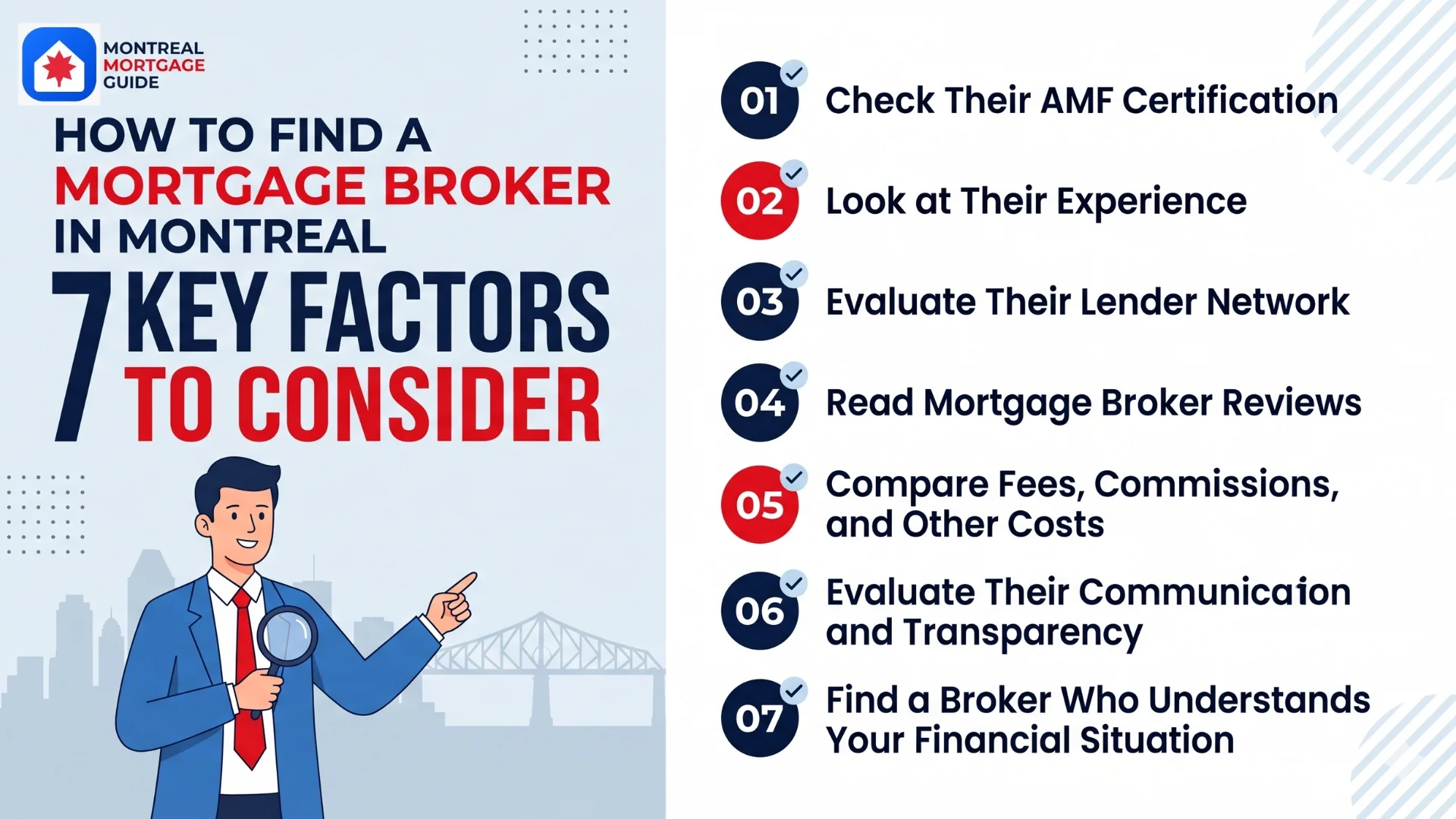
2.1. Check Their AMF Certification
This should be your first step when choosing a mortgage broker Montreal.
Quebec regulates mortgage brokerage through the Autorité des marchés financiers (AMF). Individuals acting as mortgage brokers must hold the appropriate AMF-issued certificate. You can check a professional's credentials through the AMF's official Register of firms and individuals authorized to practise.
When checking a potential broker:
- Confirm that their name appears in the AMF register.
- Check that their authorization covers mortgage brokerage.
- Verify the firm they represent, if applicable.
- Review any relevant information about their professional standing.
Do not rely solely on a broker's website, social media profile, business card, or advertising claims as proof of authorization.
2.2. Look at Their Experience
A broker's experience can influence how effectively they understand your financing needs and identify suitable mortgage products. However, general experience in mortgage brokerage is not necessarily the same as familiarity with Montreal's housing market. Look for someone who understands the local property market and has experience working with borrowers in situations similar to yours.
For example, consider whether the broker has experience with:
- First-time homebuyers purchasing condos or houses.
- Buyers purchasing properties in different Montreal neighbourhoods.
- Self-employed individuals with variable income.
- Homeowners renewing or refinancing existing mortgages.
- Buyers purchasing multi-unit residential properties.
You should also consider whether they can explain Quebec-specific requirements and the additional costs associated with purchasing property in Montreal. During your initial consultation, ask how they have handled mortgage applications similar to yours. A knowledgeable professional should be able to explain their approach without making unrealistic promises.
2.3. Evaluate Their Lender Network
Not every mortgage broker Canada has access to the same lenders or products. Some work primarily with traditional financial institutions, while others also have relationships with alternative or private lenders.
Ask potential brokers:
- How many lenders do you currently work with?
- Do you work with major banks and credit unions?
- Can you access alternative mortgage lenders?
- Are there lenders or mortgage products you cannot access?
- How do you determine which lenders are suitable for my application?
The goal is not necessarily to find someone who works with the largest number of lenders. Instead, look for a broker whose lender network is relevant to your circumstances.
2.4. Read Mortgage Broker Reviews
Online reviews can provide useful information about a broker's communication, reliability, and customer service. When researching mortgage broker reviews Montreal, look beyond the overall star rating. Read individual comments to understand what previous clients appreciated or disliked about their experience.
Pay attention to recurring feedback about:
- Responsiveness and communication.
- Clarity when explaining mortgage conditions.
- Ability to handle complicated applications.
- Transparency about costs and compensation.
- Support throughout the approval process.
For a more balanced assessment, compare reviews from multiple sources rather than relying on testimonials published exclusively on a broker's website. You should also be cautious of reviews that make unusually broad claims, contain little specific information, or appear repetitive.

2.5. Compare Fees, Commissions, and Other Costs
Before working with a broker, understand how they are compensated and whether you will need to pay any additional fees. Many mortgage brokers receive commissions from lenders after arranging a mortgage. However, some transactions may involve fees payable by the borrower, depending on the financing arrangement.
Ask for a clear explanation of:
- Whether the broker charges you directly.
- Whether the lender pays a commission.
- Whether any administrative or brokerage fees apply.
- When payments become due.
- Whether additional costs could arise if the application does not proceed.
A mortgage with a lower advertised interest rate is not necessarily the least expensive option once you account for lender fees, broker fees, appraisal costs, legal expenses, and other charges. Request written information before agreeing to proceed. This makes it easier to compare different offers and understand your financial obligations.
2.6. Evaluate Their Communication and Transparency
Mortgage applications involve sensitive financial information and several important decisions. You should feel comfortable discussing your income, debts, credit history, and financial goals with the person handling your application.
During your initial conversation, assess whether the broker:
- Explains complicated mortgage terms in plain language.
- Responds to questions clearly and promptly.
- Discusses both the advantages and disadvantages of available options.
- Explains potential risks and additional costs.
- Provides realistic expectations about approval.
- Keeps you informed about application progress.
A professional should not pressure you into accepting an offer before you understand its conditions. They should also explain their role in the transaction, their relationships with lenders, and any potential conflicts of interest where applicable.
2.7. Find a Broker Who Understands Your Financial Situation
The right mortgage product depends on more than the advertised interest rate. Your employment, income stability, credit history, existing debts, down payment, and long-term financial plans can all influence your borrowing options.
A suitable broker should ask questions about your circumstances before recommending a product. Be cautious of anyone who suggests a mortgage without understanding your financial position.
3. How to Find a Mortgage Broker in Montreal
Finding a suitable mortgage broker Montreal does not have to be complicated. By following a few practical steps, you can identify qualified professionals, compare your options, and choose someone who fits your financing needs.
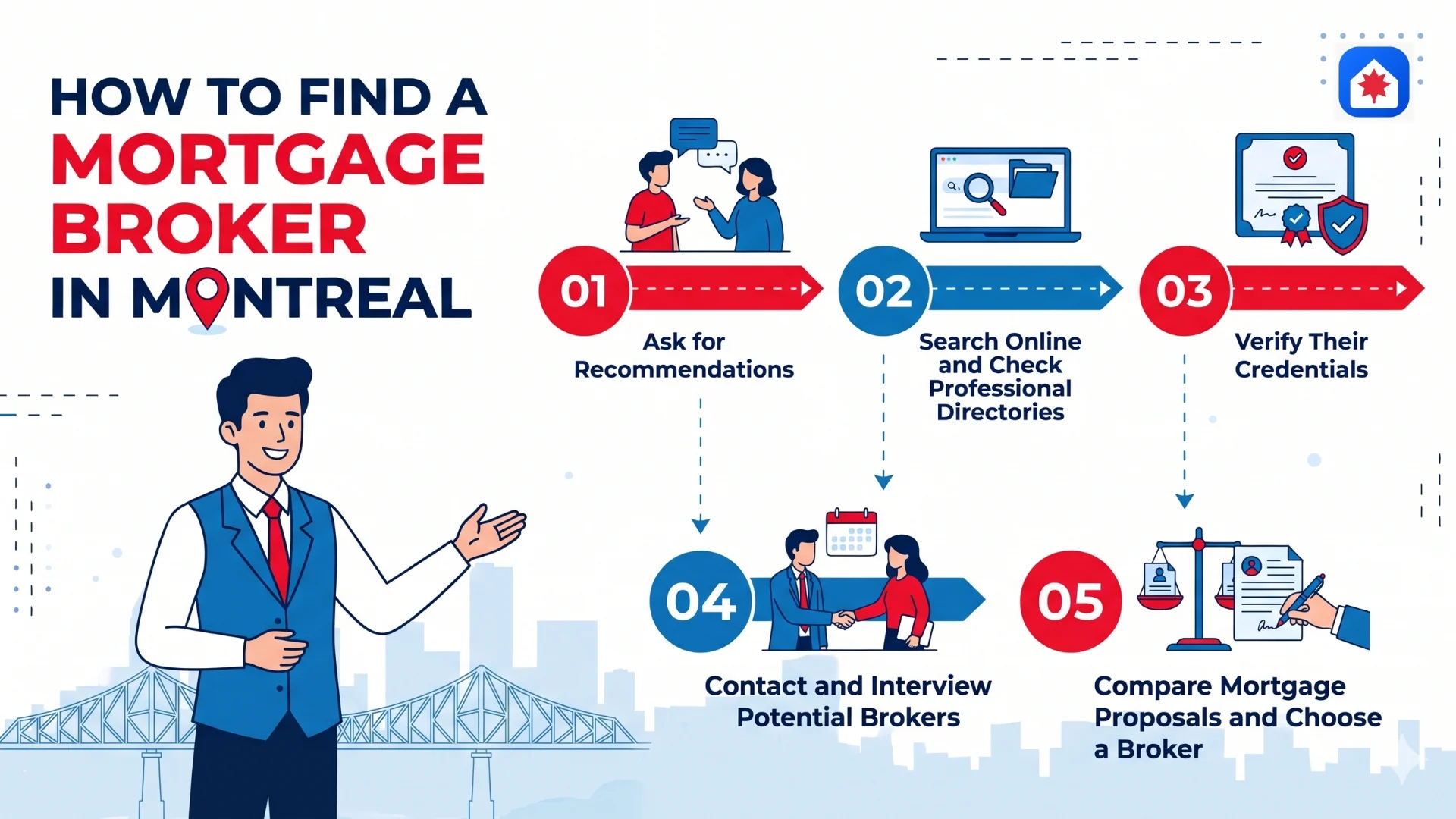
3.1. Step 1: Ask for Recommendations
Start by asking people you trust whether they have worked with a mortgage broker in Montreal. Friends, relatives, colleagues, and real estate professionals may be able to recommend brokers based on their direct experiences.
However, treat referrals as a starting point rather than a final decision. A broker who worked well for someone else may not necessarily be the right fit for your financial situation.
3.2. Step 2: Search Online and Check Professional Directories
Online searches can help you discover mortgage brokers serving Montreal and surrounding areas.
Try searching for terms such as:
- Mortgage broker Montreal
- Montreal mortgage broker
- Mortgage broker near Montreal
- Mortgage broker for first-time home buyers
- Licensed mortgage broker Quebec
You can also explore professional directories to find potential candidates. For example, CanadaHomeHub's professional directory is a resource for discovering professionals in Canada. Then, make a list of several candidates whose services and locations match your needs.
3.3. Step 3: Verify Their Credentials
Before contacting a broker about your mortgage application, confirm that they are authorized to provide mortgage brokerage services in Quebec.
Check their professional status through the Autorité des marchés financiers (AMF), Quebec's financial regulator. This helps you avoid relying solely on online profiles, advertisements, or personal recommendations. You should also review their professional background and experience to determine whether they have handled applications similar to yours.
3.4. Step 4: Contact and Interview Potential Brokers
Once you have a shortlist, contact each candidate to discuss your financing needs. An initial consultation can help you understand their experience, lender relationships, communication style, and approach to mortgage applications.
Prepare a consistent set of questions so you can compare their responses fairly. For example, ask how they would approach your application, which financing options they might consider, and what information they need to assess your eligibility. Before sharing sensitive financial documents, make sure you understand how your information will be collected, used, and protected.
3.5. Step 5: Compare Mortgage Proposals and Choose a Broker
If you decide to proceed with several candidates, compare the mortgage options they present rather than focusing only on the advertised interest rate.
Pay attention to:
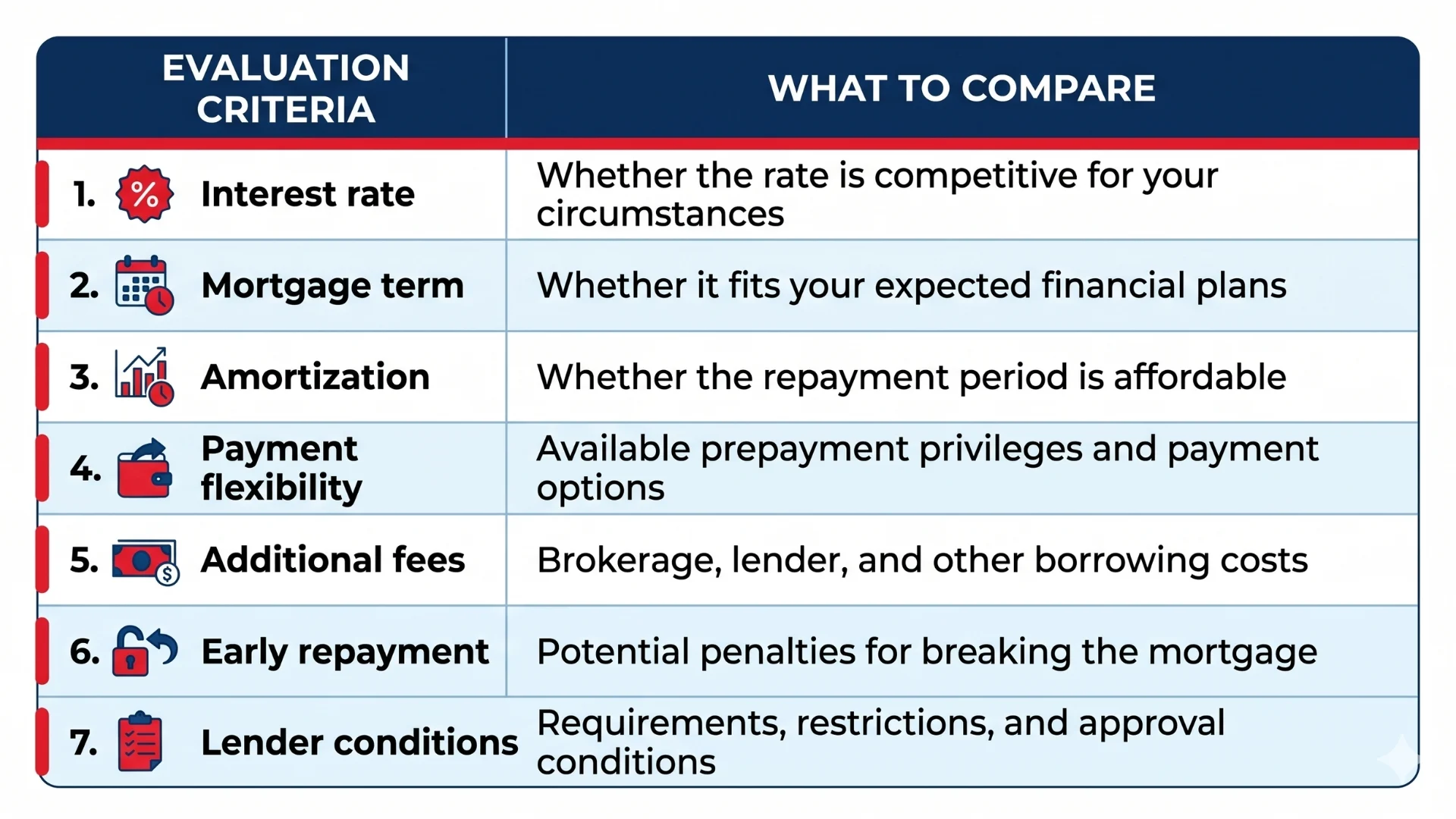
Consider the overall borrowing costs, repayment terms, and risks before making your decision. Choose the broker who explains your options clearly and helps you find a mortgage that suits your financial situation.
4. Questions to Ask Before Hiring a Mortgage Broker
An initial consultation is an opportunity to evaluate whether a broker understands your needs and can provide appropriate guidance. Rather than focusing exclusively on rates, ask questions that reveal how the professional works.
Here are seven useful questions:
- Are you certified by the AMF?
- Which lenders do you work with?
- How are you compensated?
- What mortgage options suit my financial situation?
- What happens if my application is declined?
- Can you explain the risks and conditions of each mortgage?
- How will you keep me updated throughout the process?
You should also ask whether the broker will provide written details about the recommended mortgage, including its interest rate, term, payment conditions, and applicable fees. A reliable professional should be willing to explain these details rather than expecting you to accept an offer without understanding it.
5. Finding a Mortgage Broker for First-Time Home Buyers in Montreal
Buying your first home involves several financial decisions, and a mortgage broker Montreal can help you understand the financing process. However, first-time buyers should look for someone who can explain more than just mortgage rates. The right professional should also help you understand qualification requirements, down payment rules, mortgage insurance, and additional purchasing costs.
5.1. Experience with First-Time Buyer Programs
Ask whether the broker has experience helping first-time home buyers Canada understand available financing options and government-supported homeownership programs. These programs have different eligibility requirements and withdrawal rules. A broker can help explain how your financing plan fits together, although you should also consult the official program guidelines.
5.2. Guidance on Down Payments and Mortgage Insurance
Your down payment affects how much you need to borrow and whether mortgage loan insurance is required. For eligible CMHC-insured mortgages, the minimum down payment generally starts at 5% for homes priced at $500,000 or less. For properties priced above $500,000 but below $1.5 million, the requirement is 5% on the first $500,000 and 10% on the remaining amount. A down payment of less than 20% generally requires mortgage loan insurance, subject to the applicable eligibility rules. The insurance protects the lender rather than the borrower.
5.3. Help with Mortgage Pre-Approval and Qualification
Mortgage pre-approval can help you estimate how much you may be able to borrow and understand the potential interest rate before making an offer on a property. A broker can help you prepare the necessary financial information and submit your application to a suitable lender. However, pre-approval is not a guarantee of final mortgage approval. The lender may still need to review your financial circumstances, the property, and other conditions before approving the loan.
You should also understand Canada's mortgage stress test. Federally regulated lenders generally assess mortgage applications using the higher of the contract rate plus two percentage points or the applicable minimum qualifying rate. This means the amount you can borrow may be lower than you initially expect based on the advertised mortgage rate.
5.4. Understanding Additional Homebuying Costs in Montreal
Your down payment is not the only expense to prepare for when purchasing a home.
In Montreal, buyers should also budget for:
- Notary fees and legal expenses.
- Property inspection costs.
- Municipal and school taxes.
- Property insurance.
- Moving expenses.
- Mortgage insurance premiums, when applicable.
- Quebec's welcome tax (property transfer duties).
These expenses can significantly affect the amount of money you need before closing. A mortgage broker can help you estimate financing-related costs, but you should also consult a notary and the relevant municipal authorities to understand the full cost of purchasing your property.
6. Common Mistakes to Avoid When Choosing a Mortgage Broker
Even after finding several potential candidates, it is easy to make decisions based on incomplete information. Avoiding these common mistakes can help you choose a professional more confidently.
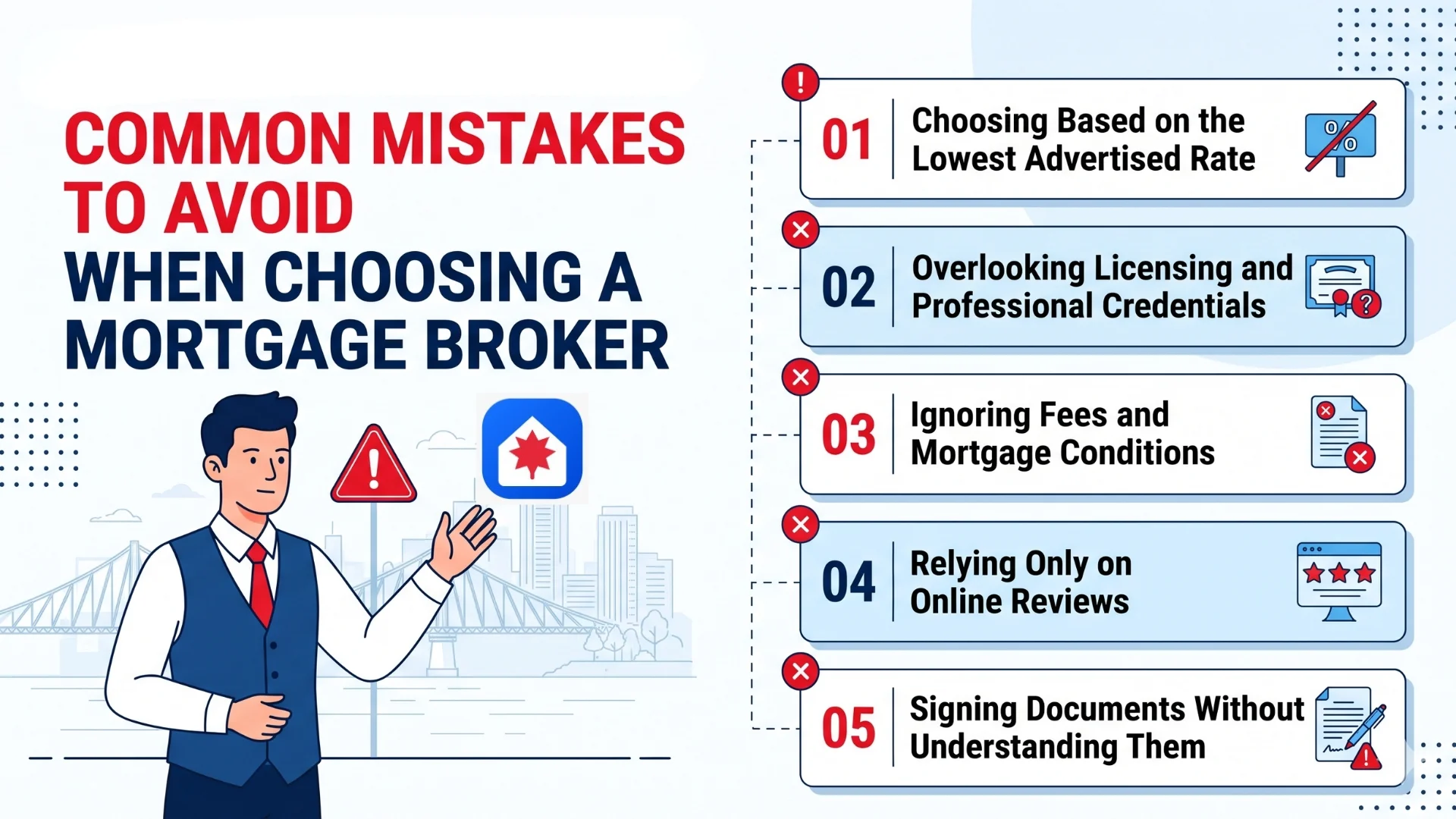
6.1. Choosing Based on the Lowest Advertised Rate
A low interest rate may look attractive, but it does not necessarily represent the best mortgage. Some offers come with restrictions, limited prepayment privileges, or additional costs. Others may apply only to borrowers who meet specific qualification requirements. So, compare the overall mortgage conditions rather than focusing on a single advertised number.
6.2. Overlooking Licensing and Professional Credentials
Never assume that someone is authorized to provide mortgage brokerage services simply because they have a professional website or receive positive customer reviews. In Quebec, check the broker's authorization through the AMF register before proceeding. If you cannot confirm their professional standing, do not move forward until the situation is clarified.
6.3. Ignoring Fees and Mortgage Conditions
Some borrowers concentrate on the interest rate and overlook other financial obligations. Before accepting a mortgage recommendation, review the applicable fees, prepayment penalties, payment flexibility, and other contractual conditions. Ask for clarification whenever a term or cost is unclear.
6.4. Relying Only on Online Reviews
Customer reviews can help you understand a broker's service quality, but they cannot replace independent verification. Combine online feedback with professional credentials, relevant experience, and a direct consultation.
6.5. Signing Documents Without Understanding Them
Mortgage agreements and related documents can contain important financial obligations. Read all documents carefully before signing, particularly those concerning fees, lender relationships, mortgage conditions, and early repayment penalties. If you are unsure about a contractual provision, consider obtaining independent legal advice before committing.
Frequently Asked Questions
1. How do I find a reliable mortgage broker in Montreal?
Start by searching for mortgage brokers operating in Montreal, then verify their professional credentials through the AMF register. Compare their experience, lender relationships, fees, customer reviews, and communication style before making a decision.
2. Do mortgage brokers in Quebec need a licence?
Yes. Individuals acting as mortgage brokers in Quebec must hold an appropriate certificate issued by the Autorité des marchés financiers (AMF). Consumers can use the AMF's official register to verify whether a broker or firm is authorized to practise.
3. How much does a mortgage broker charge in Montreal?
Many mortgage brokers receive commissions from lenders rather than charging borrowers directly. However, fees may vary depending on the broker, lender, and financing arrangement. Ask for a clear explanation of all applicable costs before proceeding.
4. Is it better to use a mortgage broker or a bank in Montreal?
A mortgage broker may help you compare products from multiple lenders, while a bank mortgage specialist primarily offers products from their own institution. The better option depends on your financing needs, available products, and preferred level of support.
5. Can a mortgage broker help first-time home buyers?
Yes. A mortgage broker can help first-time buyers understand mortgage qualification, down payment requirements, mortgage insurance, pre-approval, and available financing options. They can also explain how different mortgage terms affect long-term borrowing costs.
6. Can I work with a mortgage broker near Montreal if I live outside the city?
Potentially, yes. You can consider brokers operating in surrounding areas if they are authorized to provide mortgage brokerage services in Quebec and can accommodate your location and financing needs. Confirm their credentials and service arrangements before proceeding.
Finding the right mortgage broker Montreal involves more than comparing interest rates. You should verify professional credentials, assess relevant experience, understand lender relationships, review customer feedback, and clarify all fees before making a decision. Take the time to speak with several candidates and compare their recommendations based on your financial situation and long-term homeownership plans. Most importantly, choose a professional who communicates transparently and helps you understand the advantages, limitations, and costs of each mortgage option.
If you are preparing to buy a home in Canada, explore CanadaHomeHub for practical housing and financial resources.