
Finding the right mortgage broker in Calgary comes down to verifying provincial licensing, comparing lender access, evaluating local market knowledge, and interviewing multiple candidates before sharing your sensitive financial documents. Because mortgage rules, property types, and lending appetites vary across Canada, working with a qualified professional who understands Alberta’s lending environment can save you thousands of dollars over the life of your loan.
Whether you are buying your first condo in the Beltline, upgrading to a detached home in the suburbs, or preparing for a mortgage renewal, choosing a broker requires more than picking the top result on a search engine. This guide walks you through every step of vetting, comparing, and selecting a licensed mortgage professional in Calgary.
Why Work With a Calgary Mortgage Broker Instead of Going Straight to a Bank?
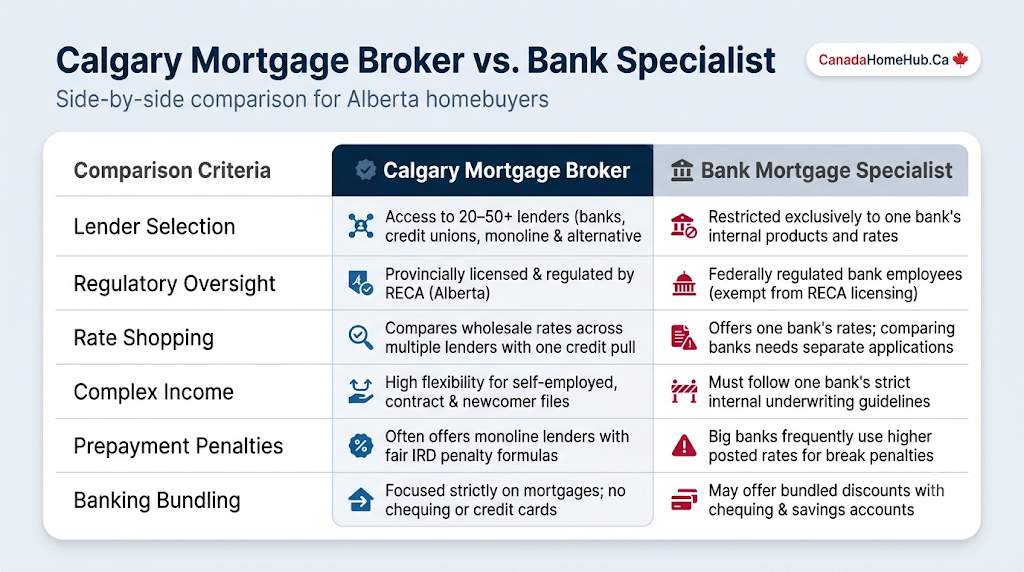
When Canadians need a mortgage, many default to walking into the branch where they hold their chequing account. While bank mortgage specialists can be helpful, they are employees of a single institution and can only offer that bank’s proprietary mortgage products, rates, and underwriting policies.
A licensed Calgary mortgage broker, by contrast, acts as an independent intermediary between you and dozens of lending institutions.
Access to Multiple Lenders Beyond the Big Six Banks
In Canada, mortgage financing comes from several tiers of lenders:
- Major Banks (The Big Six): Traditional institutions offering full-service banking alongside mortgages.
- Credit Unions: Provincially regulated financial cooperatives in Alberta (such as ATB Financial or regional credit unions) that often feature flexible underwriting for local residents.
- Monoline Lenders: Financial institutions that focus exclusively on residential mortgages (such as First National, MCAP, or RFA). They typically operate through the broker channel and are well known for fair prepayment privileges and transparent penalty calculations.
- Alternative (B-Lenders) and Private Lenders: Institutions serving self-employed borrowers, newcomers with limited Canadian credit history, or applicants recovering from past credit challenges.
By submitting a single application through a broker, you gain access to multiple lenders simultaneously rather than having to apply separately at several institutions.

Understanding Calgary’s Local Real Estate and Lending Landscape
Calgary’s housing market has distinct characteristics that influence how lenders evaluate a property and a borrower. A broker who regularly closes deals in Calgary understands local nuances that an out-of-province call centre might overlook, including:
- Condo Corporation Reviews: Calgary has a large inventory of condominiums and townhomes. Local brokers know which lenders have stricter policies regarding condo reserve fund studies, special assessments, or post-tension cable buildings.
- Acreages and Surrounding Communities: If you are looking at properties in Airdrie, Cochrane, Okotoks, or rural Rocky View County, certain lenders place restrictions on well water, septic systems, or maximum acreage valuations.
- Energy and Tech Sector Income Structures: Many Calgary professionals earn income through bonuses, overtime, consulting contracts, or incorporated businesses. Experienced local brokers know which lenders average two years of T4/T1 General income most favourably.
How to Find a Mortgage Broker in Calgary in 6 Practical Steps
Rather than rushing into an application, follow a structured vetting process to narrow down your options.
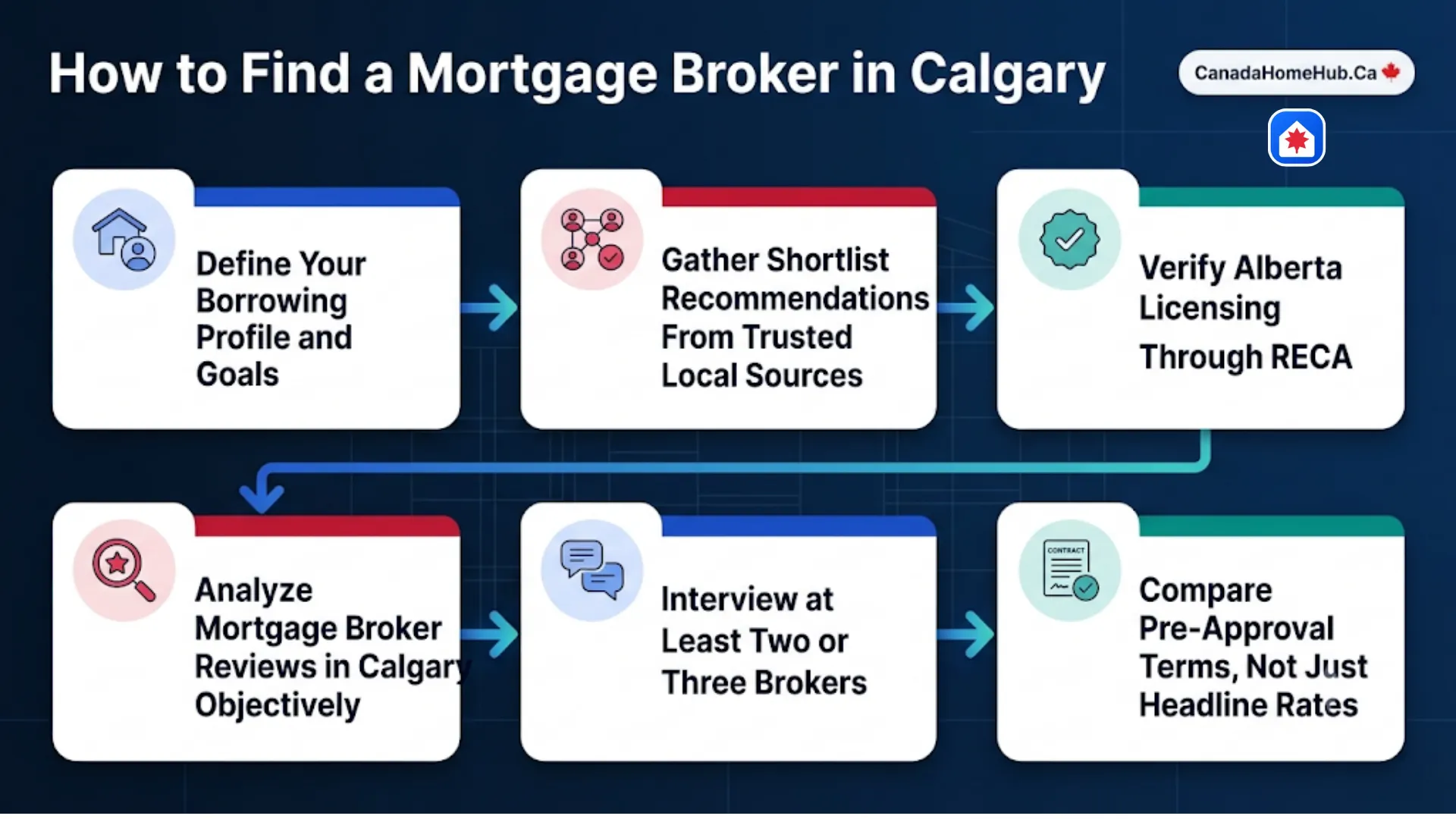
Step 1: Define Your Borrowing Profile and Goals
Before contacting any broker, clarify what you need. Different brokers specialize in different types of files:
- Standard Purchase or Renewal: You have steady T4 employment, a strong credit score (typically 680 or higher), and a down payment of at least 5% to 20%.
- First-Time Home Buyer: You need guidance on the federal Mortgage Stress Test, default mortgage insurance (via CMHC, Sagen, or Canada Guaranty), and down payment programs like the First Home Savings Account (FHSA) or Home Buyers’ Plan (HBP).
- Self-Employed or Complex Income: You own a business, write off expenses, or rely on commission income and need a broker skilled in stated-income or stated-business-for-self programs.
- Investment Property or Refinance: You are purchasing a rental suite in Calgary or pulling equity out of an existing home.
Knowing your profile helps you ask targeted questions and immediately see whether a broker handles situations like yours on a regular basis.
Step 2: Gather Shortlist Recommendations From Trusted Local Sources
Start by building a list of four to six potential candidates. Reliable ways to find a mortgage broker near Calgary include:
- Local Real Estate Professionals: Calgary Realtors work closely with mortgage brokers every day and quickly learn which ones communicate clearly, meet financing condition deadlines, and close smoothly.
- Real Estate Lawyers in Alberta: Since real estate lawyers handle the closing and funding instructions, they have first-hand insight into which brokers are organized and which ones cause last-minute delays.
- Friends, Family, and Colleagues in Calgary: Ask peers who have recently bought or renewed a home in the city about their experience—specifically how responsive their broker was under tight timelines.
- Industry Associations: Organizations such as the Alberta Mortgage Brokers Association (AMBA) and Mortgage Professionals Canada (MPC) maintain member directories of active professionals.
As you research broader Canadian real estate and home-buying considerations, platforms like CanadaHomeHub.Ca can also serve as a useful starting point for exploring housing topics across Canada before you finalize your local shortlist.
Step 3: Verify Alberta Licensing Through RECA
In Canada, mortgage brokering is regulated at the provincial level. Anyone arranging mortgages for a fee or commission in Calgary must be licensed by the Real Estate Council of Alberta (RECA).
Before sharing personal financial data or sin numbers, look up the individual on RECA’s public licensee database:
- Confirm that their license status is Active.
- Check whether they are licensed as a Mortgage Associate (who works under the supervision of a brokerage) or a Mortgage Broker (who is qualified to manage a brokerage). Both can legally arrange your mortgage, though a Mortgage Broker generally has more years of experience and additional regulatory training.
- Verify if there are any past disciplinary actions or administrative sanctions on their public record.
Never work with an unlicensed individual who claims they can "guarantee" approval or asks for upfront cash fees to arrange a standard residential mortgage.
Step 4: Analyze Mortgage Broker Reviews in Calgary Objectively
Reading mortgage broker reviews Calgary homebuyers have left on Google, Trustpilot, or local forums can reveal patterns in customer service—provided you know what to look for.
Instead of focusing solely on a 5.0-star average, read the detailed written reviews for specific indicators:
- Communication Under Pressure: In Calgary, purchase contracts typically include a financing condition period of 5 to 10 business days. Look for reviews mentioning that the broker met tight deadlines and kept the buyer informed at every step.
- Education and Transparency: Good reviews often note that the broker took time to explain penalty calculations, fixed vs. variable trade-offs, and closing costs rather than simply pushing a single rate.
- Problem-Solving: Pay close attention to reviews from borrowers who faced appraisal shortfalls, condo document issues, or self-employment hurdles.
- Critical Reviews: If a brokerage has a few negative reviews, read how the broker responded. Professional, measured responses show accountability, whereas defensive or dismissive replies are a warning sign.
Step 5: Interview at Least Two or Three Brokers
Treat your initial consultation like a job interview. Most Calgary mortgage brokers offer a free 15- to 30-minute discovery call or virtual meeting. Speaking with two or three candidates lets you compare:
- How clearly they explain complex Canadian mortgage rules.
- Whether they ask thorough questions about your five-year financial plans (such as whether you might move, renovate, or pay down the mortgage early).
- Their responsiveness—if it takes three days to get a reply during the sales phase, communication may be even slower once your file is in underwriting.
Step 6: Compare Pre-Approval Terms, Not Just Headline Rates
Once you select a broker to work with, they will collect your documentation and submit your file for a formal mortgage pre-approval. Remember that the lowest advertised interest rate is not always the cheapest mortgage over a five-year term.
Ask your broker to walk you through:
- Prepayment Privileges: How much extra principal can you pay down each year without penalty (e.g., 15% or 20% lump-sum payments)?
- Penalty Calculations: If you break a fixed-rate mortgage early, does the lender calculate the Interest Rate Differential (IRD) using posted rates (often resulting in steep penalties at major banks) or discounted rates (typically much lower at monoline lenders)?
- Portability: Can you transfer the mortgage to a new property if you move within Calgary or elsewhere in Canada without paying a discharge penalty?
- Rate Hold Duration: How long is the pre-approval rate guaranteed (usually 90 to 120 days)?
Mortgage Broker vs. Bank Specialist in Calgary: Side-by-Side Comparison
Understanding the structural differences between a broker and a traditional bank branch can help you decide which route fits your situation best.
Choosing a First-Time Home Buyer Mortgage Broker in Calgary
If you are entering the housing market for the first time, working with a dedicated first time home buyer mortgage broker Calgary residents trust can make the process far less intimidating. First-time buyers face unique hurdles under Canadian mortgage rules, including the federal Mortgage Stress Test—which requires you to qualify at either 5.25% or your contract rate plus 2%, whichever is higher.
A strong broker for first-time buyers in Calgary will proactively help you with:
- Down Payment Strategy: Explaining the minimum down payment rules in Canada (5% on the first $500,000 of the purchase price, and 10% on the portion between $500,000 and $1,499,999; 20% minimum for homes $1.5 million and above).
- Tax-Advantaged Accounts: Helping you coordinate timelines for withdrawing funds from a First Home Savings Account (FHSA) or the RRSP Home Buyers’ Plan (HBP) so the cash is liquid in time for closing.
- True Closing Cost Budgeting: While Alberta does not have a provincial land transfer tax (unlike Ontario or British Columbia), Calgary buyers still need to budget roughly 1.5% to 2.5% of the purchase price for legal fees, Alberta Land Titles registration fees, property tax adjustments, title insurance, and home inspections.
- True Pre-Approval vs. Online Pre-Qualification: Ensuring a human underwriter—or at minimum a thorough document review—has verified your income and down payment before you waive your financing condition.
Essential Questions to Ask a Mortgage Broker Near Calgary Before You Sign
During your initial consultation, use the following checklist to evaluate a broker’s expertise and transparency:
- How many lenders do you actively work with, and which types (banks, credit unions, monolines) do you place most of your business with?
- Do you specialize in borrowers with my specific profile (e.g., first-time buyer, self-employed, newcomer, or investment property)?
- Will you review my income documents, credit report, and down payment statements upfront before issuing a pre-approval?
- How do you compare mortgage options beyond the interest rate—specifically regarding prepayment privileges and early break penalties?
- What is your typical turnaround time for responding to emails or calls during a live offer with a financing condition?
- Will you be my main point of contact throughout the entire process, or will my file be handed off to an assistant or fulfillment team?
- Are there any situations in which I would be charged a direct broker fee for my application?
How Mortgage Brokers Are Paid (And Potential Red Flags)
Understanding how compensation works removes guesswork and helps you spot potential conflicts of interest.
Standard Lender Compensation vs. Direct Borrower Fees
For standard residential mortgages placed with prime ("A") lenders—such as major banks, credit unions, and monoline lenders—you typically do not pay the mortgage broker out of pocket. Instead, the lender pays the brokerage a commission (often called a finder’s fee) once your mortgage funds. This fee is generally calculated as a percentage of the loan amount and varies slightly depending on the mortgage term (for example, a 5-year term pays more than a 1-year term).
However, direct borrower fees can apply in specialized scenarios, such as:
- Alternative (B-lender) or private mortgage placements where the lender does not pay a broker commission.
- Complex commercial or construction financing.
Under Alberta regulations, any broker fee charged to you must be disclosed clearly in writing before you are obligated to pay it.

Warning Signs to Watch For
Be cautious if you encounter any of the following red flags during your search:
- Pushing a Single Term Without Asking About Your Plans: If a broker immediately recommends a 5-year fixed mortgage without asking how long you plan to keep the property, they may be prioritizing higher commission over your flexibility.
- Reluctance to Put Terms in Writing: A trustworthy broker will gladly provide a written breakdown of rates, lender names, privileges, and estimated closing costs.
- Suggesting You Falsify Application Details: Never work with anyone who encourages inflating income, misrepresenting an investment property as owner-occupied, or fabricating gift letters. Mortgage fraud carries severe legal and financial consequences in Canada.
- Issuing a Pre-Approval Without Seeing Documents: A pre-approval based solely on verbal numbers offers very little protection when you submit a binding offer on a Calgary home.
Frequently Asked Questions About Finding a Mortgage Broker in Calgary
How do I check if a mortgage broker is licensed in Calgary?
You can verify a broker’s credentials through the Real Estate Council of Alberta (RECA) online licensee lookup tool. Search by the individual’s full name or brokerage name to confirm their license is active, see whether they are registered as a Mortgage Associate or Mortgage Broker, and check for any disciplinary history.
Does using a mortgage broker in Calgary cost the homebuyer anything?
In most standard residential purchases and renewals with prime lenders, there is no direct cost to the homebuyer because the lending institution pays the broker a finder’s fee upon closing. Direct fees generally only arise when arranging complex, alternative (B-lender), or private mortgages, and must be disclosed in writing beforehand.
Is it better to use a local Calgary mortgage broker or an online national brokerage?
Both options have merits, depending on your priorities. National online brokerages often advertise aggressive rate specials for straightforward, low-risk borrowers. However, a local Calgary mortgage broker brings valuable familiarity with Alberta real estate contracts, local condo boards, acreage lending rules, and Calgary appraisers—which can be decisive when navigating a tight financing condition.
How many mortgage brokers should I talk to before choosing one?
Interviewing two or three brokers is generally ideal. It gives you enough perspective to compare communication styles, lender access, and rate options without creating confusion or duplicating paperwork. Once you choose the broker you trust most, commit to working with them so they can advocate effectively with lenders on your behalf.
Will talking to multiple mortgage brokers hurt my credit score in Canada?
Having initial discovery conversations will not affect your credit score at all, because a broker should never pull your credit without your explicit written consent. If you do authorize credit checks while shopping for a mortgage, Canadian credit bureaus (Equifax and TransUnion) typically treat multiple mortgage-related inquiries within a short shopping window (generally 14 to 45 days, depending on the scoring model) as a single inquiry for scoring purposes. Still, it is best practice to choose your broker first before authorizing a hard credit pull.
What documents do I need before meeting a Calgary mortgage broker?
To get an accurate assessment, gather your government-issued photo ID, recent pay stubs, your last two years of T4 slips and Notice of Assessment (NOA) forms from the Canada Revenue Agency (CRA), a letter of employment confirming your position and income, and 90 days of bank or investment statements verifying your down payment and closing cost funds. If you are self-employed, also prepare two years of full T1 General tax returns and business financial statements.
Conclusion: Taking the Next Step Toward Your Calgary Mortgage
Choosing the right mortgage broker in Calgary is one of the highest-leverage financial decisions you will make during the home-buying or renewal process. By verifying active RECA licensing, reading local reviews critically, comparing lender diversity, and interviewing two or three professionals before handing over your documents, you put yourself in a strong position to secure competitive rates and flexible mortgage terms tailored to Alberta’s market.
Before booking your initial consultations, take time to organize your income records, clarify your five-year housing goals, and review broader Canadian home-buying resources on CanadaHomeHub.Ca so you walk into every conversation prepared to ask informed questions.