Purchasing a home is one of the most substantial financial commitments you will ever make. In Canada’s dynamic real estate landscape, where older properties sit alongside new modular builds and temperatures swing dramatically from summer heatwaves to sub-zero winter freezes, knowing the structural integrity of your potential home is paramount.
Securing a qualified home inspector in Canada is not simply a procedural checkbox on your purchase agreement - it is your principal defence against unforeseen structural defects, hazardous electrical systems, water infiltration, and catastrophic repair bills. However, navigating the landscape of Canadian home inspections can be confusing. Licensing standards vary significantly between provinces, professional designations differ, and inspection scopes are often misunderstood.
This comprehensive guide walks you through finding, vetting, and hiring a reputable, certified home inspector in Canada, ensuring your property investment rests on solid ground.
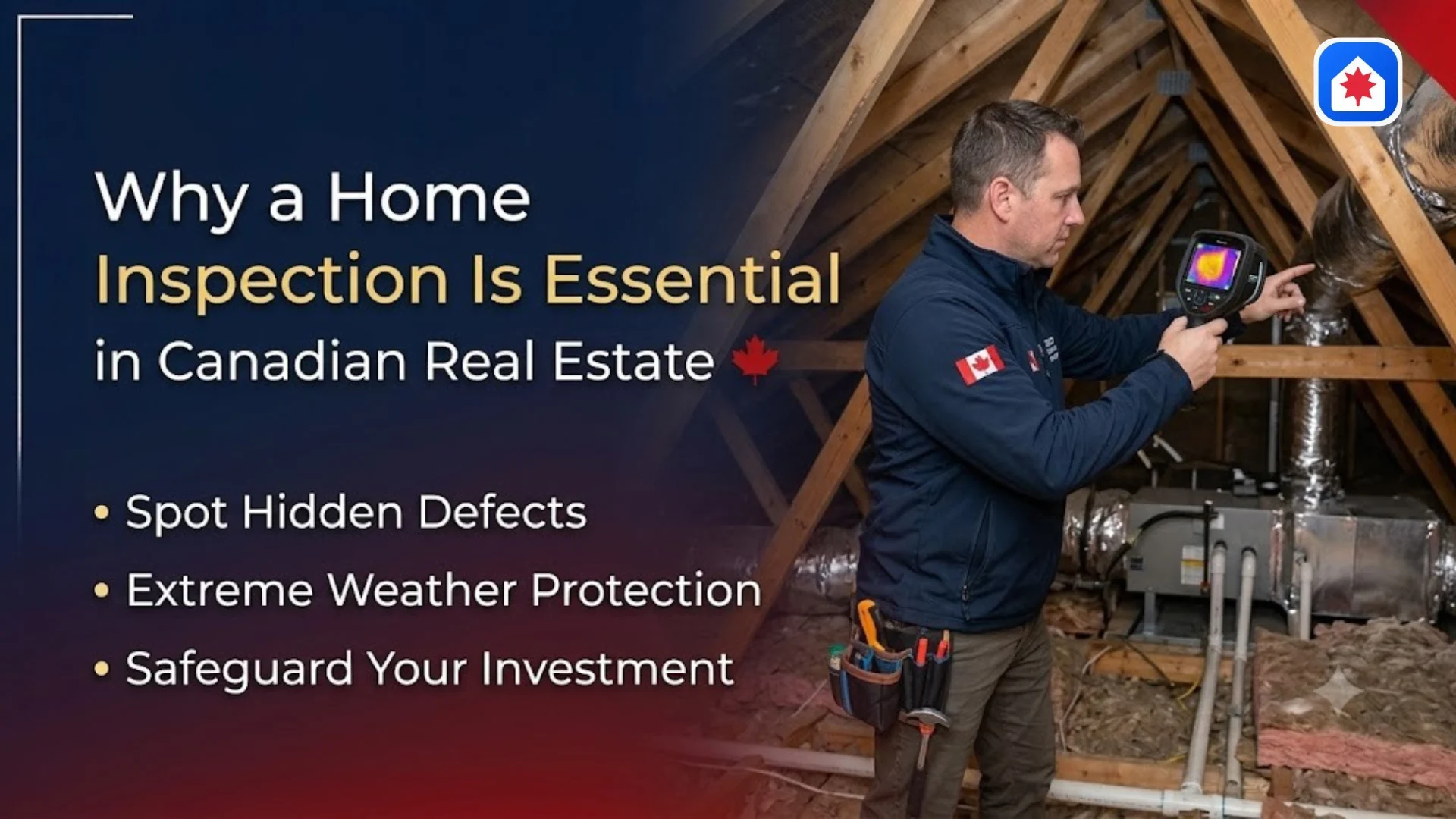
Why a Professional Home Inspection Is Essential in Canadian Real Estate
A home inspection is an unbiased, visual examination of the physical structure and mechanical systems of a property, from the foundation to the roof ridge. In competitive markets across the country, buyers are frequently tempted to waive conditions to make their offers more appealing. Doing so without understanding the ramifications can lead to devastating financial consequences.
Weathering the Elements: Why Canadian Climates Demand Specialized Vetting
Canadian homes endure extreme weather patterns. Properties across Ontario and Quebec must handle heavy snow loads, freeze-thaw cycles that stress foundation concrete, and seasonal ground heave. Coastal properties in British Columbia face persistent moisture, driving rain, and potential mould risks, while Prairie homes in Alberta and Saskatchewan endure aggressive thermal expansion and contraction.
A qualified professional understands regional building science. They know how to spot the early warning signs of ice damming under eaves, foundation cracking caused by frost penetration, and aging heating systems operating under severe seasonal stress.
The Inspection Contingency: Protecting Your Deposit and Rights
Including a standard home inspection condition in your Agreement of Purchase and Sale gives you a contractual window—typically three to seven business days—to have the property assessed by a professional. If the inspection uncovers major issues such as structural failure, knob-and-tube wiring, polybutylene plumbing, or obsolete furnaces, this clause provides you with critical leverage to:
- Negotiate a repair credit or purchase price reduction.
- Request that the seller complete repairs before closing via licensed contractors.
- Walk away from the transaction entirely with your deposit returned in full.
Understanding Provincial Licensing and Regulations Across Canada
One of the most widespread misconceptions among Canadian buyers is the assumption that home inspectors are regulated under a uniform national licensing framework. They are not. The regulatory environment differs drastically depending on the province in which you are purchasing real estate.
Regulated Provinces: British Columbia and Alberta
If you are buying property in British Columbia or Alberta, home inspectors must hold a valid, government-issued licence to operate legally:
- British Columbia: Regulated under Consumer Protection BC. To secure and maintain a licence, inspectors must complete accredited academic training, perform supervised field inspections, pass rigorous examinations, and carry mandatory Errors and Omissions (E&O) and Commercial General Liability insurance.
- Alberta: Regulated under Service Alberta. Inspectors must hold an active Home Inspection Business Licence, complete accredited testing, provide a clean criminal record check, and maintain required surety bonds and liability coverage.
Ontario: Industry Self-Regulation and the OAHI Framework
While Ontario passed the Home Inspection Act to introduce province-wide licensing, implementation timelines have historically left the industry largely self-regulated through established professional bodies. The Ontario Association of Home Inspectors (OAHI), established under provincial legislation (Bill Pr158), sets stringent qualification requirements for members holding the Registered Home Inspector (RHI) designation.
Non-Regulated Provinces: What Buyers Must Look For
In provinces such as Saskatchewan, Manitoba, Nova Scotia, New Brunswick, Prince Edward Island, and Newfoundland and Labrador, literally anyone can print business cards and market themselves as a home inspector without completing an exam or proving field experience.
In these jurisdictions, the burden of vetting falls squarely on you, the buyer. You must confirm that your candidate voluntarily belongs to a recognized professional body and adheres to strict Codes of Ethics and Standards of Practice.
Credential Check: Recognized Associations and Designations
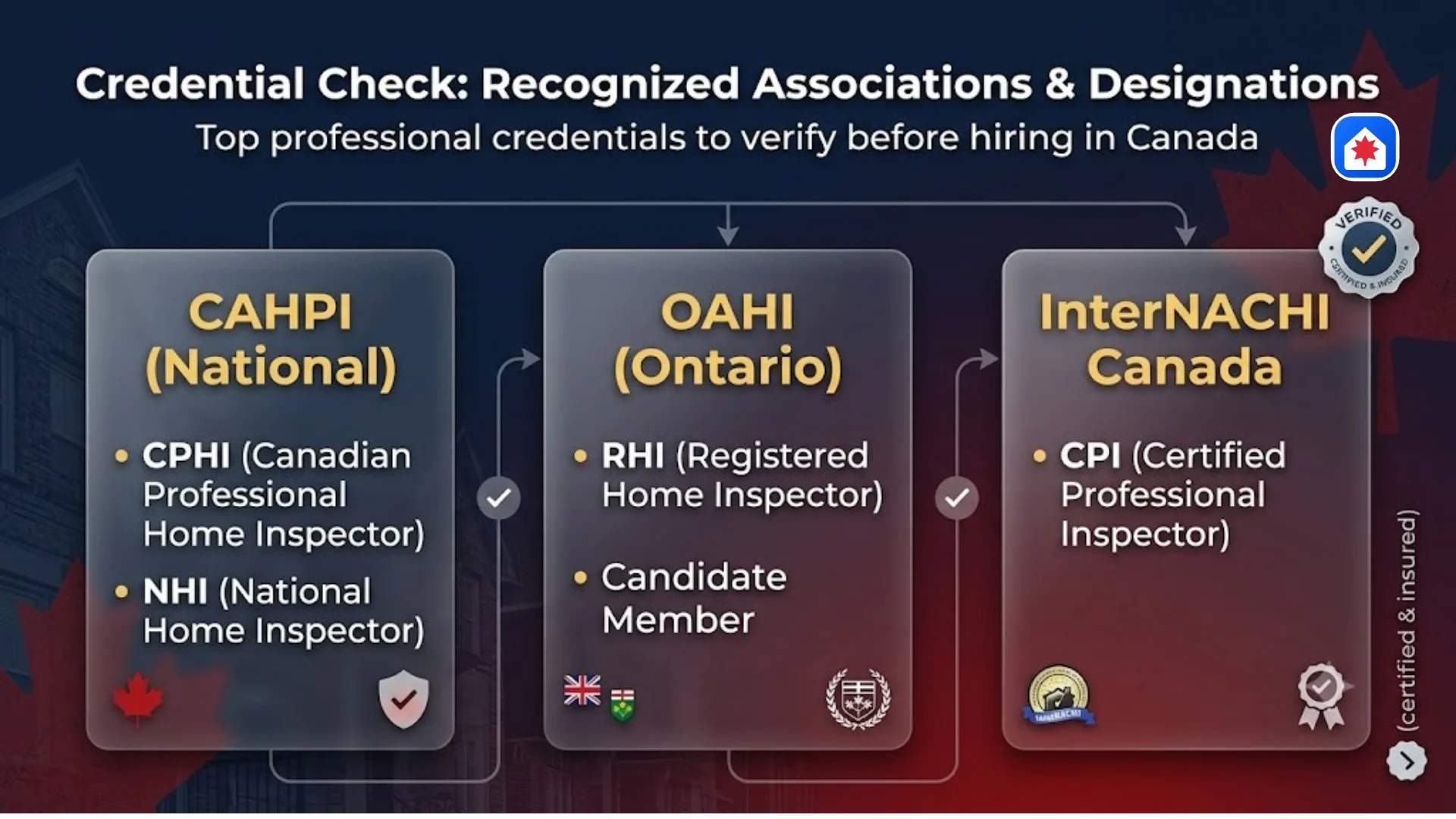
When reviewing credentials, search for inspectors affiliated with established Canadian and North American credentialing organisations.
Canadian Association of Home and Property Inspectors (CAHPI)
CAHPI is the national voice for the home inspection profession in Canada. An inspector carrying credentials through CAHPI typically holds the Canadian Professional Home Inspector (CPHI) or National Home Inspector (NHI) designation. These titles indicate that the practitioner has:
- Completed hundreds of hours of peer-reviewed academic instruction.
- Logged a verified minimum number of paid, completed field inspections.
- Undergone continuous background and quality audits.
- Committed to mandatory ongoing continuing education credits every year.
Ontario Association of Home Inspectors (OAHI)
Within Ontario, the Registered Home Inspector (RHI) designation represents the gold standard. RHI holders have fulfilled rigorous educational requirements, demonstrated field competency through peer-reviewed inspection assessments, and operate under a legislated code of professional conduct.
InterNACHI Canada
The International Association of Certified Home Inspectors (InterNACHI) operates an active Canadian division. InterNACHI requires candidates to pass regular comprehensive examinations, complete specific Canadian building code curricula, and conform to standardized inspection routines.
Step-by-Step Guide: How to Find and Choose a Certified Home Inspector Canada
Follow this systematic five-step methodology to source, vet, and contract the right professional for your transaction.
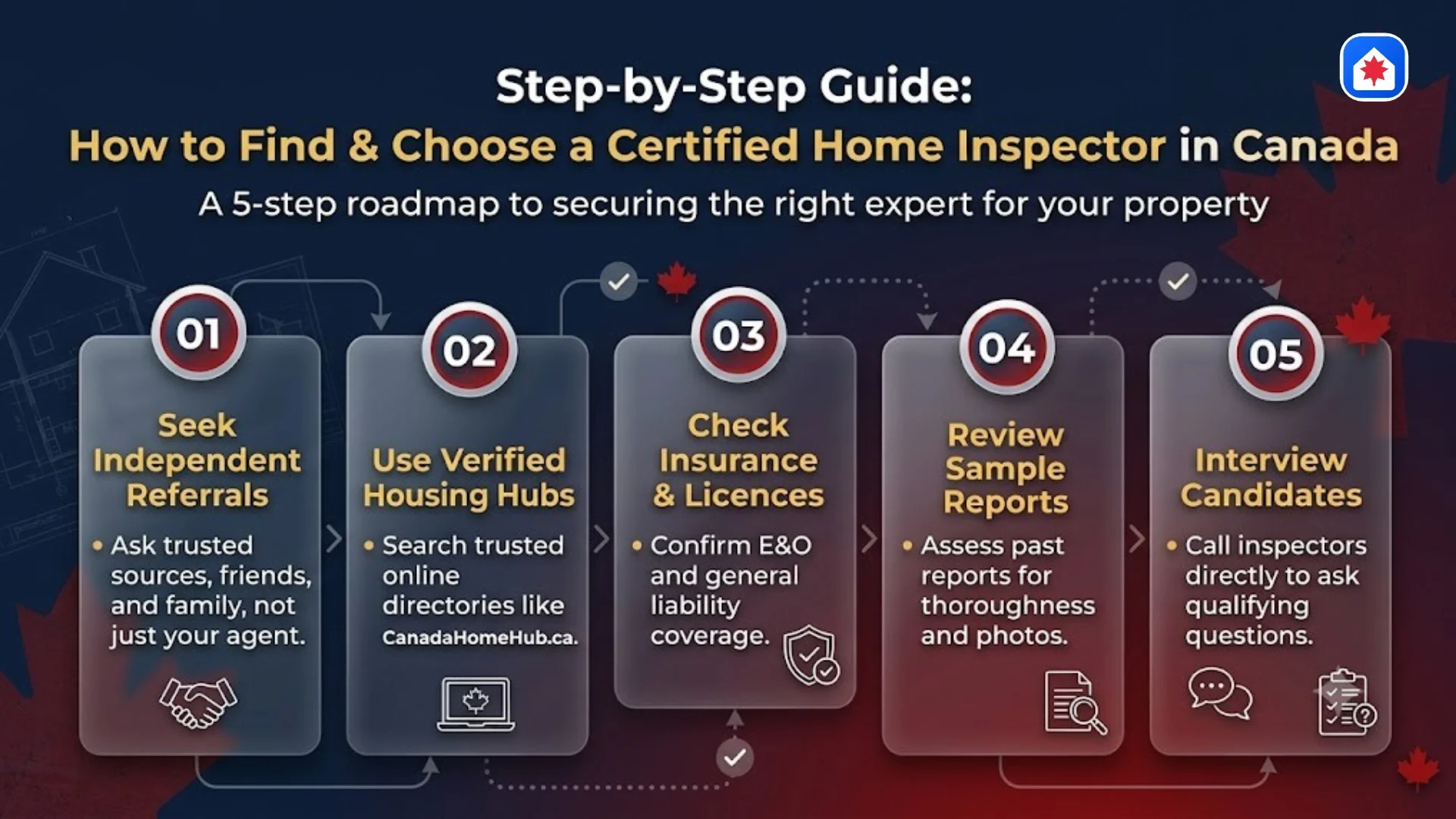
Step 1: Seek Independent Referrals (Beyond Just Your Real Estate Agent)
While real estate agents regularly provide a list of preferred inspectors, rely on independent sources as well. Some agents genuinely recommend thorough inspectors, but an inherent conflict of interest can exist: an overly thorough inspector who uncovers deal-breaking defects might prevent a sale from closing.
Ask friends, relatives, colleagues, and structural contractors for recommendations based on their own prior home purchases. When your realtor provides a list, treat those names as preliminary leads rather than default choices.
Step 2: Leverage Verified Canadian Housing Hubs and Directories
Rather than typing a generic query like home inspector near me into a basic search engine and clicking the first sponsored ad, use curated real estate portals and dedicated trade directories. Independent resources such as CanadaHomeHub.Ca provide educational guides and insights into local real estate landscapes across Canada, helping buyers locate specialized professionals suited to regional housing realities. Cross-reference candidates against the official member registries of CAHPI, OAHI, or Consumer Protection BC.
Step 3: Verify Valid E&O and General Liability Insurance
Never hire an inspector who does not maintain both:
- Errors and Omissions (E&O) Insurance: Protects you if the inspector fails to identify a critical visible defect that should have been noted according to standard inspection guidelines.
- Commercial General Liability Insurance: Covers accidental physical damage caused to the seller’s home during the inspection (e.g., an accidental attic ceiling break or plumbing leak during valve testing).
Request an insurance certificate showing current policy numbers and expiration dates. A true professional will supply this documentation without hesitation.
Step 4: Demand and Review a Sample Inspection Report
Before signing an agreement, request a copy of an actual anonymized report previously issued for a similar property. Assess the document critically:
- Avoid Checkbox-Only Sheets: Outdated two-page carbon-copy checklists provide almost no actionable context.
- Look for Detailed Narrative Explanations: The report should clearly outline what the problem is, why it matters, and what action is recommended (e.g., immediate repair by a licensed master electrician).
- High-Resolution Photography: Clear images with annotations (arrows, highlights) demonstrating exact defect locations are indispensable when negotiating repair credits.
Step 5: Interview Candidates Directly
Call at least two or three independent home inspection companies in Canada before booking an inspection. Speak directly with the individual inspector who will be on-site, not just a dispatch agent. Gauge their willingness to answer questions, their communication style, and their depth of regional building knowledge.
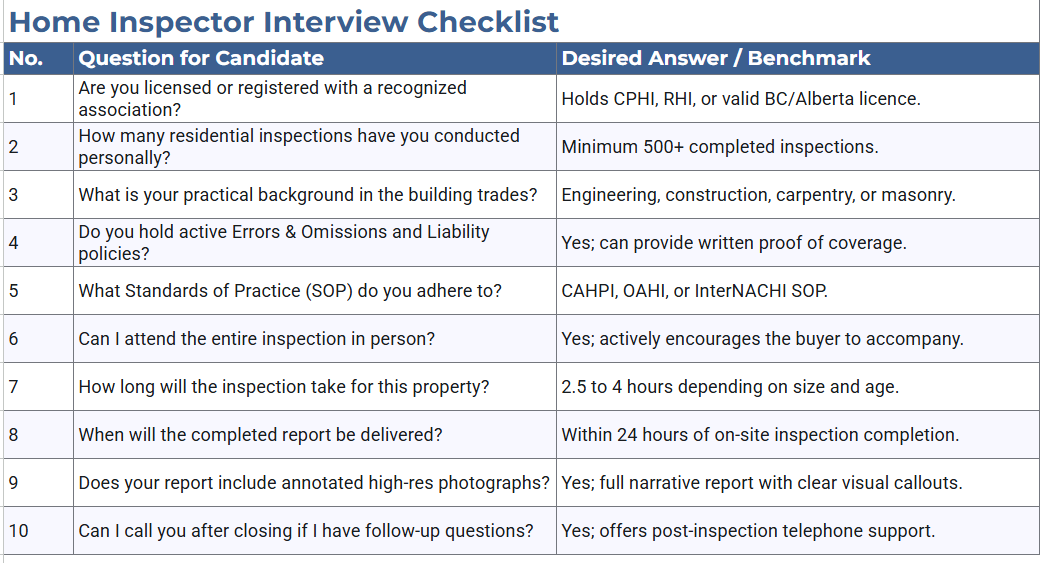
10 Critical Questions to Ask Before Hiring a Home Inspector
Take this checklist into your initial phone consultations. An experienced, client-focused inspector should answer these questions with confidence:
Home Inspection Cost in Canada: Pricing Breakdown and Variables
The baseline home inspection cost in Canada generally ranges between $400 and $800+ CAD for an average-sized single-family detached home. However, pricing depends on several specific variables: property square footage, structural age, overall complexity, and geographical location.
Average Costs by Property Type
Below is an estimated breakdown of average costs for standard residential inspections across Canadian urban centres:
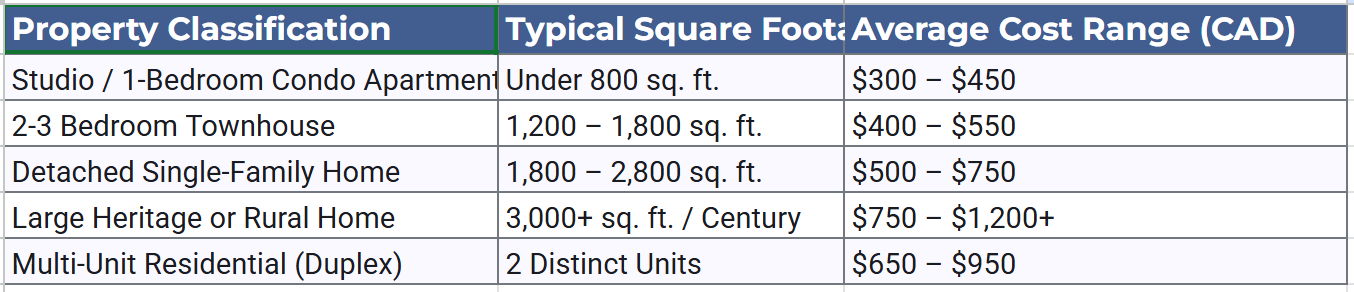
Note: In remote communities, northern regions, or high-cost-of-living metropolitan centres (such as Vancouver and the Greater Toronto Area), prices often skew toward the higher end of these brackets due to travel overhead and commercial operational costs.
Specialized Ancillary Inspections (Add-on Services)
Standard visual inspections do not assess buried, hidden, or environmental hazards. Most established inspection companies offer supplementary diagnostic services for an additional fee:
- Radon Testing ($200 – $400 CAD): Highly recommended in areas prone to elevated soil-gas infiltration, such as parts of the Prairies, the interior of British Columbia, and rural Ontario.
- Sewer Lateral Video Scope ($250 – $450 CAD): An absolute essential for older Canadian properties with mature tree-lined streets, where clay or cast-iron pipes may be cracked, misaligned, or collapsed by tree roots.
- Thermal Imaging / Infrared Scans ($150 – $300 CAD): Identifies hidden moisture pockets behind drywall, cold air bridges, and missing attic insulation without invasive wall demolition.
- Well Water Quality & Septic Evaluation ($300 – $600 CAD): Mandatory for rural acreages and non-serviced recreational properties.
What a Standard Canadian Home Inspection Covers (and What It Doesn’t)
To avoid disputes and mismanaged expectations, buyers must distinguish between the standard scope of visual home inspections and specialist diagnostics.
Included in the Scope of Work
A standard home inspection assesses visually accessible systems under the industry-standard Standards of Practice:
- Roofing & Exterior: Shingles, flashing, gutters, downspouts, exterior cladding, windows, doors, decks, balconies, surface drainage, and property grading.
- Foundation & Structure: Basements, crawlspaces, visible concrete or block foundation walls, floor joists, bearing walls, and roof trusses.
- HVAC Systems: Heating equipment (furnaces, boilers, heat pumps), cooling systems (air conditioning), distribution ductwork, and exhaust systems.
- Plumbing System: Supply lines, drain, waste, and vent lines, water heaters, plumbing fixtures, static pressure, and functional drainage.
- Electrical Systems: Main service panel, service amperage, grounding, presence of subpanels, circuit breakers, GFCI/AFCI receptacles, and visible branch wiring.
- Attic & Insulation: Insulation depths, proper vapour barriers, roof deck ventilation, and signs of past attic moisture or mold growth.
Excluded from Standard Visual Inspections
Inspectors do not perform invasive or destructive testing. Standard contracts exclude:
- Conditions hidden inside wall cavities or beneath subflooring.
- Buried systems (in-ground oil tanks, municipal sewer lines, private septic tanks).
- Swimming pools, hot tubs, and landscape irrigation systems.
- Code compliance certifications (an inspection report is an assessment of condition, not a municipal building-code pass/fail permit).
- Aesthetic flaws and cosmetic finishes.
Red Flags: Warning Signs of an Unreliable Inspector
Keep an eye out for these operational red flags during your search. If you encounter any of them, continue your search:
- Discouraging You From Attending: An inspector who insists you wait in your car or read the report later may be rushing their walk-through or avoiding technical explanations.
- Refusing to Disclose Insurance Details: Lack of proof for E&O or general liability insurance leaves you completely exposed to liability for accidental on-site property damage.
- Offering Repair Services on Inspected Homes: This is a flagrant conflict of interest. Ethical codes strictly forbid inspectors from offering paid contractor repair services on any home they inspect within a 12-month window.
- Significantly Undercutting Competitor Rates: If regional market rates average $550 CAD and an operator offers to do it for $199 CAD, they are likely skipping crawlspaces, spending under an hour on-site, or relying on high-volume, superficial sweeps.
- Making "Pass/Fail" Declarations: Homes do not "pass" or "fail" a standard Canadian home inspection. The inspector’s job is to objectively document observed conditions and maintenance requirements, not to issue arbitrary grades.
Frequently Asked Questions About Home Inspections in Canada
Can a home fail an inspection in Canada?
No. A home inspection is an informational assessment of condition, not a pass-or-fail municipal exam. The resulting documentation informs you of existing deficiencies and required capital expenditures; deciding whether those issues are acceptable or negotiable rests solely with you and your legal counsel.
Should I attend the home inspection in person?
Yes, absolutely. Walking through the property with your inspector during the final hour (or throughout the entire process, if agreed upon) is one of the most educational experiences a Canadian homeowner can have. You will learn the locations of emergency shutoff valves, understand seasonal maintenance cycles, and see minor versus major defects firsthand.
How long does a standard Canadian home inspection take?
For a typical detached residential property between 1,500 and 2,500 square feet, a thorough physical inspection takes approximately 2.5 to 3.5 hours. Century homes, rural acreages, or properties with multiple outbuildings and complex additions can take 4 to 5 hours or more.
Can my real estate agent choose my home inspector for me?
While realtors frequently offer a list of suggestions, the final choice and contractual engagement should always belong to you. You are the client, the inspector works directly for you, and your financial protection is the top priority.
What happens if an inspector misses a major defect?
If a major visual defect that fell within the established Standards of Practice was missed, review your pre-inspection agreement. Reputable inspectors carry Errors & Omissions insurance to handle valid claims. Keep in mind that inspectors are not liable for concealed conditions that were inaccessible or hidden behind finished drywall or beneath heavy furniture at the time of the inspection.
Is a pre-listing inspection worth it for sellers?
Yes. Performing a pre-listing inspection allows home sellers to uncover hidden defects before listing their property. This lets you make repairs at competitive rates ahead of time or price the property accurately, preventing renegotiations or transaction cancellations during the buyer’s condition period.
Final Thoughts: Making an Informed Investment
Buying property in Canada requires diligence, objective analysis, and the right team of professionals in your corner. Sourcing a dedicated, certified home inspector in Canada provides the objective clarity you need to proceed with your transaction confidently or renegotiate terms from a position of strength.
Take the time to verify association credentials, insist on proof of insurance, review sample reports, and speak with inspectors directly before committing. By pairing careful on-the-ground vetting with the wide range of tools and informational resources available on platforms like CanadaHomeHub.Ca, you can protect your financial future and invest in your next Canadian property with peace of mind.