
Relocating to a new home represents an exciting milestone, but navigating the logistics of a move across Canadian neighbourhoods, cities, or provinces can be daunting. Canada presents distinct moving challenges: expansive geographical distances, unpredictable winter weather, unique provincial regulatory environments, and a moving industry that varies significantly in operational quality.
Hiring a professional moving company in Canada can transform what is often rated among life's most stressful events into a coordinated, predictable experience. However, choosing the wrong operator can lead to damaged heirlooms, unforeseen surcharges, or outright extortion through deceptive moving scams.
Whether you are hiring local movers for a short transfer across Toronto, Calgary, or Vancouver, or contracting long distance movers in Canada to transport your household across provincial borders, doing proper due diligence is essential. This guide provides a detailed roadmap on how to choose a reputable mover, decipher estimates, understand transit liability, avoid predatory operators, and safeguard your consumer rights under Canadian law.
Why Choosing the Right Moving Company Matters in Canada
Moving in Canada is fundamentally different from moving in smaller, densely populated nations. Distance alone magnifies risk: a long-distance transit from British Columbia to Ontario spans over 4,000 kilometres across mountain passes, prairies, and variable climatic zones. During winter and transitional shoulder seasons, freezing temperatures, blizzards, and road closures can compromise schedules and demand specialized logistics, including temperature-controlled freight or winterized handling protocols.
Furthermore, moving is an industry where consumer complaints remain disproportionately high. According to the Better Business Bureau (BBB) and provincial consumer affairs agencies, household goods moving consistently generates grievances regarding damaged furniture, late deliveries, unexpected fee hikes, and unauthorized delays. Because you are entrusting your most valuable personal possessions to strangers, vetting candidates against rigorous performance and legal criteria is a non-negotiable safeguard.
Types of Moving Services Across Canada: Local vs. Long-Distance
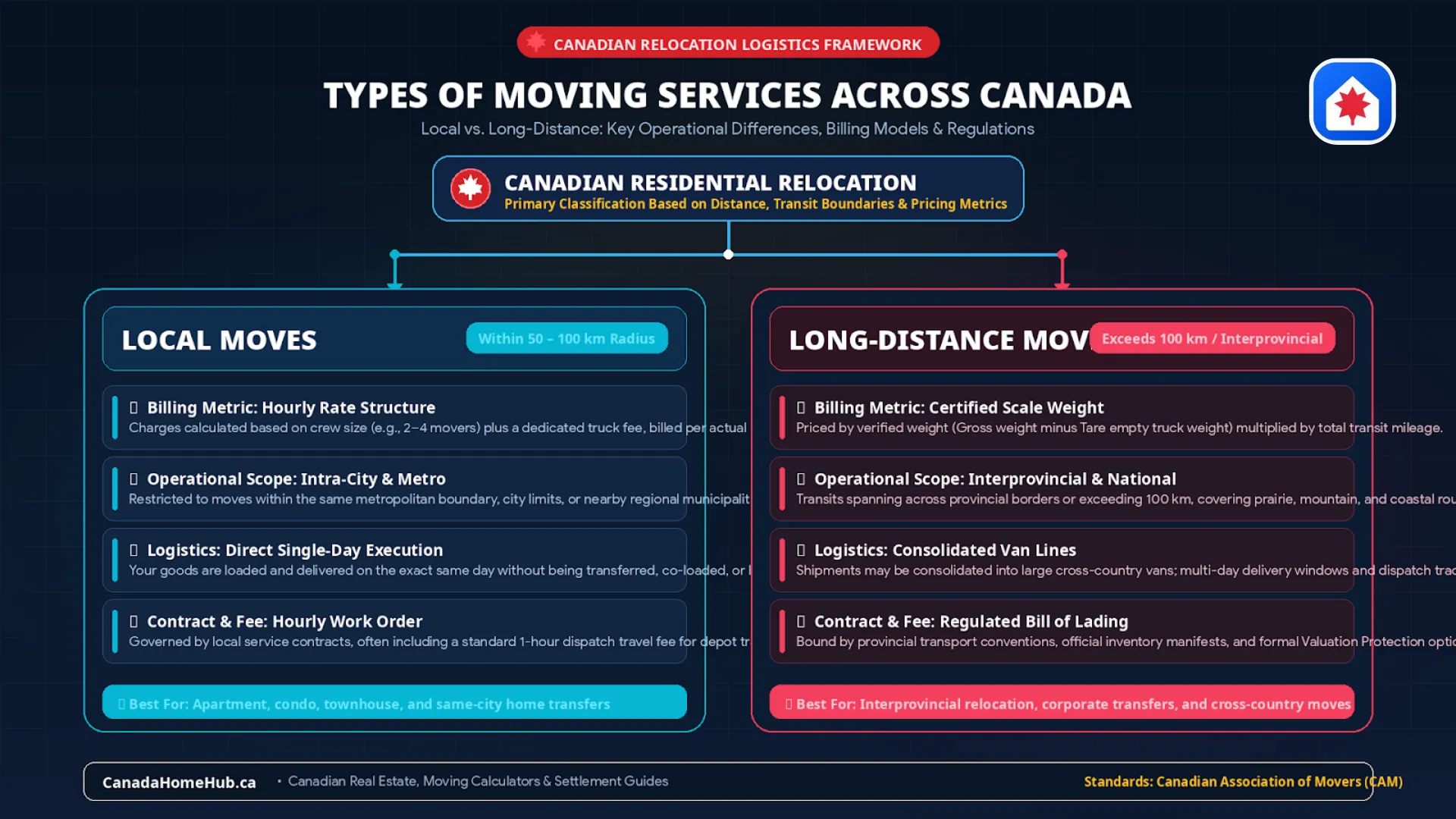
Before collecting quotes, clarify the operational scope of your move. In Canada, moving companies categorize relocations primarily by distance and provincial boundaries, which directly alters how pricing is computed.
Local Moving Services (Hourly Rates and City Logistics)
A local move generally involves an origin and destination within a 50-to-100-kilometre radius inside the same metropolitan area or municipal region.
- Billing structure: Local operators predominantly charge an hourly rate based on the number of movers assigned (e.g., a two-person, three-person, or four-person crew) plus a standard truck fee.
- Travel fees: Many local movers charge a "travel time" or "dispatch fee" (typically equivalent to one additional hour of labour) to cover the driving time from their dispatch depot to your initial home, and from your destination back to their yard.
Long-Distance Movers Canada (Weight-Based Pricing and Interprovincial Transit)
When your move extends beyond 100 kilometres or crosses provincial borders, it qualifies as an intercity or interprovincial relocation.
- Billing structure: Reputable long distance movers in Canada calculate prices based on two primary metrics: the total certified scale weight of your shipment (expressed in pounds or kilograms) and the travel distance between postal codes.
- Weighing procedure: Professional carriers weigh the transport truck empty (known as the tare weight) on an approved government-certified scale before arrival. After loading your goods, the truck is weighed again (the gross weight). The difference represents your shipment's net weight. As a shipper under Canadian transport conventions, you maintain the legal right to witness both scale weigh-ins and request a re-weigh if you suspect discrepancies.
Specialized Services: Packing, Storage, and Vehicle Transport
Depending on your circumstances, you may require additional services:
- Full-service packing: Professional crews bring industry-standard double-walled boxes, bubble cushioning, and packing paper to wrap your entire residence. While this increases labour expenses, items professionally packed by the carrier qualify for full transit valuation coverage, whereas owner-packed cartons frequently carry liability waivers.
- Storage-in-Transit (SIT): If your closing dates do not align, your carrier holds your household goods in a secure, climate-controlled warehouse facility.
- Vehicle and specialty transport: Transporting personal vehicles, upright or grand pianos, pool tables, or high-value artwork requires custom crating and hydraulic-lift trailers.
Understanding Moving Costs in Canada (What to Expect in 2026)
Moving expenses vary across provinces due to differing regional fuel costs, local labour markets, and urban parking complexities. Budgeting accurately requires understanding typical baseline ranges.
Key Factors That Dictate Your Moving Bill
-
Shipment volume and weight: The total physical weight (for long distance) or total loading/unloading hours (for local) forms the foundation of your invoice.
- Crew size: While a three-person crew carries a higher hourly rate than a two-person team, they often load large homes significantly faster, reducing total billable hours.
- Calendar timing: Rates surge during peak season (May through September), at month-ends, and on statutory holidays due to intense demand across Canadian rental turnover cycles.
- Physical accessibility: Long walking pathways from the truck to your front entrance ("long carry"), lack of an elevator, narrow staircases, or restricted downtown parking in dense urban cores (such as Vancouver or downtown Toronto) incur documented access surcharges.
Typical Price Ranges for Local vs. Long-Distance Moves
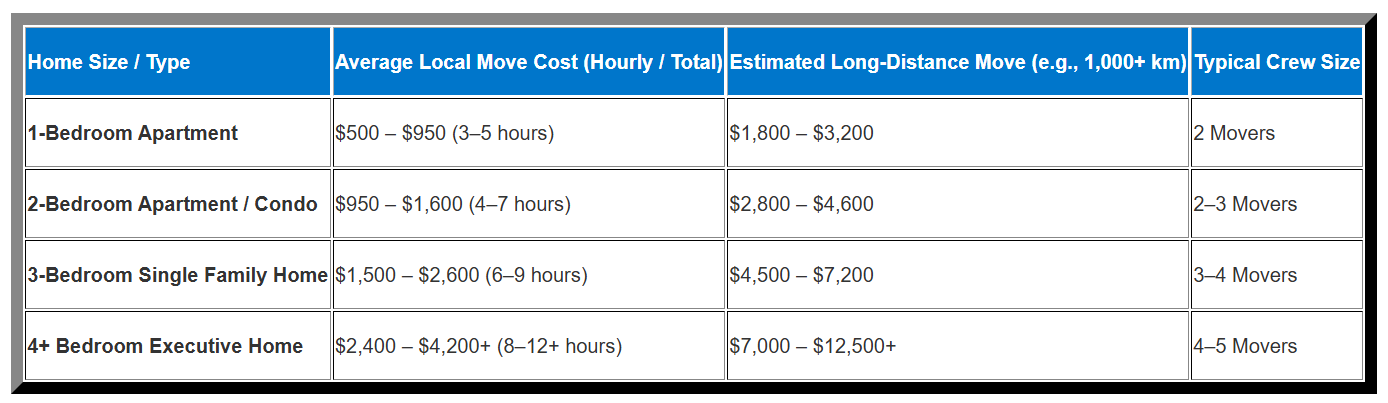
Note: Figures reflect typical market averages across Canadian provinces in Canadian Dollars (CAD). Actual quotes depend heavily on distance, exact weight scale tickets, access logistics, and seasonal demand. When planning a complete home purchase or relocation, evaluating your full transaction requirements—such as closing costs, title transfers, and moving budgets—with transparent tools on CanadaHomeHub.Ca helps prevent unexpected financial shortfalls.
Step-by-Step Guide: How to Vet and Choose a Moving Company in Canada
Selecting among moving companies in Canada requires an organized, objective vetting sequence. Never hire the first contractor appearing in paid search ads without completing these five validation steps.

Step 1: Research and Verify Credentials (CAM, BBB, and Licensing)
Unlike real estate brokerages or mortgage lenders, household goods moving companies are not federally licensed under a single national regulatory body in Canada. This regulatory gap makes industry association accreditation your first line of defense.
- The Canadian Association of Movers (CAM): CAM is Canada's recognized non-profit national trade association representing professional moving and storage businesses. Companies certified by CAM must commit to an established ethical code of conduct, maintain validated commercial premises, carry valid insurance, and maintain clean consumer resolution records. Checking the CAM member directory at mover.net confirms whether a prospective carrier is a verified Certified Canadian Mover.
- Better Business Bureau (BBB): Review the mover's rating across regional Canadian BBB bureaus (e.g., BBB Serving Central Ontario, BBB Mainland B.C.). Examine not only their letter grade (aim for A or A+) but specifically the nature of resolved and unresolved consumer complaints over the preceding 36 months.
- Provincial Consumer Protection Registries: In Ontario, search the Ministry of Public and Business Service Delivery's Consumer Beware List. In Alberta, check Service Alberta's database for active enforcement actions or licensing compliance for businesses operating under provincial Fair Trading legislation.
Step 2: Demand a Written In-Home or Virtual Visual Survey
Never accept a quote provided solely through a quick telephone conversation or brief text exchange. Unscrupulous movers frequently quote artificially low prices over the phone to secure an initial deposit, only to double the charge once your belongings are loaded onto their vehicle.
- A reliable estimator must inspect every room, basement, attic, garage, and closet to evaluate total cubic volume, physical weight, delicate items, and walking pathways.
- If an in-person visit is impractical due to geographical distance, reputable movers conduct a detailed virtual survey via video call.
Step 3: Compare Estimates (Binding vs. Non-Binding vs. Guaranteed Not-to-Exceed)
When you evaluate quotes from at least three competing companies, ensure you are comparing identical contractual structures:
- Non-Binding Estimate: A non-binding quote is an approximation based on the mover's projection of time or weight. The final invoice reflects actual hours worked or verified scale weight. While flexibility exists, it provides the least financial certainty.
- Binding Estimate: A binding quote guarantees you will pay precisely the agreed amount, provided your inventory list and physical conditions do not change between the estimate date and moving day.
- Guaranteed Not-to-Exceed Estimate: The most consumer-friendly contract option. If your shipment weighs less than projected, you pay the lower actual cost; if it weighs more, your invoice is capped at the agreed ceiling.
Step 4: Verify Workplace Safety and Commercial Liability
If an employee of an uninsured moving company sustains an injury on your premises (such as slipping on icy front steps or suffering a severe back injury while lifting a heavy appliance), you could be exposed to direct personal liability lawsuits.
- Demand proof of active provincial workplace safety coverage: WSIB (Workplace Safety and Insurance Board) in Ontario, WorkSafeBC in British Columbia, or WCB in Alberta.
- Request a Certificate of Commercial General Liability Insurance (minimum $2,000,000 policy limit) and verify motor vehicle cargo insurance.
Step 5: Master the Bill of Lading and Contract Terms
The Bill of Lading serves as the definitive legal contract governing the carriage of your goods under Canadian provincial commercial regulations.
- Under provincial transport regulations, the driver must provide a signed, dated copy of the Bill of Lading before loading begins.
- The document must explicitly stipulate the carrier's registered legal corporate name, complete physical address, vehicle identifiers, explicit pickup and delivery dates, payment method provisions, valuation selection, and an itemized manifest of charges.
Moving Valuation vs. Insurance: How Are Your Belongings Protected?
One of the most persistent misunderstandings among Canadian consumers centers on moving coverage. Carriers are not licensed insurance underwriters; rather, they provide contractual levels of liability, referred to in the industry as valuation.
Released Value Protection ($0.60 per Pound Standard Liability)
By standard commercial transportation law across Canada, basic liability included in your baseline moving rate is limited to $0.60 CAD per pound per article.
- The practical implication: If your brand-new 65-inch flat-screen OLED television weighs 50 pounds and is dropped and completely destroyed during transit, the carrier's maximum legal obligation under basic released valuation is exactly $30.00 CAD ($0.60 × 50 lbs), regardless of whether you paid $2,500 at retail.
- Never rely on released value protection for valuable, fragile, or essential household furnishings.
Full Replacement Value Protection (FRVP)
If you opt for Full Replacement Value Protection, the mover assumes contractual liability for the true replacement cost of damaged, destroyed, or lost goods.
- Under FRVP, if an item is damaged while under the mover's custody, the company must either repair the item to its prior condition, replace it with an article of like kind and quality, or issue a cash settlement reflecting current market replacement value.
- Note that deductibles often apply, and you must declare any items of extraordinary value (articles valued at over $100 per pound, such as fine jewelry, silverware, or designer art) on a separate "High-Value Inventory Declaration."
Third-Party Transit Coverage and Your Homeowners Policy
Review your existing homeowners or tenant insurance policy prior to moving day. Certain comprehensive Canadian home insurance policies extend coverage to personal property while in transit between residences, though deductibles and exclusions (such as mechanical derangement of electronics or damage to self-packed boxes) commonly apply. Clarify coverage limits with your insurance broker well in advance of moving day.

Major Red Flags: How to Avoid Moving Scams in Canada
The Canadian moving sector includes disreputable, fly-by-night operations commonly known as "rogue movers". Protect your household by watching for these critical warning indicators:
- Blind, Over-the-Phone Lowball Quotes: An operator offers a price that is 40% to 50% cheaper than established competitors without viewing your goods or assessing building layout.
- Excessive Cash Deposits Upfront: Reputable Canadian movers rarely demand cash-only transactions or deposits exceeding 10% to 15% of the total estimate. Demands for large cash payments or wire transfers before loading signal extreme risk.
- No Verifiable Physical Address: Their website lists only a cell phone number or a generic postal box (P.O. Box), with no verifiable physical commercial depot, warehouse, or corporate office.
- Unmarked Rental Equipment: The movers arrive in a plain, unmarked rental truck with no corporate branding, safety fitness certificates, or uniforms.
- The "Hostage Goods" Scenario: This classic extortion tactic occurs when movers load your goods, transport them to the destination, and refuse to open the truck doors until you pay hundreds or thousands of dollars above the signed contract price in untraceable cash.
Canadian Consumer Protection Laws (The 10% Estimate Rule)
Canadian consumers hold specific statutory rights under provincial legislation:
- Ontario Consumer Protection Act: In Ontario, moving contracts valued over $50 must be in writing. Crucially, by law, a moving company cannot charge more than 10% above the written estimate, unless you explicitly request additional services, inventory additions, or specialized packing supplies and agree in writing to the amendment.
- Holding Goods Hostage Is Unlawful: Movers cannot lawfully withhold your possessions to extort disputed sums exceeding the 10% buffer. If you encounter a rogue mover holding your goods hostage, document the interaction, clearly state you are paying disputed balances "under protest" on the invoice to regain possession, and immediately notify local police and provincial consumer protection officials.
Essential Questions to Ask Before Signing Any Moving Contract
Before issuing any deposit or signing a service agreement, ask each prospective company these practical screening questions:
- Are you a registered member in good standing with the Canadian Association of Movers (CAM)?
- What is your legal corporate business name, and what is your Commercial Vehicle Operator registration or provincial carrier number?
- Is this estimate binding, non-binding, or guaranteed not-to-exceed?
- Are all potential supplementary fees (stairs, elevators, long carries, heavy item handling, fuel surcharges) explicitly itemized in writing?
- Are the crew members direct, payroll-screened employees covered by provincial workers' compensation (e.g., WSIB), or are you brokering the job to third-party subcontractors?
- What specific valuation options do you offer, and what is the exact claim filing deadline if damages occur? (Standard industry timelines require reporting within 30 days for local moves and 60 days for interprovincial moves).
- What specific payment methods are accepted on moving day, and when is the balance due?
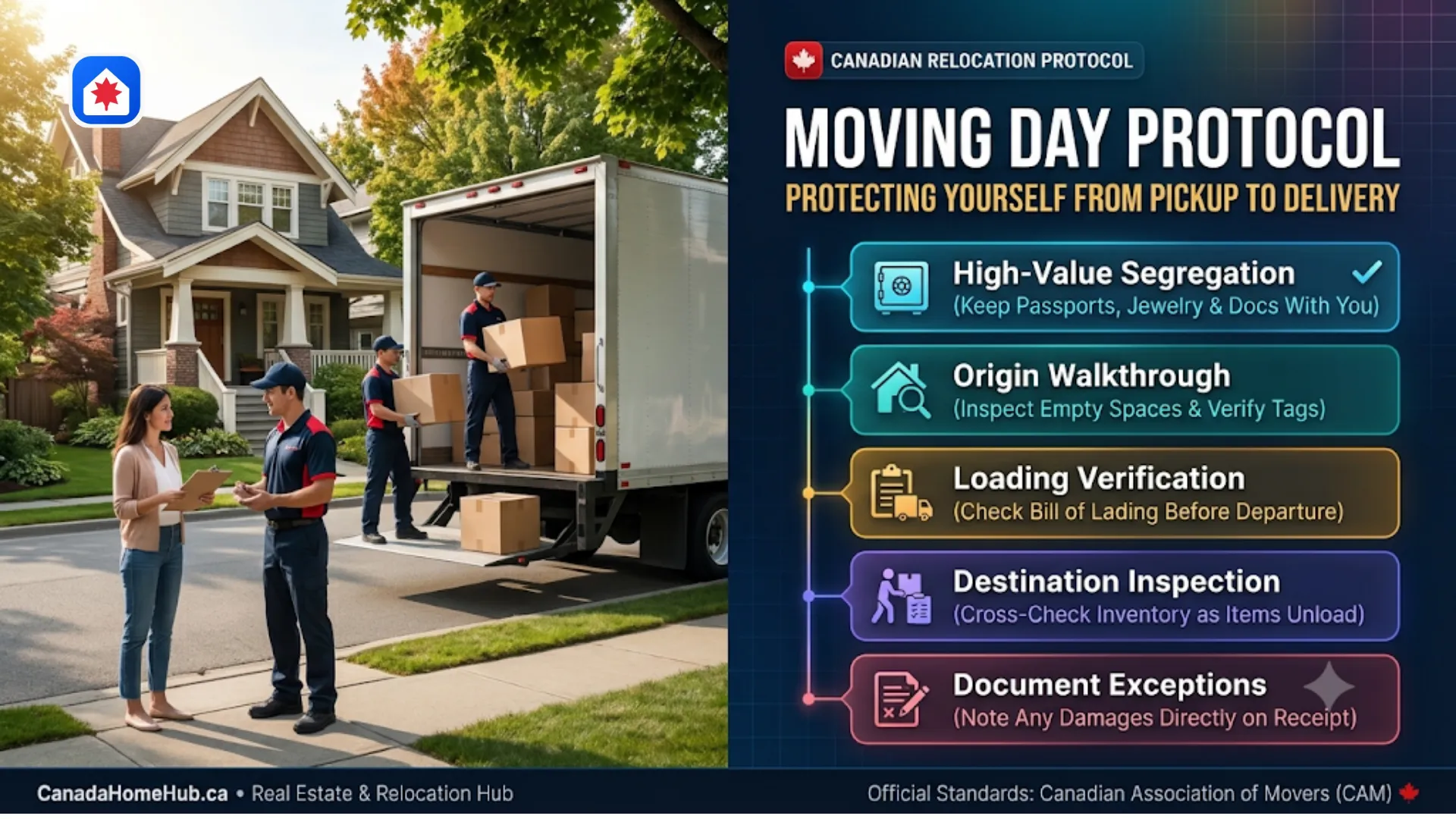
Moving Day Protocol: Protecting Yourself from Pickup to Delivery
Proper administrative supervision on moving day ensures legal recourse remains intact should discrepancies arise:
- Keep Critical Personal Items With You: Never load passports, legal documents, birth certificates, jewelry, primary medications, or essential work laptops onto the moving van. Transport these personally in your own vehicle.
- Perform an Initial Condition Walkthrough: Accompany the driver as they compile the Household Goods Descriptive Inventory. Check the condition codes they write down; if the mover notes pre-existing scratches on pristine furniture, correct the entry on the sheet before signing.
- Cross-Check Delivery at Destination: As the crew unloads items at your new residence, check off each numbered tag against your copy of the inventory manifest.
- Document Damages Immediately on the Delivery Receipt: Never sign a clean, blank delivery receipt if boxes are crushed or furniture is scuffed. Write down all damaged, dented, or missing items directly onto the driver’s copy and your copy of the Bill of Lading before the driver departs. Take timestamped, high-resolution photographs of all affected goods immediately.
Frequently Asked Questions About Moving in Canada
How far in advance should I book a moving company in Canada?
For peak season relocations occurring between May and September, or moves scheduled during month-end changeovers, book your moving company at least 6 to 8 weeks in advance. For mid-month off-peak moves (October through April), a 3 to 4-week window is generally sufficient, though specialty long-distance carriers fill schedules rapidly year-round.
Is a moving company legally allowed to charge more than the original estimate in Canada?
Under provincial consumer protection legislation (such as the Ontario Consumer Protection Act), a moving company cannot charge more than 10% above the written estimate, unless you explicitly agreed to additional goods, packing supplies, or unexpected services in writing. If an operator attempts to bill beyond that 10% threshold without your authorization, they are in violation of provincial consumer statutes.
What is the Canadian Association of Movers (CAM), and why does certification matter?
The Canadian Association of Movers (CAM) is Canada's sole national trade association representing professional moving and storage operators. CAM validates that member companies hold verified business premises, maintain active workers' compensation and commercial liability coverage, adhere to an ethical code of practice, and deliver honest commercial estimates. Hiring a CAM-certified mover substantially reduces exposure to rogue operators.
Does standard home insurance cover items while they are in transit?
Some Canadian comprehensive homeowners and tenant insurance policies provide limited transit coverage, but many explicitly exclude breakages of fragile items packed by owners or damage caused by normal transit vibration. Standard carrier liability only pays $0.60 per pound. You should consult your insurance broker and consider purchasing Full Replacement Value Protection directly through your certified mover.
What should I do if a mover damages my belongings or refuses to deliver my shipment?
If belongings arrive damaged, note the specifics directly on the delivery receipt/Bill of Lading and file a formal written claim with the mover within the contractual deadline (usually within 30 days for local and 60 days for interprovincial moves). If a mover holds your items hostage for extra fees, notify local law enforcement, contact your provincial consumer affairs ministry, and reach out to the Canadian Association of Movers if the mover is a certified member.
What is the cheapest month or day to move in Canada?
The most cost-effective time to move in Canada is during mid-month periods between November and March, avoiding major winter holidays. Weekdays (Tuesday through Thursday) are typically cheaper than weekends. Moving between May and August, or on the final two days of any calendar month, commands premium rates due to peak lease rollovers and peak real estate closings.
Can I write off moving expenses on my Canadian taxes?
Under Canada Revenue Agency (CRA) guidelines, you can deduct eligible moving expenses from employment or self-employment income if you relocated to start a new job, operate a business, or attend full-time post-secondary education. A mandatory criterion is that your new home must be at least 40 kilometres closer to your new work or study location than your previous residence. Retain all moving contracts, official weight tickets, and itemized receipts for tax filing purposes.
Conclusion: Making an Empowered, Stress-Free Move
Choosing the best moving company in Canada boils down to proactive research, contractual transparency, and careful verification. By insisting on in-person or virtual visual estimates, verifying active accreditation with the Canadian Association of Movers, demanding binding written contracts, and securing adequate replacement valuation, you protect both your finances and your cherished possessions.
As you prepare for your transition, remember that moving is just one component of settling into your new residence. To budget your broader property journey—from estimating closing costs and mortgage stress tests to accessing newcomer settlement checklists and professional directories—explore the comprehensive tools and community resources available on CanadaHomeHub.Ca. With the right preparation, your relocation can be a smooth, secure step toward your new Canadian home.