Explore the true cost of living in Montreal. From historic walk-ups along tree-lined avenues to world-renowned food and festivals, Quebec’s largest metropolis offers a distinct European quality of life in North America. Historically celebrated as Canada’s most affordable urban centre, Montreal’s real estate landscape and everyday expenses have undergone noticeable shifts over recent years.
Whether you are moving from high-cost markets like Toronto or Vancouver, immigrating as an international professional, or reassessing your personal budget, this guide provides an authentic, data-backed breakdown of the cost of living in Montreal. Below, you will find real-world rental costs by borough, vital legal protections under the Tribunal administratif du logement (TAL), grocery and utility metrics, and the salary required to thrive comfortably.
Montreal Cost of Living Overview: The 2026 Reality
Montreal remains considerably more accessible than Vancouver or Toronto, where median one-bedroom rents routinely exceed $2,400 to $2,700 CAD. However, local cost patterns have evolved. General inflation, sustained rental demand, and rising operational costs mean budget calculations require precision rather than outdated assumptions.
The primary structural advantages keeping Montreal affordable include:
- Stable Domestic Energy: Quebec’s public utility, Hydro-Québec, provides clean hydroelectric energy at rates among the lowest in North America.
- Dense Public Transit Infrastructure: An underground metro network and extensive bike corridors allow residents across central boroughs to live comfortably car-free.
- Social Infrastructure: Programs such as Quebec’s network of subsidized early-childhood centres (Centres de la petite enfance or CPE) significantly reduce overhead for young families.
Quick Snapshot: Realistic Monthly Living Costs (CAD)
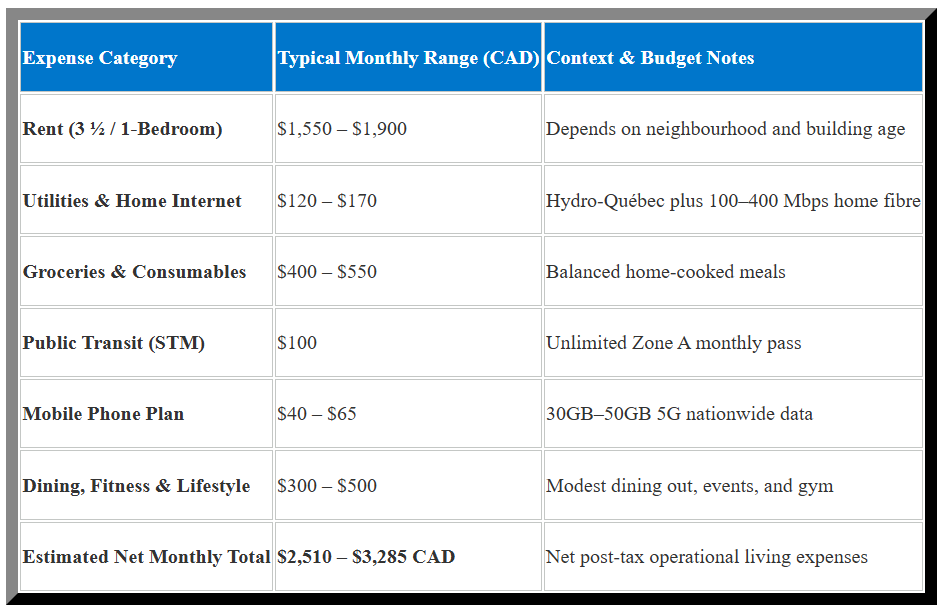
For a single working adult leasing an independent one-bedroom apartment (3 ½), baseline monthly expenditures generally fall into the following brackets:
Housing and Rent in Montreal: Rules, Boroughs, and Costs
Housing represents the single largest expenditure line in any Montreal budget. Successfully navigating the local market requires familiarity with Quebec’s unique apartment classification system and local rental tenancy legislation.
Decoding Quebec Apartment Sizing (1 ½ to 5 ½ Explained)
Rental listings in Montreal do not typically use terms like "studio" or "two-bedroom." Instead, apartments are categorized by total room count, with the bathroom designated as the "half" (.5):
- 1 ½: A compact bachelor/studio consisting of one main living/sleeping/kitchen space and a bathroom.
- 2 ½: An apartment with a distinct alcove or partitioned kitchen room separate from the primary living space, plus a bathroom.
- 3 ½: A standard one-bedroom apartment, including a separate closed bedroom, living room, kitchen, and bathroom.
- 4 ½: A standard two-bedroom apartment, with two separate bedrooms, living area, kitchen, and bathroom.
- 5 ½: A three-bedroom apartment, commonly sought by families or shared roommate households.
Average Rental Costs Across Key Montreal Boroughs
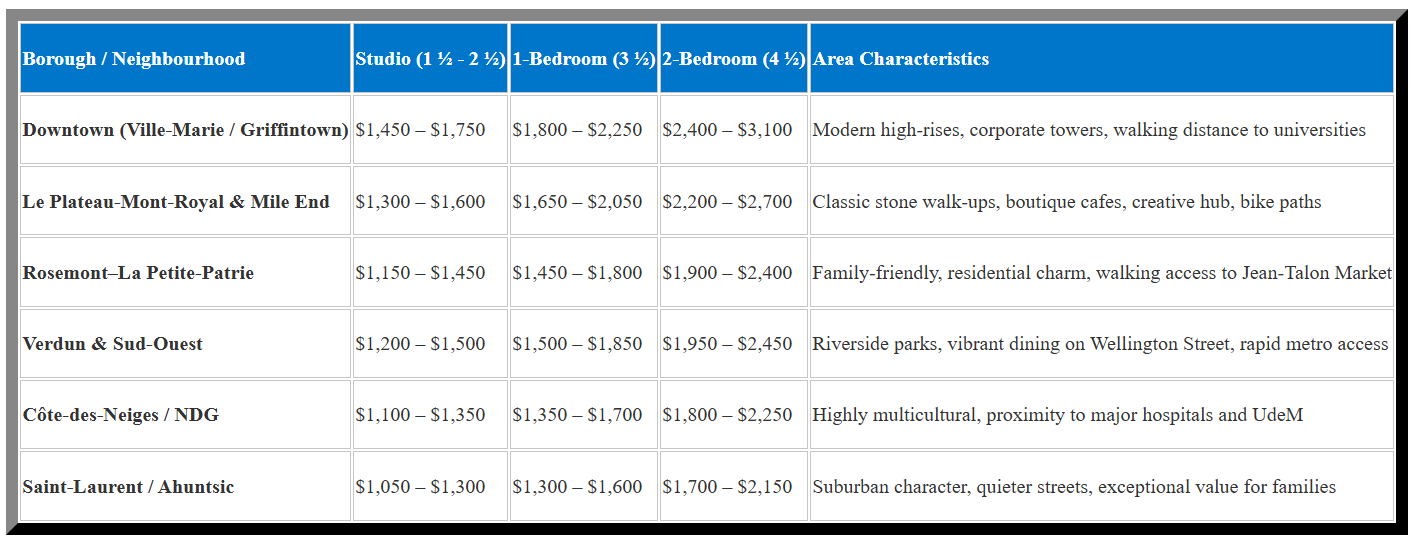
Location relative to the Green and Orange metro lines heavily dictates rental premiums. The following table illustrates realistic monthly rental expectations:
 For renters evaluating long-term financial milestones or planning to step from leasing into property acquisition, platforms like CanadaHomeHub.Ca provide valuable context on mortgage considerations, emerging property trends, and neighbourhood price dynamics throughout Canadian real estate markets.
Crucial Tenant Rights: Bill 31 and Section G of the TAL Lease
Tenancy rules in Quebec differ fundamentally from other Canadian provinces. When entering the market, renters should be aware of two critical legal factors governed by the Tribunal administratif du logement (TAL):
- The Impact of Bill 31 on Lease Transfers (Cession de bail):
Historically, incoming tenants avoided market rent hikes by having outgoing tenants assign their low-cost leases. Under Quebec’s Bill 31 (Loi 31), landlords can now refuse a lease transfer for non-serious reasons. If a landlord exercises this refusal, the current lease is automatically terminated on the proposed transfer date, freeing the outgoing tenant from liability but preventing the incoming tenant from inheriting the old rental rate. While direct lease transfers are now more restrictive, negotiated sublets and conventional agreements remain standard.
- The Power of Section G (Clause G):
Every standard Quebec lease contains Section G. By law, the landlord must state the lowest rent paid for the dwelling in the 12 months preceding the new lease. If the landlord substantially escalated the rent without capital improvements, the new tenant has the legal right to apply to the TAL within 10 days of signing (or within two months if Section G was left blank) to have their rent formally adjusted downward to match provincial guidelines.
Renting Rule in Quebec: Landlords cannot legally ask for damage deposits, key deposits, or last month’s rent up front. Only the first month's rent can be requested upon signing the standard TAL lease.
Everyday Living Expenses in Montreal
Beyond rent, day-to-day expenditures require practical budgeting across utilities, seasonal heating, transit, and groceries.
Groceries and Food Inflation
Food retail in Montreal is segmented across conventional supermarkets (Metro, IGA, Provigo) and discount grocers (Maxi, Super C). Distinct from many other North American cities, Montreal’s historic public markets—specifically Marché Jean-Talon in Little Italy and Marché Atwater in Saint-Henri—allow residents to purchase seasonal produce, artisanal cheeses, and meats directly from regional producers, often at competitive prices.
- Milk (2 Litres): $5.20 – $6.15
- Dozen Eggs: $3.95 – $5.10
- Fresh Chicken Breasts (1 kg): $14.50 – $18.50
- Loaf of Bread: $3.50 – $4.80
- Staple Produce (Potatoes, Carrots, Apples per kg): $3.00 – $4.25
- Typical Monthly Grocery Cost (Single Person): $400 – $550 CAD
- Typical Monthly Grocery Cost (Family of Four): $1,150 – $1,500 CAD
Dining out is subject to federal GST (5%) and provincial QST (9.975%), resulting in an effective combined sales tax of 14.975%, followed by the North American custom of tipping 15% to 20%.
Energy and Connectivity: Hydro-Québec, Heating, and Telecoms
Quebec’s hydroelectric infrastructure keeps domestic electricity rates low:
- Hydro-Québec Heating & Power: In an average 3 ½ apartment, annual electricity bills average $60 to $95 CAD per month. However, uninsulated older masonry buildings reliant on electric baseboard heaters can encounter winter spikes of $180 to $250 per month between December and March. Enrolling in Hydro-Québec’s Equalized Payments Plan (EPP) balances these seasonal fluctuations into identical monthly debits.
- Home Internet: Unlimited high-speed packages (100–500 Mbps) through major providers or discount resellers cost $55 to $85 CAD per month.
- Cellular Data Plans: Standard bring-your-own-device mobile plans with nationwide calling and 30GB–50GB of 5G data range from $40 to $65 CAD per month.
Getting Around: STM Transit Passes vs. Car Ownership
Montreal’s public transit network, operated by the Société de transport de Montréal (STM), renders vehicle ownership optional for central-city residents:
- STM Monthly Pass (Zone A - Island of Montreal): $100 CAD (providing unlimited subway, bus, and regional bus links on the island).
- Single Transit Fare: $3.75 CAD.
- Regional Commuting (REM / Exo): The automated light-rail system (REM) connects downtown to the South Shore and suburban links via multi-zone passes (Zone AB or ABC).
Between mandatory seasonal winter tires (required by law from December 1 to March 15), municipal parking permits (vignettes running $60 to over $200 annually depending on engine size), snow removal operations, and high gas taxes, owning an automobile adds considerable drag to a monthly budget.
Healthcare and Subsidized Childcare (CPE)
-
Universal Healthcare: Eligible residents and qualifying work permit holders are covered by RAMQ (Régie de l'assurance maladie du Québec). Physician consultations and inpatient services are publicly funded. Prescription medications, vision care, and dental services require private employer plans or enrollment in the provincial public prescription drug insurance plan.
- Subsidized Childcare: Quebec’s renowned CPE (Centres de la petite enfance) network provides high-quality early childhood spaces at a provincially indexed rate of $9.35 CAD per day. While securing a placement requires proactive registration through the central Place 0-5 registry, it represents substantial savings compared to out-of-province daycares that frequently bill $1,200 to $1,800+ monthly.
Sample Monthly Budgets: Single Renter, Couple, and Family of Four
Here is how typical monthly expenses assemble across three practical household scenarios in Montreal:
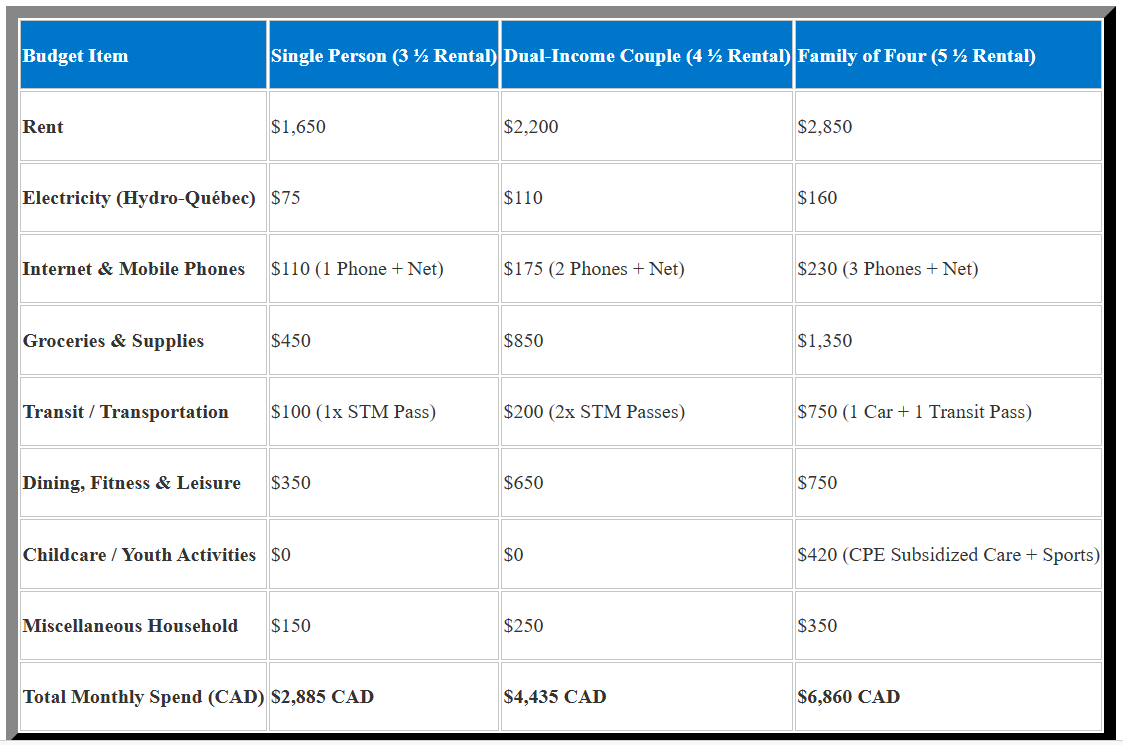
Note: Budgets represent necessary after-tax operational expenses and do not incorporate individual debt servicing, student loan repayments, or dedicated personal savings.
What Salary Do You Need to Live in Montreal?
Determining the salary needed to live in Montreal requires understanding Quebec’s distinctive provincial income tax schedule.
Understanding Quebec’s Provincial Tax Impact
Quebec residents pay federal income tax to the Canada Revenue Agency (CRA) and separate provincial income tax directly to Revenu Québec. Because the province funds extensive social safety nets, Quebec’s combined income tax brackets commence at higher marginal rates than those in Ontario, British Columbia, or Alberta.
For example, an individual earning an annual gross salary of $65,000 CAD can anticipate an approximate net take-home pay of $3,800 to $3,950 CAD per month, contingent upon mandatory contributions toward the Quebec Pension Plan (QPP/RRQ), the Quebec Parental Insurance Plan (QPIP/RQAP), and private workplace group insurance.

Recommended Salary Benchmarks
To meet primary expenditures while maintaining financial headroom:
- Independent Single Earner:
- Baseline Requirement: ~$42,000 – $46,000 CAD gross per year (adequate for shared roommate housing or tight single-budget control).
- Comfortable Living Benchmark: $55,000 – $68,000 CAD gross per year. This band finances a private 3 ½ in desirable central boroughs, modest dining out, recreation, and consistent contributions to an emergency fund or TFSA/RRSP.
- Dual-Income Couple (No Children):
- Combined Household Target: $85,000 – $115,000 CAD gross per year. Sharing accommodation overhead gives a couple access to a spacious 4 ½ in walkable neighbourhoods like Le Plateau, Rosemont, or Verdun alongside regular dining and annual travel.
- Family of Four (Two Children):
- Combined Household Target: $120,000 – $155,000 CAD gross per year. This bracket accommodates multi-room rental housing (or condominium carrying charges), children's seasonal gear, extracurriculars, vehicle maintenance, and family emergency cushions.
Strategic Ways to Cut Living Costs in Montreal
-
Leverage Section G When Signing: Always inspect Section G on your TAL standard lease. If the landlord substantially hiked the price from the prior tenant’s rent without verifiable structural improvements, explore your legal right to request a formal TAL rent calculation.
- Skip the Personal Vehicle: By utilizing the STM network alongside BIXI bicycle subscriptions ($20/month seasonally) and Communauto car-sharing for weekend grocery runs, central-city dwellers save $6,000 to $9,000 annually in vehicle overhead.
- Smooth Heating Bills with EPP: Set up Hydro-Québec’s Equalized Payments Plan to divide your total annual electric heating burden into 12 equal monthly instalments, avoiding sudden winter billing surprises.
- Target High-Value Outer Metro Boroughs: Look beyond Plateau and Downtown. Established neighbourhoods like Ahuntsic, Lasalle, Saint-Michel, and Mercier offer substantial rent savings while preserving immediate access to the Orange and Green lines.

Frequently Asked Questions About the Cost of Living in Montreal
How much money do you need to live comfortably in Montreal?
For a single adult renting an independent one-bedroom apartment (3 ½), a gross income of $55,000 to $65,000 CAD affords a comfortable lifestyle. This yields an estimated after-tax monthly income of roughly $3,300 to $3,900 CAD, keeping average rent within the recommended 30% to 35% income ceiling while leaving adequate funds for savings, dining, and hobbies.
How did Quebec’s Bill 31 change apartment hunting in Montreal?
Passed by the National Assembly of Quebec, Bill 31 altered lease transfer rules (cession de bail). Landlords can now legally refuse a lease assignment without demonstrating a serious reason (such as financial insolvency). However, exercising this refusal automatically releases the existing tenant from their lease without financial penalty. This change makes finding low-cost transferred leases rarer, shifting more rental transactions into newly negotiated market agreements.
What is Section G in a Quebec lease, and why does it matter?
Section G is a mandatory clause in standard Quebec residential leases where the landlord must disclose the lowest rent paid for the rental unit in the preceding 12 months. If the landlord raised the rent disproportionately relative to provincial guidelines, the new tenant has the statutory right to request a rent reduction through the TAL within 10 days of lease signing (or within two months if the clause was omitted).
How expensive are Hydro-Québec winter heating bills?
Thanks to public hydroelectric generation, electricity rates in Montreal are exceptionally competitive. For a standard one-bedroom apartment, annual electricity bills average $60 to $95 CAD monthly. In older, drafty historic walk-ups with electric baseboard heaters, winter bills can spike to $180 to $250 CAD per month between December and March if the account is not placed on an equalized annual billing plan.
Do you actually need a car in Montreal?
In the central boroughs—including Ville-Marie, Le Plateau, Mile End, Rosemont, Verdun, and Côte-des-Neiges—a personal vehicle is unnecessary. An integrated network of metro lines, frequent buses, dedicated cycling tracks, and car-share services like Communauto makes living car-free straightforward and economical.
What is a comfortable household income for a family of four?
A combined household gross income of $120,000 to $150,000 CAD provides comfortable security for a family of four in Montreal. This income accommodates a spacious 5 ½ apartment rental, household groceries, childcare expenses or extracurricular youth programs, seasonal clothing, and structured retirement savings.
Navigating Your Financial Future in Montreal
Montreal balances dynamic cultural life, world-class dining, and European urban heritage with living costs that remain distinctly competitive against North America’s largest metropolises. While local housing expenses have adjusted upward, the city's robust transit network, accessible renewable electricity, and strong tenant legislation provide clear pathways to a balanced lifestyle.
By aligning your borough choice with your transportation routine, understanding your rights under the TAL, and planning around provincial tax realities, you can establish an enjoyable and financially sound life in Quebec’s premier city.