
Thinking about making Calgary your next home? Known for its sunny skyline, proximity to the Canadian Rockies, and an expanding economy, Alberta's largest city has become a major destination for both international newcomers and Canadians relocating from higher-priced metropolitan centres like Toronto and Vancouver. However, moving to a new city requires a clear, realistic understanding of your day-to-day finances. From surging rental markets to heating bills during sub-zero winters, understanding the cost of living Calgary demands an honest look at your expected monthly budget.
This comprehensive guide breaks down the true cost of living in Calgary—covering current rental rates, everyday utilities, groceries, transit costs, the unique tax structure in Alberta, and the realistic salary needed to live comfortably.
Calgary Cost of Living: Overview and Quick Monthly Estimates
The overall cost of living in Calgary remains notably more accessible than in Toronto or Vancouver, primarily due to lower housing acquisition costs and favorable tax policies. Nonetheless, general inflation and rapid population growth have driven rental rates and service fees upward in recent years.
To understand the baseline, living costs can generally be split into two primary brackets: housing costs (rent or mortgage payments) and non-housing daily operational expenses.
Monthly Cost Summary: Single Person vs. Family of Four
The figures below represent estimated monthly ranges in Canadian Dollars (CAD), reflecting typical middle-class living conditions.
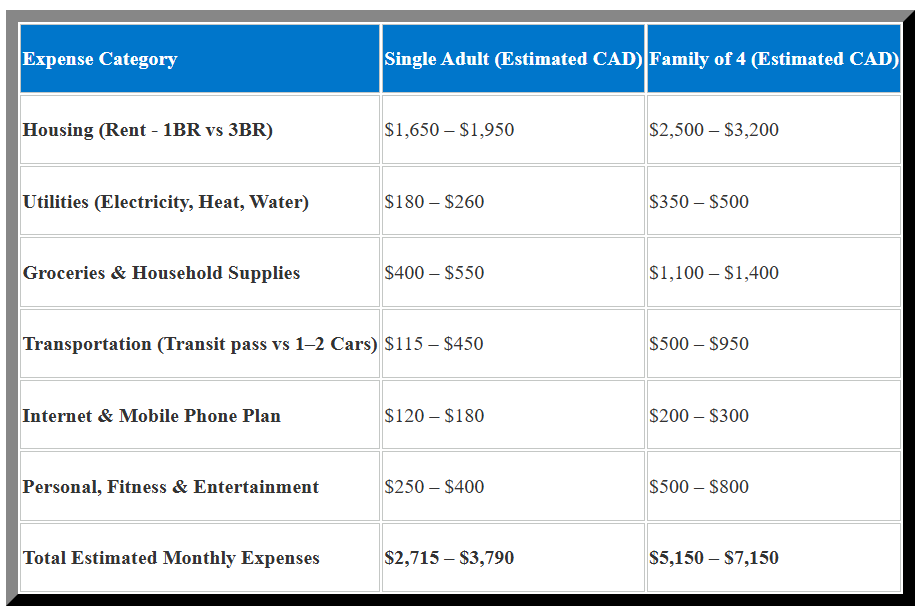
Note: These estimates do not include discretionary childcare fees, which vary substantially based on eligibility for provincial and federal daycare subsidies.
Housing and Rent in Calgary
Housing represents the largest portion of any household budget. While rental inventory tightened significantly over recent years due to interprovincial migration, Calgary still offers diverse options spanning downtown high-rises, inner-city walk-ups, and master-planned suburban townhomes.
Average Rental Prices by Property Type
When evaluating rent Calgary listings, market rates fluctuate depending on neighborhood proximity to the downtown core, post-secondary institutions, and transit access along the CTrain lines (such as the Beltline, Kensington, or Brentwood).
- One-Bedroom Apartment: $1,650 – $1,950 per month
- Two-Bedroom Apartment: $2,050 – $2,450 per month
- Three-Bedroom Townhome / Main Floor House: $2,500 – $3,200 per month
- Basement Suites (1–2 Bedrooms): $1,350 – $1,750 per month
Basement suites remain a practical alternative for budget-conscious renters and solo professionals, offering substantial monthly savings provided the unit is legally registered with the City of Calgary.
Additional Rental Costs: Utilities, Tenant Insurance, and Parking
When leasing an apartment or house, verify whether utilities are included in the lease contract:
- Basic Utilities (Electricity, Heating, Water): Often paid separately by tenants, particularly in single-family homes and newer condo buildings. Expect to budget $180 to $300 per month for an apartment and $350 to $550 for a full detached house, with peak expenses occurring during peak winter months (December to February).
- Tenant Insurance: Many landlords in Alberta require proof of coverage before handoff. Standard tenant insurance averages between $25 and $45 per month.
- Secured Parking: If you live downtown or in the Beltline district, a dedicated underground parking stall generally adds $100 to $220 monthly to your rental payment.
Renting vs. Buying in the Calgary Housing Market
For newcomers and prospective buyers looking to put down roots, comparing rental outlay against ownership equity is an important calculation. While home purchase prices across major Canadian urban markets sit well above national historical averages, Calgary's benchmark home values remain far more balanced than Southern Ontario or Lower Mainland British Columbia.
Before making a permanent transaction, prospective buyers frequently monitor neighborhood benchmark prices, mortgage qualification thresholds, and property transfer expenses using comprehensive real estate research portals like CanadaHomeHub.Ca, which provides structured insights into local housing trends across Canada.
Daily Living Expenses in Calgary
Beyond housing, day-to-day monthly expenses Calgary residents encounter cover essential consumables, mobility, and provincial service structures.
Groceries and Food Costs
Food costs in Calgary reflect standard Canadian national grocery trends. Major supermarket chains range from discount grocers (No Frills, Real Canadian Superstore, Walmart) to full-service retailers (Safeway, Sobeys, Co-op).
Estimated typical grocery expenses:
- Milk (4 Litres): $5.50 – $6.20
- Bread (Loaf): $3.00 – $4.00
- Eggs (Dozen): $3.90 – $4.80
- Chicken Breast (1 kg): $13.50 – $17.00
- Coffee & Dining Out: A casual lunch downtown costs roughly $18 to $25 per person, while a standard three-course dinner for two at a mid-range restaurant ranges from $80 to $130, excluding alcoholic beverages and customary tips (15% to 18%).
Getting Around: Public Transit vs. Owning a Vehicle
Calgary is geographically sprawling, spanning over 825 square kilometers. Your transit budget will depend heavily on whether you rely on public transportation or commute via personal automobile.
Public Transit (Calgary Transit)
Calgary Transit operates an extensive bus network alongside the light-rail transit system known as the CTrain. Notably, traveling along the 7th Avenue downtown corridor within the specified "Free Fare Zone" is completely free of charge.
- Adult Single Fare: $3.70
- Adult Monthly Transit Pass: $115.00
- Youth Monthly Pass (Ages 13–17): $82.00
Personal Vehicle Ownership
While public transit works efficiently for downtown commuters along rail corridors, many Calgary residents consider a personal car essential for suburban commuting, grocery hauling, and weekend trips to Canmore and Banff.
- Gasoline: Alberta typically enjoys lower fuel taxes compared to neighboring provinces, keeping pump prices slightly below national averages.
- Auto Insurance: Alberta operates on a private auto insurance model. Clean-record drivers can anticipate paying between $130 and $220 monthly, though newer drivers and international transferees without established Canadian driving histories may face higher initial premiums.
- Winter Maintenance: Budget an annual $150 to $200 for seasonal tire switchovers (winter tires are strongly recommended for driving between November and April).
Healthcare, Childcare, and Personal Discretionary Spending
-
Healthcare (AHCIP): Alberta residents registered with the Alberta Health Care Insurance Plan (AHCIP) do not pay monthly provincial healthcare premiums for basic medically necessary hospital and physician services. However, prescription medications, dental work, vision checkups, and ambulance rides require private extended health insurance (frequently subsidized through employer benefit packages).
- Childcare: The federal and provincial $10-a-day childcare subsidy agreement has steadily lowered licensed daycare costs for participating facilities across Alberta, though waitlists remain competitive. Private or non-subsidized preschool and daycare services run from $900 to $1,500 monthly per child.
- Fitness & Leisure: A standard gym membership (such as YMCA, GoodLife, or local recreation centres) averages $55 to $95 per month.
Taxes and the Alberta Advantage
One of the most compelling aspects shaping the Calgary cost of living is Alberta’s unique tax environment, often referred to as the "Alberta Advantage":
- No Provincial Sales Tax (PST): Unlike Ontario (13% HST), British Columbia (12% PST+GST), or Quebec (14.975%), Alberta has no Provincial Sales Tax. You pay only the federal 5% Goods and Services Tax (GST) on taxable retail goods and services. On major purchases—such as vehicles, furniture, electronics, and clothing—this offers a 7% to 10% cash savings.
- Competitive Provincial Income Tax: Alberta maintains a progressive personal income tax structure starting at 10% for the lowest bracket, with relatively high basic personal exemption thresholds.
- No Land Transfer Tax: Unlike provinces such as Ontario or British Columbia, Alberta does not charge a percentage-based provincial land transfer tax on residential real estate purchases (only nominal title transfer and mortgage registration administrative fees apply).
What Salary Is Needed to Live in Calgary Comfortably?
Determining the exact salary needed to live in Calgary hinges on household size, debt obligations, housing preferences, and lifestyle expectations.
Minimum Wage vs. The Living Wage in Calgary
-
Alberta Provincial Minimum Wage: Currently set at $15.00 per hour. A full-time worker (40 hours per week) on minimum wage earns approximately $31,200 annually before taxes. In current market conditions, maintaining independent single-bedroom housing on a single minimum wage is difficult without housemates or secondary income.
- Calculated Living Wage: According to economic research groups such as the Alberta Living Wage Network, the calculated living wage for Calgary typically sits around $23.70 to $24.50 per hour. This metric reflects the hourly income required to cover basic necessities, modest shelter, healthcare add-ons, and emergency savings without reliance on public income transfers.

Recommended Gross Salary Scenarios
To maintain standard financial safety—aiming to keep total shelter expenses within 30% to 35% of pre-tax gross income—the following salary targets serve as dependable guidelines:
- Single Adult (Living with Roommates / Shared Suite):
- Recommended Gross Income: $42,000 – $48,000 CAD per year
- Single Adult (Renting an Independent 1-Bedroom Apartment):
- Recommended Gross Income: $60,000 – $70,000 CAD per year
- Dual-Income Couple (No Children, 2-Bedroom Condo):
- Recommended Combined Gross Income: $85,000 – $100,000 CAD per year
- Family of Four (Renting a 3-Bedroom Home or Paying Mortgage):
- Recommended Combined Gross Income: $115,000 – $140,000 CAD per year
Calgary vs. Other Canadian Cities: How Does It Compare?
Understanding Calgary’s relative affordability becomes clearer when placed side-by-side with Canada’s two other major relocation hubs:
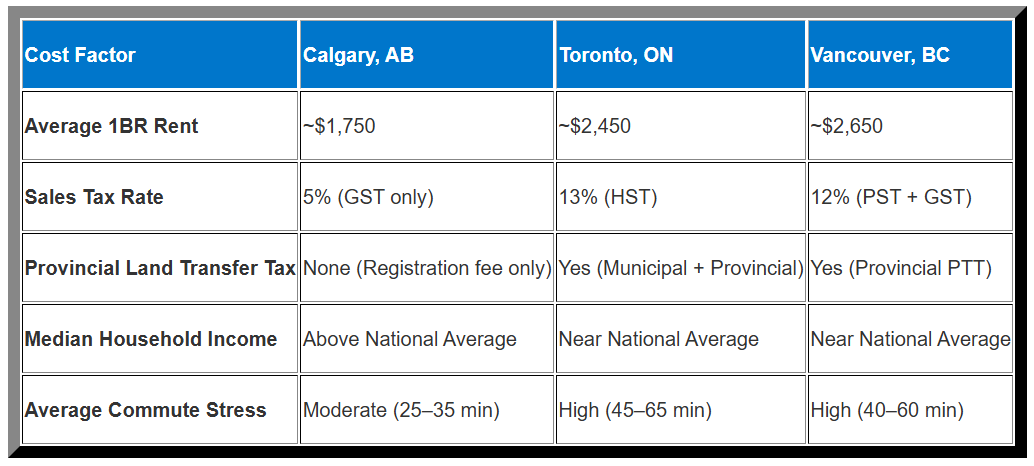
While Calgary is no longer the hyper-cheap frontier it was a decade ago, it continues to deliver a favorable balance between compensation levels and recurring living expenses.
Frequently Asked Questions About the Cost of Living in Calgary
Is Calgary cheaper to live in than Toronto or Vancouver?
Yes. Although everyday food and utility prices are similar nationwide, Calgary offers substantially lower rental and home purchase costs. Furthermore, the absence of an 8% to 10% provincial sales tax delivers consistent everyday savings on consumer goods, services, and vehicle acquisitions.
What is the average rent in Calgary for a 1-bedroom apartment?
As of current rental benchmarks, expect to pay between $1,650 and $1,950 per month for a standard one-bedroom apartment in Calgary, with prime inner-city locations commanding higher rates than outer suburban communities.
How much does a single person need per month to live in Calgary?
A single adult living independently in a one-bedroom apartment generally requires between $2,700 and $3,600 CAD per month after taxes to cover rent, utilities, food, transit, basic insurance, and discretionary personal needs.
Do you need a car to live comfortably in Calgary?
Not strictly, but it depends on where you live and work. If your residence and workplace both sit directly along the CTrain lines or within the central Beltline district, you can live comfortably using public transit, rideshares, and bicycle pathways. However, if you live in outer suburbs or plan regular trips to the mountains, owning a vehicle offers significant daily convenience.
What is the Alberta provincial sales tax rate?
Alberta does not levy a Provincial Sales Tax (PST). Consumers pay only the federal 5% Goods and Services Tax (GST) on applicable goods and services.
How much should I budget for utilities during Calgary winters?
Due to sustained freezing temperatures, home heating and electricity consumption increase during winter. For a detached house, budget between $350 and $550 per month for combined natural gas, power, water, and waste services between November and March. For a multi-family condo unit, winter utilities usually range between $180 and $280 monthly if not partially included in condo maintenance fees.
Final Thoughts: Is Moving to Calgary Worth It?
Navigating the cost of living in Calgary ultimately comes down to balancing personal lifestyle priorities against your household earning capacity. With higher-than-average median household earnings, zero provincial sales tax, and accessible housing markets relative to coastal metropolitan centres, Calgary provides strong economic value for professionals, skilled workers, and growing families.
If you are planning a relocation or preparing to transition from renting to owning, taking time to examine detailed regional market guides, property trends, and local neighborhood dynamics through Canadian housing platforms like CanadaHomeHub.Ca will help ensure your budget remains sound as you establish your home in Western Canada.