Becoming a Canadian citizen is the final, most rewarding milestone of your immigration journey. It grants you the right to vote, run for political office, carry a Canadian passport, and fully participate in the democratic life of the nation. However, before you can stand in front of the judge and take the Oath of Citizenship, you must pass the official Canadian citizenship test. For many applicants, the exam can feel intimidating. The test covers hundreds of years of history, complex governmental structures, geography, national symbols, and legal rights. Without a structured strategy, it is easy to get lost in the details. This comprehensive citizenship test study guide will break down everything you need to know. You will discover the exact exam format, how to master the official study materials, a step-by-step preparation plan, and actionable strategies to help you pass on your very first try.
Overview of the Canadian Citizenship Test
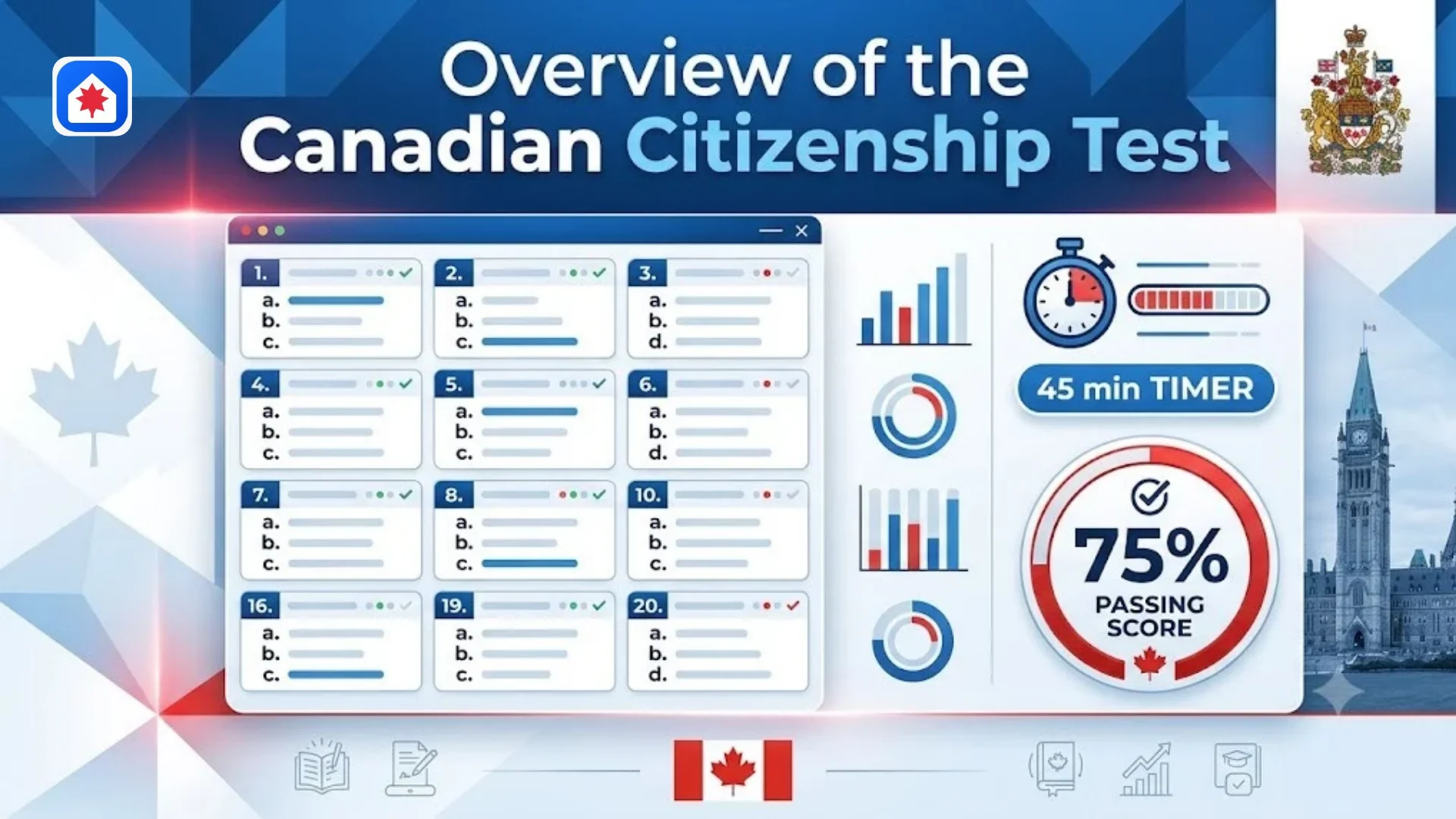
To feel confident on test day, you must first understand the ground rules. Knowing the exam mechanics eliminates unnecessary anxiety and lets you focus strictly on the content.
Key Exam Specifications
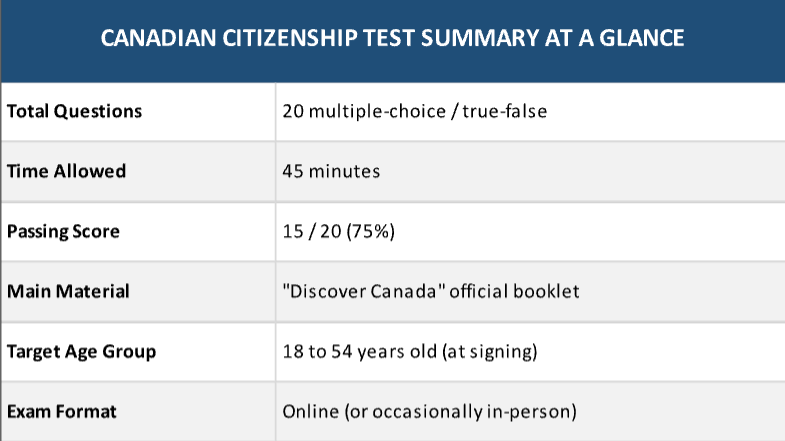
- Number of Questions: 20 questions
- Question Format: Multiple-choice and True/False
- Passing Grade: 75% (You must answer at least 15 out of 20 questions correctly)
- Time Limit: 45 minutes
- Delivery Format: Online (via a secure invitation link from IRCC) or occasionally in-person
- Age Requirement: Applicants aged 18 to 54 on the day they sign their application must take the test
Core Topics Covered in the Exam
The test assesses your knowledge across several fundamental pillars of Canadian society:
- Rights and Responsibilities: The legal freedoms guaranteed to Canadians, as well as the obligations every citizen shares.
- Canadian History: Major historical eras, Indigenous roots, European settlement, key battles, and political milestones.
- Government Systems: How Canada's parliamentary democracy and constitutional monarchy function at federal, provincial, and municipal levels.
- Elections and Law: The voting process, the branches of government, the justice system, and the Canadian Constitution.
- Geography and Economy: Canada’s five main regions, trade networks, resources, and geography.
- National Symbols: The significance of the Canadian flag, coat of arms, anthem, and historical icons.
Proper Canadian citizenship test preparation requires treating each of these topics with equal importance, as the exam draws randomly from all sections.
The Core Resource: Discover Canada Study Guide
When preparing for the exam, remember one rule above all else: 100% of the questions are based directly on the official guide published by Immigration, Refugees and Citizenship Canada (IRCC).
That publication is titled Discover Canada: The Rights and Responsibilities of Citizenship.
How to Access the "Discover Canada" Study Guide
IRCC makes the guide freely accessible in several media formats:
- Online PDF / HTML: Available directly on the official IRCC website for reading on computers or tablets.
- Audiobook: An official, free audio version available for streaming or download. Listening to the audiobook while commuting, exercising, or doing household chores is an excellent way to reinforce memory.
- Paper Copy: You can request a physical copy from IRCC or borrow one from your local public library.
How to Read the Guide Effectively
Many candidates make the mistake of attempting to memorize every single date or line of text verbatim. A far more effective approach to your discover Canada study guide prep is reading for comprehension and contextual understanding.
- Focus on Cause and Effect: Instead of simply memorizing that the War of 1812 happened, understand why it was fought (British-American conflict) and what it achieved (it preserved Canada’s independence from the United States).
- Pay Attention to Bolded Terms and Captions: Important terms, names, and concepts are bolded throughout the text. Additionally, photo captions often contain facts that appear in exam questions.
- Master the Key Chapters: While every page counts, history, government structures, and legal rights historically make up the majority of exam questions.
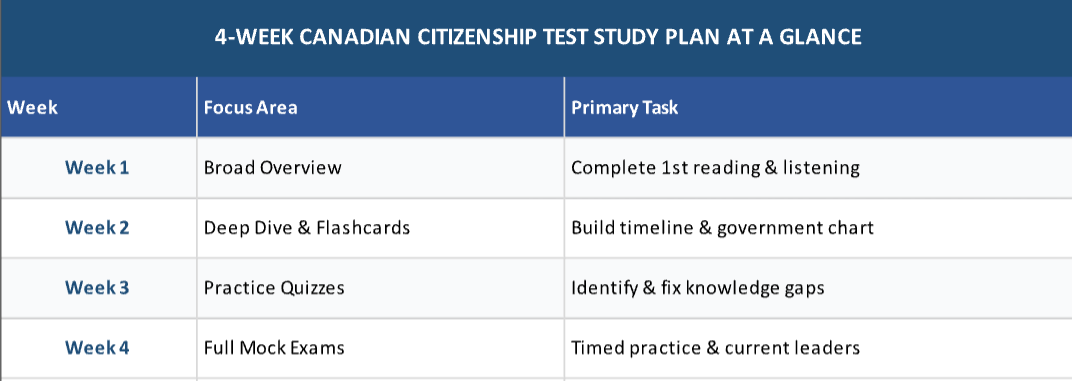
Your 4-Week Citizenship Test Study Plan
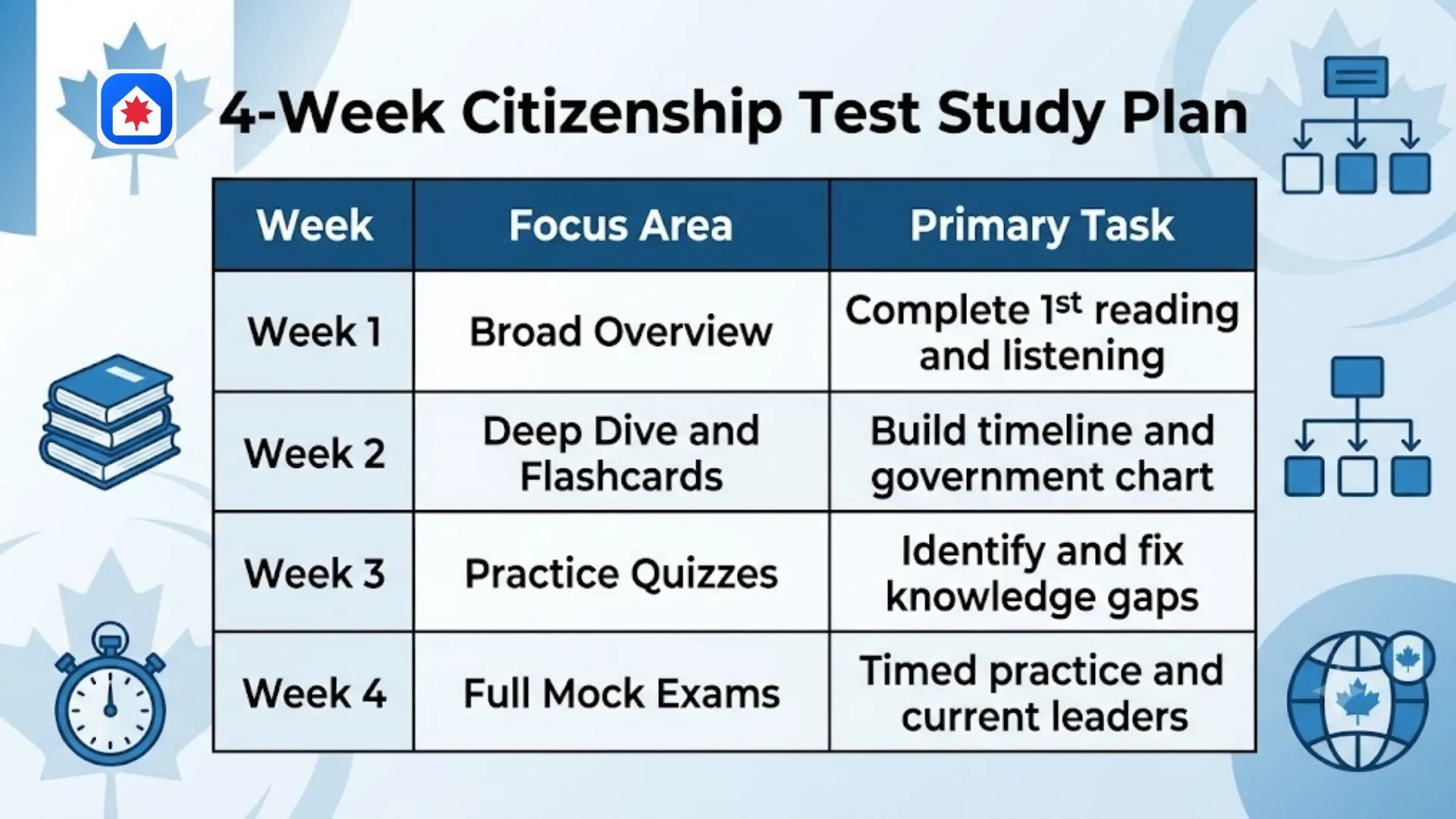
Cramming the night before rarely works for an exam with so many specific names, historical events, and technical terms. A structured citizenship test study plan spread across four weeks gives your brain time to absorb, organize, and retain the information.
Week 1: Foundation and First Pass
Your primary goal in Week 1 is to understand the broad narrative of Canada without getting bogged down in micro-details.
- Daily Time Investment: 30 to 45 minutes per day.
- Action Steps:
- Read through the entire Discover Canada booklet from start to finish once.
- Do not stop to memorize every date. Simply get a feel for the timeline and vocabulary.
- Highlight unfamiliar terms like Habeas Corpus, Responsible Government, or Confederation.
- Listen to the official audio chapters matching what you read each day.
Week 2: Deep Dive, Summaries, and Timelines
In Week 2, transition from passive reading to active learning. This is where you organize facts into easy-to-remember visual structures.
- Daily Time Investment: 45 to 60 minutes per day.
- Action Steps:
- Build a Historical Timeline: Draw a timeline starting from the early Indigenous nations, passing through 1608 (Founding of Quebec by Samuel de Champlain), 1759 (Battle of the Plains of Abraham), 1812 (War of 1812), 1867 (Confederation), and 1982 (Patriation of the Constitution).
- Create Flashcards: Use digital tools like Anki or Quizlet (or traditional physical index cards) to quiz yourself on key individuals (e.g., Sir John A. Macdonald, Louis Riel, Laura Secord).
- Map the Government Structure: Draw a diagram showing how the Executive, Legislative, and Judicial branches interact, and distinguish between the roles of the Sovereign, Governor General, Prime Minister, MPs, and Senators.
Week 3: Topic-by-Topic Practice and Gap Analysis
Week 3 is about testing your active recall and pinpointing your weak areas so you can fix them before test day.
- Daily Time Investment: 45 minutes per day.
- Action Steps:
- Begin taking free topic-specific practice quizzes online.
- Track Your Mistakes: Keep an "Error Log." Whenever you answer a question incorrectly, do not just look at the right answer—go back to the corresponding section in Discover Canada and re-read the entire paragraph.
- Focus specifically on Canadian geography: memorize the five main regions, their economic capitals, and their major physical features (e.g., Prairie provinces, Atlantic region, Canadian Shield).
Week 4: Mock Exams and Final Polish
In your final week, you will simulate actual exam conditions to build stamina, speed, and confidence.
- Daily Time Investment: 30 to 45 minutes per day.
- Action Steps:
- Take full-length 20-question mock exams under real conditions (strict 45-minute timer, no reference notes).
- Aim for consistent scores of 90% or higher (18/20) on practice tests to give yourself a safety cushion for test day.
- Check Current Political Leaders: Verify the current names for political roles that may have changed since the book was printed (see Section 4).
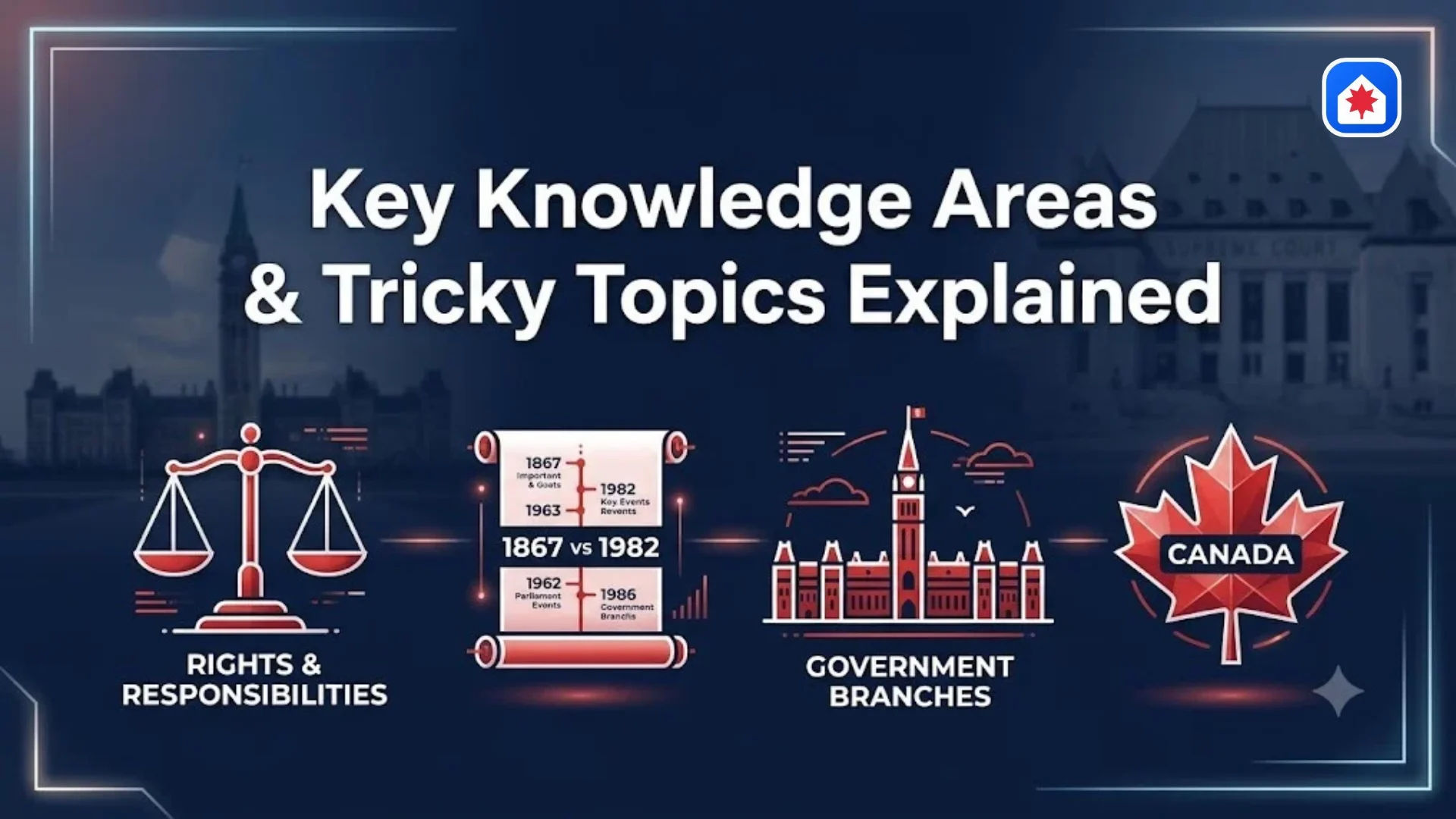
Key Knowledge Areas & Tricky Topics Explained
To study for citizenship test Canada effectively, you must pay attention to concepts that frequently confuse test-takers. Here are the most common "trap areas" on the exam and how to master them:
The Difference Between Rights and Responsibilities
The exam heavily tests your understanding of what citizens are entitled to versus what citizens are expected to do.
- Rights (Guaranteed under the Charter of Rights and Freedoms):
- Freedom of expression, religion, and peaceful assembly
- Democratic rights (the right to vote and run for office)
- Mobility rights (the right to live and work anywhere in Canada)
- Legal rights (protection against unreasonable search or arrest)
- Equality rights (freedom from discrimination)
- Responsibilities (Your duty as a Canadian citizen):
- Obeying Canada's laws
- Taking responsibility for oneself and one's family
- Serving on a jury when called upon
- Voting in federal, provincial, and municipal elections
- Helping others in the community through volunteer work
- Protecting and enjoying Canada's heritage and environment
Constitutional Milestones: 1867 vs. 1982
Do not confuse these two crucial years in Canadian legal history:
- July 1, 1867 (The British North America Act): The Dominion of Canada was officially born. The original four provinces (Ontario, Quebec, Nova Scotia, and New Brunswick) united under Confederation. Sir John A. Macdonald became the first Prime Minister.
- 1982 (Patriation of the Constitution): Queen Elizabeth II signed the Constitution Act, 1982. This officially transferred full constitutional control from the United Kingdom to Canada and enshrined the Canadian Charter of Rights and Freedoms into the Constitution.
How the Canadian Government Functions
Understanding Canada's government structure is crucial for the exam. Ensure you can distinguish between these key positions:
- Head of State: The Sovereign (King Charles III), represented in Canada by the Governor General at the federal level and by Lieu-tenant Governors at the provincial level.
- Head of Government: The Prime Minister, who leads the political party with the most seats in the House of Commons.
- Parliamentary Branches:
- House of Commons: Members of Parliament (MPs) elected by the voters.
- Senate: Senators appointed by the Governor General on the advice of the Prime Minister.
CRITICAL TIP: Verify Current Political Leaders
Settle on a quick check of current political names 24-48 hours before your test. Discover Canada explains the system, but you may be asked for real-time names. Know the current:
- Prime Minister of Canada
- Governor General of Canada
- Leader of the Official Opposition
- Premier of your province
- Lieutenant Governor of your province
- Your local Member of Parliament (MP)
Symbols and Culture
Expect questions regarding national symbols:
- The Beaver: Adopted centuries ago as the symbol of the Hudson’s Bay Company due to the fur trade.
- The Maple Leaf: A Canadian symbol since the 1700s, officially placed on the national flag in 1965.
- National Sports: Ice hockey is Canada's official winter sport; Lacrosse is the official summer sport.
- The Victoria Cross: The highest military honor available to Canadians for bravery.
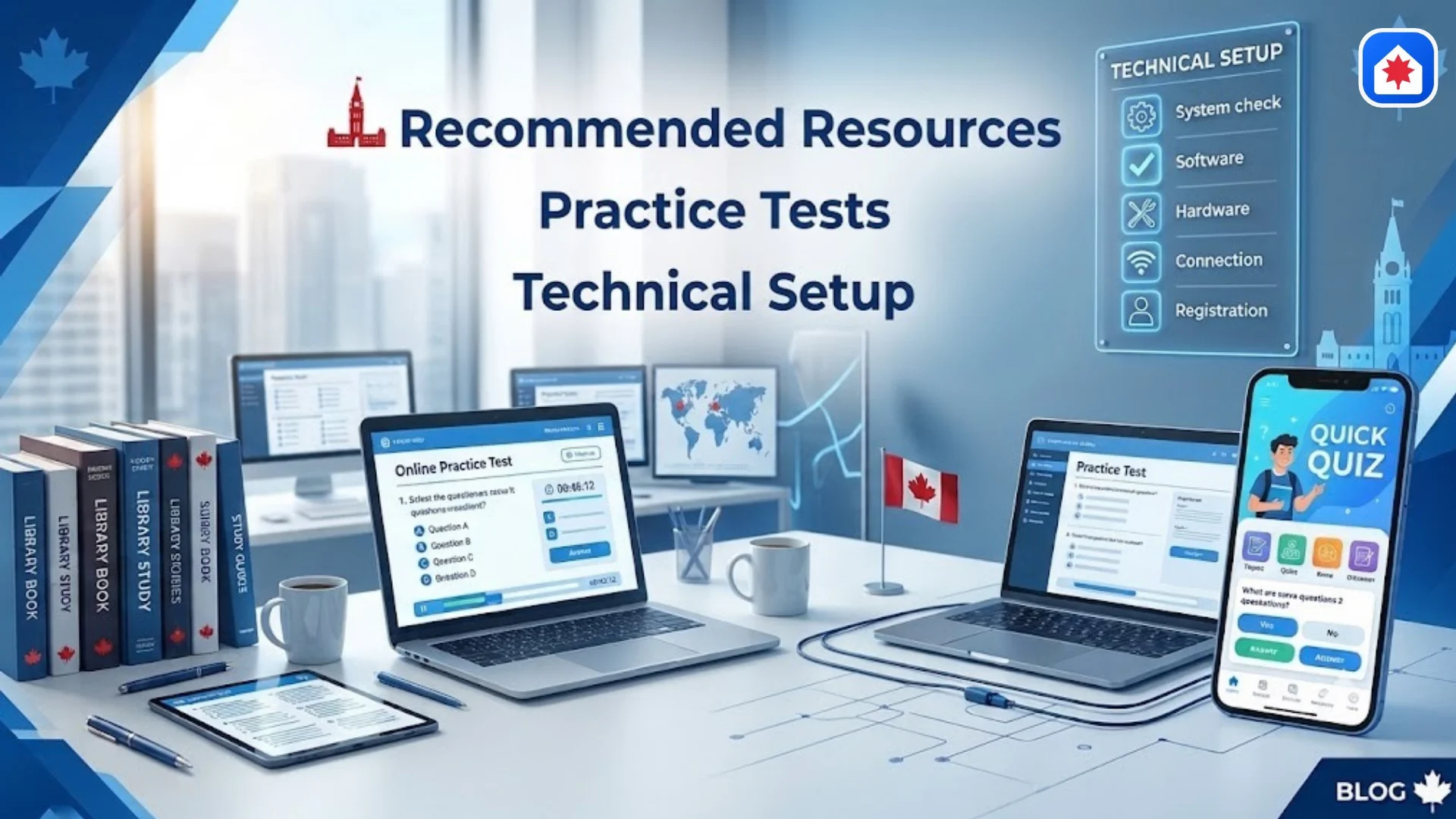
Recommended Resources, Practice Tests, and Technical Setup
Using reliable secondary materials alongside your citizenship test study guide will dramatically improve your speed and retention.
Trusted Online Practice Platforms
- Public Library Quizzes: Municipal libraries across Canada (such as the Richmond Public Library, Calgary Public Library, and Toronto Public Library) offer exceptional, free online practice tests reflecting real IRCC questions.
- Citizenship Counts: An interactive free platform containing chapter-by-chapter quizzes, flashcards, and practice tests.
- Mobile Quiz Apps: Search your mobile app store for "Canadian Citizenship Test 2026" to find flashcard and quiz apps for practicing during short breaks.
Preparation Checklist for the Online Exam
If you are taking the test online, technical or procedural errors can invalidate your attempt. Use this checklist on test day:
- Environment: Choose a quiet, private, well-lit room where no one will enter.
- Hardware: Use a laptop or desktop computer equipped with a working webcam.
- Internet: Connect to a reliable, high-speed Wi-Fi network or Ethernet cable.
- Identification: Have your PR Card, Passport, or provincial driver's license ready.
- Rules Compliance: Ensure your face remains visible on camera throughout the exam.
- No Aids: Remove all study guides, notes, phones, and second monitors from the desk.
Frequently Asked Questions (FAQ)
What happens if I fail the citizenship test on my first attempt?
If you do not achieve 15 out of 20 marks on your first try, do not panic. IRCC will automatically schedule you for a second test (re-test). If you do not pass the second written test, you will be invited to a short interview with a citizenship judge to orally demonstrate your knowledge of Canada.
How long should I study before taking the test?
Most successful candidates dedicate 3 to 4 weeks, studying roughly 30 to 60 minutes each day. This provides ample time to read Discover Canada, make flashcards, and consistently score above 90% on practice quizzes.
Are the questions on the online test the same as the in-person test?
Yes. Both online and in-person tests use the exact same question bank maintained by IRCC, adhering strictly to the content found in the Discover Canada guidebook.
Final Words of Encouragement
Passing the Canadian citizenship test is entirely within your reach. The exam is not designed to trick you; it is designed to ensure you understand the history, laws, values, and responsibilities that bind Canadians together.
By relying on the official discover Canada study guide, following a structured citizenship test study plan, and completing regular practice quizzes at canadahomehub.ca, you will walk into your exam with total confidence.
Take a deep breath, stick to your routine, and prepare to take your final step toward becoming a proud Canadian citizen.
Thank you for reading our article!