Becoming a Canadian citizen is a monumental milestone. It represents the final step in a long, often challenging journey of immigration, integration, and commitment to a new home. For many permanent residents, taking the Oath of Citizenship is a dream come true, bringing a profound sense of belonging, the right to vote, and the privilege of holding one of the most respected passports in the world. However, before you can proudly sing "O Canada" at your citizenship ceremony, there is one final, crucial hurdle to clear: passing the official Canadian citizenship test.
While the official government study guide, Discover Canada: The Rights and Responsibilities of Citizenship, is packed with fascinating historical facts, geographical details, and vital political information, simply reading it from cover to cover is rarely enough to guarantee success. The sheer volume of dates, geographical regions, government structures, and historical figures can easily become overwhelming for anyone. This is exactly where engaging in comprehensive Canadian citizenship test practice becomes absolutely essential.
Welcome to CanadaHomeHub.ca's ultimate, deep-dive guide to acing your exam. In this extensive resource, we will break down the test structure, highlight the key study areas you must master, and provide you with an extensive, categorized list of free questions and detailed answers. Whether you are just beginning your studies or looking for a final, thorough review before exam day, this guide is designed to maximize your chances of success and build your confidence.
Comprehensive Overview of the Canadian Citizenship Test
Before diving into the study material, it is crucial to understand the battlefield. Knowing the format, requirements, and rules of the test will help reduce exam anxiety and allow you to strategize your study time effectively.
What is the Format of the Exam?
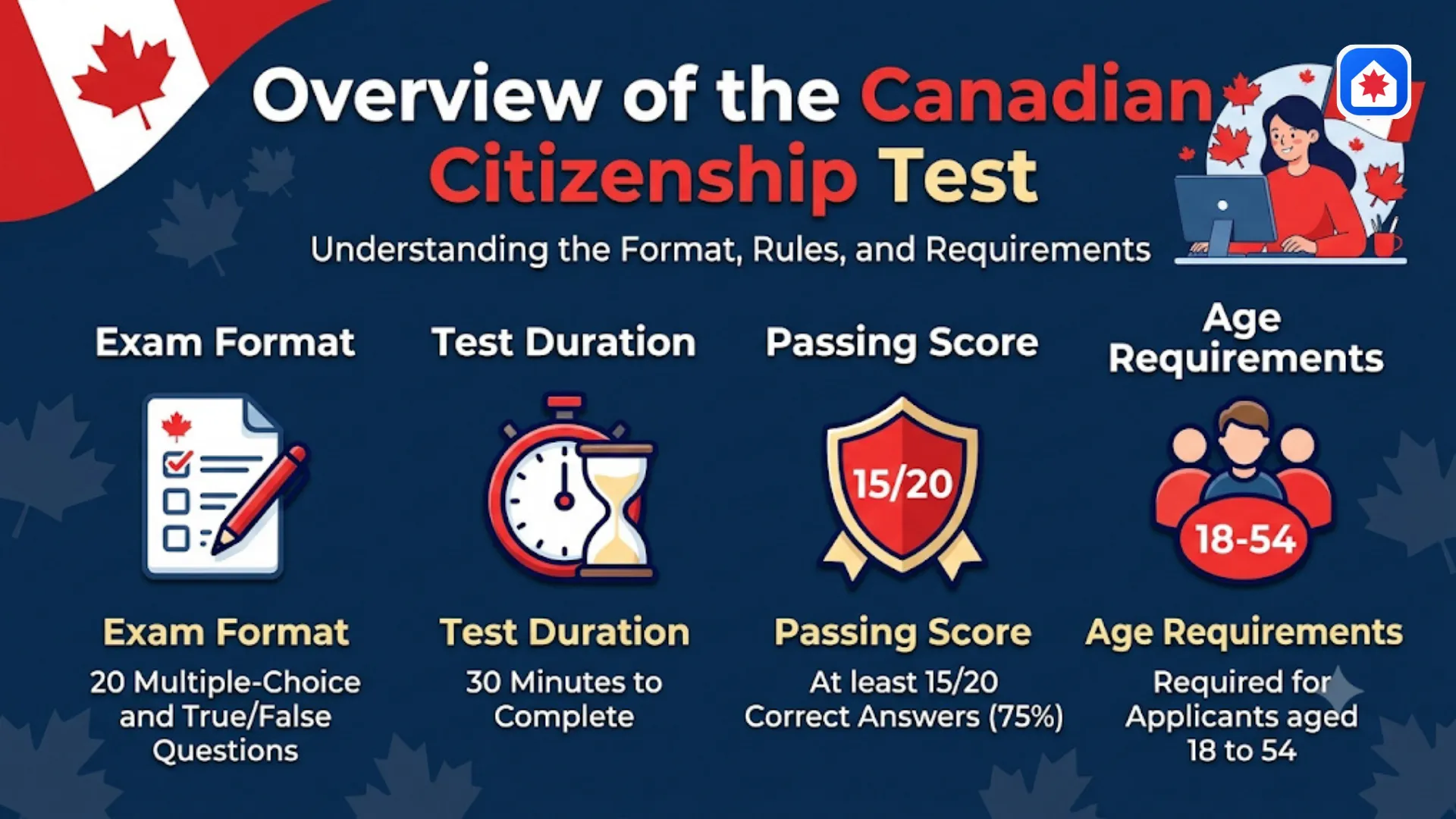
The official Canadian citizenship test consists of exactly 20 questions. These questions are presented in a multiple-choice and true/false format. For multiple-choice questions, you will typically be given four possible answers, and you must select the single best, most accurate answer from the options provided.
How Much Time Do You Have?
Candidates are given exactly 30 minutes to complete the 20 questions. While this translates to 1.5 minutes per question, most well-prepared applicants find this is more than enough time. In fact, those who have practiced extensively often finish the exam in 10 to 15 minutes, leaving plenty of time to review their answers.
What is the Passing Score?
To pass the citizenship test, you must answer at least 15 out of 20 questions correctly. This means you need a minimum score of 75%. If you score 14 or below, you will not pass. However, do not panic if this happens: Immigration, Refugees and Citizenship Canada (IRCC) usually gives you a second opportunity to rewrite the test at a later date. If you fail a second time, you may be scheduled for an interview with a citizenship judge or officer.
Who is Required to Take the Test?
Generally, applicants between the ages of 18 and 54 on the day they sign their citizenship application must take the knowledge test. Those under 18 or over 54 are exempt from the knowledge test, though they must still meet other residency and language requirements.
Language Options
The exam must be taken in either of Canada’s two official languages: English or French. This test not only evaluates your knowledge of Canada but also serves as a secondary check of your adequate knowledge of one of the official languages.
Why is Citizenship Test Practice Canada So Crucial?
You might wonder why you should spend hours on practice questions instead of just reading the Discover Canada book multiple times. Engaging in targeted citizenship test practice Canada offers several distinct psychological and educational advantages that passive reading simply cannot match.
Active Recall vs. Passive Reading
When you read a book, it is easy to suffer from the "illusion of competence." You recognize the words and concepts as your eyes scan the page, so you assume your brain has stored them. However, when faced with a multiple-choice question without the text in front of you, you are forced to actively recall the information. Practice tests instantly expose the areas where your memory is weak—whether that’s the specific year of Confederation or the exact responsibilities of a provincial Premier.
Understanding Tricky Phrasing and Distractors
The official test is known for occasionally using "distractors"—options that look very similar to the correct answer but are fundamentally wrong. For example, confusing a "Member of Parliament" with a "Member of the Legislative Assembly." By exposing yourself to a high volume of practice questions, you learn how to read questions carefully and spot the traps that test-makers lay out.
Building Mental Stamina for Exam Day
Sitting in a quiet room reading is entirely different from a timed exam environment. Taking timed practice tests helps you build the mental stamina, pacing, and focus required to confidently read, analyze, and answer 20 questions within the 30-minute limit, significantly reducing test-day anxiety.
Key Study Areas: Breaking Down "Discover Canada"
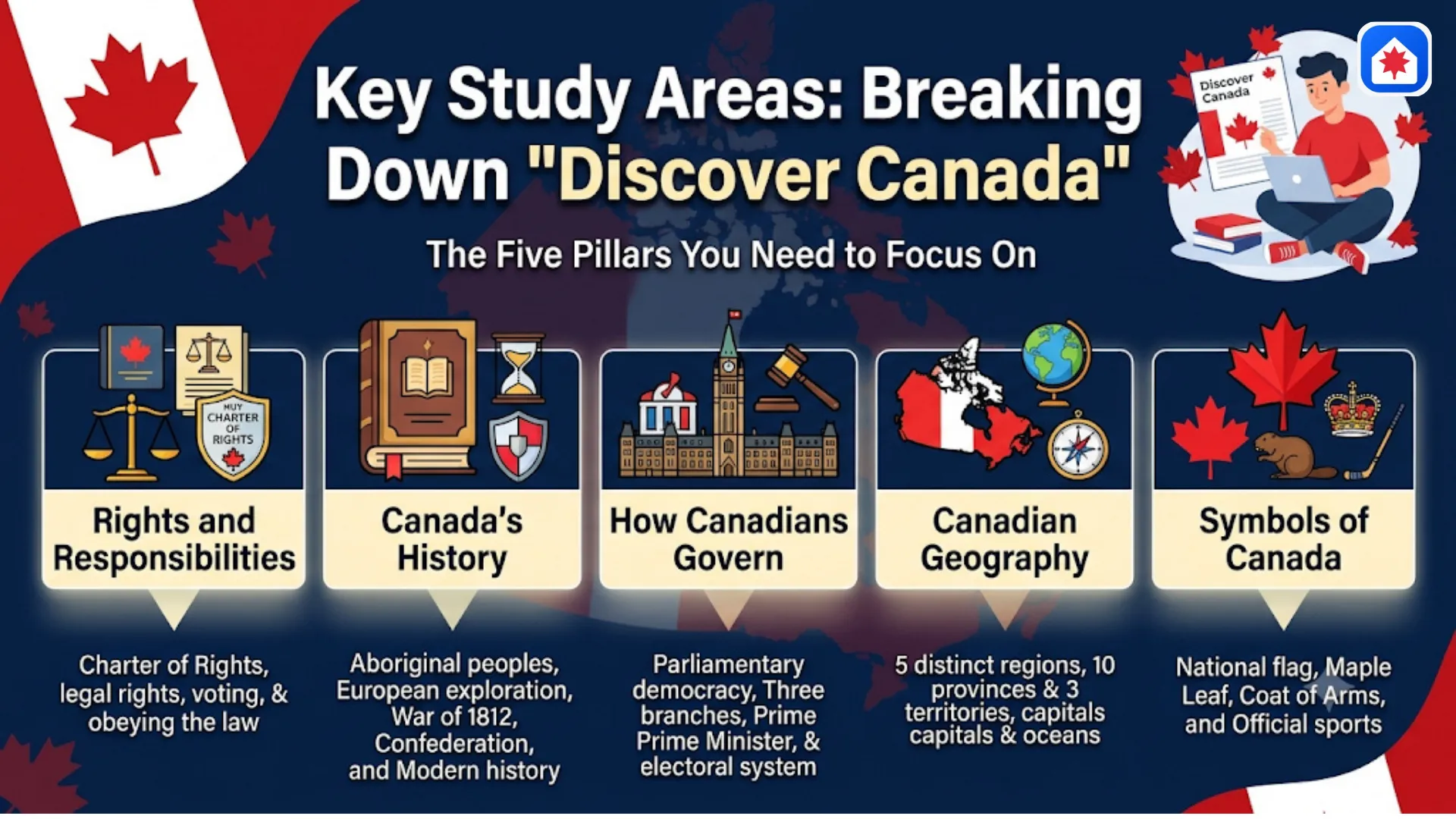
To optimize your study time, you should not treat all pages of the study guide equally. The exam questions generally fall into five major pillars. Here is what you need to focus on:
Rights and Responsibilities of Citizenship
Canada is built on a foundation of shared values, human rights, and the rule of law. You must deeply understand the Canadian Charter of Rights and Freedoms. You must know your legal rights (mobility, Aboriginal peoples' rights, official language rights) and your responsibilities (obeying the law, serving on a jury, voting, volunteering, and protecting the environment).
Canada’s History
This is often the most challenging section due to the number of dates and names. Focus on the timeline:
- Aboriginal Peoples: First Nations, Inuit, and Métis.
- European Exploration: The arrival of the French and British, and the founding of New France.
- The War of 1812: How Canada defended against American invasion.
- Confederation (1867): The creation of the Dominion of Canada.
- Modern History: Canada’s vital role in WWI (Vimy Ridge), WWII, and the creation of the Charter of Rights and Freedoms in 1982.
How Canadians Govern Themselves
Canada is a federal state, a parliamentary democracy, and a constitutional monarchy. You must know the three branches of government (Executive, Legislative, and Judicial), how a bill becomes a law, the role of the Sovereign (the King/Queen), the role of the Prime Minister, and how the electoral system works (including how to vote).
Canadian Geography
Canada is the second-largest country in the world, stretching from the Atlantic to the Pacific and northward to the Arctic Ocean. You need to memorize:
- The 5 distinct regions (Atlantic, Central, Prairie, West Coast, Northern).
- The 10 provinces and 3 territories.
- Their capital cities.
- The three founding oceans (Pacific, Atlantic, Arctic).
Symbols of Canada
Don't ignore the symbols! You will likely get questions about the Canadian Crown, the National Flag, the Maple Leaf, the Coat of Arms, the beaver, and our official sports (hockey and lacrosse).
The Ultimate List of Canadian Citizenship Practice Questions
To provide you with the highest value possible, we have compiled an extensive list of Canadian citizenship practice questions divided by category. We have included detailed explanations for why the correct answer is right, ensuring you are learning the underlying concepts, not just memorizing letters.
Category A: Rights and Responsibilities
1. Which of the following is NOT a responsibility of a Canadian citizen?
A) Serving on a jury
B) Obeying the law
C) Driving a car safely
D) Voting in elections
Correct Answer: C
Explanation: While driving safely is a legal requirement if you drive, it is not listed as a core democratic responsibility in Discover Canada. The core responsibilities include obeying the law, taking responsibility for oneself/family, serving on a jury, voting, helping the community, and protecting our heritage/environment.
2. What are the three founding peoples of Canada?
A) Aboriginal, French, and British
B) Inuit, Metis, and First Nations
C) English, French, and American
D) French, British, and Chinese
Correct Answer: A
Explanation: Canada’s history and culture have been heavily shaped by three founding groups: the Aboriginal (Indigenous) peoples who lived here for thousands of years, and the French and British settlers who established modern institutions.
3. In Canada, are men and women equal under the law?
A) Yes, but only in the workplace.
B) Yes, men and women are absolutely equal under the law.
C) No, laws differ by province.
D) Equality is a guideline, not a legal right.
Correct Answer: B
Explanation: In Canada, men and women are equal under the law. Canada’s openness does not tolerate barbaric cultural practices like spousal abuse, "honour killings," or forced marriage.
4. What document legally protects the basic rights and freedoms of all Canadians?
A) The Criminal Code
B) The Magna Carta
C) The Canadian Charter of Rights and Freedoms
D) The Supreme Court Act
Correct Answer: C
Explanation: The Canadian Charter of Rights and Freedoms, entrenched in the Constitution in 1982, legally protects human rights in Canada, including freedom of speech, religion, and peaceful assembly.
5. Name two fundamental freedoms protected by the Canadian Charter of Rights and Freedoms.
A) Freedom of speech and freedom of the press.
B) Freedom to own land and freedom to start a business.
C) Freedom of religion and freedom of peaceful assembly.
D) Both A and C.
Correct Answer: D
Explanation: Fundamental freedoms include freedom of conscience and religion; freedom of thought, belief, opinion and expression (including freedom of speech and of the press); freedom of peaceful assembly; and freedom of association.
Category B: Canadian History
6. Who was the first Prime Minister of Canada?
A) Alexander Mackenzie
B) Sir Wilfrid Laurier
C) Sir John A. Macdonald
D) Lester B. Pearson
Correct Answer: C
Explanation: Sir John A. Macdonald was a Father of Confederation and became Canada’s first Prime Minister in 1867. His portrait is featured on the Canadian $10 bill.
7. What year did Confederation take place?
A) 1812
B) 1867
C) 1982
D) 1931
Correct Answer: B
Explanation: On July 1, 1867, the Fathers of Confederation established the Dominion of Canada, uniting Ontario, Quebec, Nova Scotia, and New Brunswick. We celebrate this anniversary every year as Canada Day.
8. Which famous battle during the First World War is often referred to as the birth of a nation for Canada?
A) The Battle of Waterloo
B) The Battle of Passchendaele
C) The Battle of Vimy Ridge
D) The Battle of the Somme
Correct Answer: C
Explanation: In April 1917, the Canadian Corps captured Vimy Ridge in France. It was a spectacular victory where Canadian troops fought together for the first time as a single national force, sparking a deep sense of national identity.
9. Who are the Acadians?
A) Indigenous people of the West Coast.
B) Descendants of French colonists who began settling in what are now the Maritime provinces in 1604.
C) Settlers who came from England in the 1700s.
D) The founders of the province of Quebec.
Correct Answer: B
Explanation: The Acadians are descendants of early French settlers in the Maritimes. In the 18th century, many were deported by the British in the "Great Upheaval," but Acadian culture survived and thrives today in Atlantic Canada.
10. What was the significance of the War of 1812?
A) It led to the immediate creation of Canada.
B) It ensured that Canada would remain independent of the United States.
C) It gave women the right to vote.
D) It abolished slavery in Canada.
Correct Answer: B
Explanation: The War of 1812 was fought between the British Empire (including Canadian colonists and Indigenous allies) and the United States. Successfully defending the borders ensured that Canada would not become part of the United States.
11. Who was the first French-Canadian Prime Minister of Canada?
A) Pierre Elliott Trudeau
B) Sir George-Étienne Cartier
C) Sir Wilfrid Laurier
D) Louis Riel
Correct Answer: C
Explanation: Sir Wilfrid Laurier became the first French-Canadian prime minister since Confederation and his portrait is on the $5 bill. He encouraged immigration to the West.
Category C: How Canadians Govern Themselves
12. What are the three parts of Parliament?
A) The Prime Minister, the Cabinet, and the Departments
B) The Sovereign (King/Queen), the Senate, and the House of Commons
C) The Premier, the Mayor, and the Police
D) The Executive, the Legislative, and the Judicial branches
Correct Answer: B
Explanation: Parliament in Canada has three parts: The Sovereign (represented by the Governor General), the Senate (appointed on the advice of the Prime Minister), and the House of Commons (elected by voters).
13. How are Members of Parliament (MPs) chosen?
A) Appointed by the Prime Minister
B) Elected by Canadian citizens in a general election
C) Appointed by the Governor General
D) Selected by the provincial Premiers
Correct Answer: B
Explanation: In a federal election, Canadians vote for the candidate in their electoral district (riding). The candidate with the most votes becomes the Member of Parliament (MP) for that riding, representing them in the House of Commons.
14. What is a majority government?
A) When a single political party wins more than half the seats in the House of Commons.
B) When the Prime Minister gets the majority of the popular vote.
C) When two parties join together to form a government.
D) When a party wins exactly 50% of the seats.
Correct Answer: A
Explanation: If the party in power holds at least half of the seats in the House of Commons, it is called a majority government. If they hold less than half but still have the most seats compared to other parties, it is a minority government.
15. Who is Canada's Head of State?
A) The Prime Minister
B) The Governor General
C) The Sovereign (King or Queen of Canada)
D) The Chief Justice
Correct Answer: C
Explanation: Canada is a constitutional monarchy. The Sovereign is the Head of State (symbolizing the rule of law and the state), while the Prime Minister is the Head of Government (directing day-to-day governance).
16. What do you call the sovereign's representative in the provinces?
A) The Premier
B) The Mayor
C) The Lieutenant Governor
D) The Senator
Correct Answer: C
Explanation: While the Governor General represents the Sovereign at the federal level, the Lieutenant Governor represents the Sovereign in each of the ten provinces.
Category D: Canadian Geography & Symbols
17. Which region of Canada is known as the "industrial and manufacturing heartland"?
A) The Atlantic Provinces
B) The Prairie Provinces
C) Central Canada (Ontario and Quebec)
D) The West Coast (British Columbia)
Correct Answer: C
Explanation: Central Canada (Ontario and Quebec) is home to more than half the people in Canada and produces more than three-quarters of all Canadian manufactured goods.
18. What is the capital city of Canada?
A) Toronto
B) Montreal
C) Vancouver
D) Ottawa
Correct Answer: D
Explanation: Ottawa, located on the Ottawa River in Ontario, is the national capital. It was chosen by Queen Victoria in 1857.
19. Which province has its own time zone?
A) British Columbia
B) Alberta
C) Newfoundland and Labrador
D) Nova Scotia
Correct Answer: C
Explanation: Newfoundland and Labrador, the most easterly point in North America, has its own unique time zone (Newfoundland Standard Time), which is 30 minutes ahead of Atlantic Time.
20. What is the highest mountain in Canada?
A) Mount Tremblant
B) Mount Logan
C) Mount Robson
D) Whistler Mountain
Correct Answer: B
Explanation: Mount Logan, located in the Yukon Territory, is the highest mountain in Canada. It was named in honour of Sir William Logan, a world-famous Canadian geologist.
21. What are Canada's two official sports?
A) Ice hockey and Soccer
B) Ice hockey and Curling
C) Ice hockey and Lacrosse
D) Basketball and Lacrosse
Correct Answer: C
Explanation: Ice hockey is Canada's most popular spectator sport and is considered the national winter sport. Lacrosse, a sport with Indigenous origins, is the official summer sport.
22. Which animal is an official symbol of Canada, famous for its industriousness?
A) The Moose
B) The Polar Bear
C) The Beaver
D) The Canada Goose
Correct Answer: C
Explanation: The beaver was adopted centuries ago as a symbol of the Hudson’s Bay Company. It became an emblem of the St. Jean Baptiste Society, and today it is seen on the five-cent coin and the coats of arms of Saskatchewan and Alberta.
Experience the Real Thing: Citizenship Test Quiz Canada
Reading through the questions above is an excellent start, but to truly gauge your readiness, you need to simulate the actual exam environment. This means sitting down, removing all distractions, setting a strict timer for 30 minutes, and taking a full 20-question mock exam.
To help you with this crucial step, we highly recommend utilizing a dedicated citizenship test quiz Canada platform. By taking a dynamic, computer-based quiz, the questions are randomized, the timer keeps you accountable, and you get immediate, detailed feedback upon submission. This mimics the exact format you will face on the actual IRCC testing portal.
Are you ready to put your knowledge to the ultimate test? Jump into our interactive, highly accurate mock exams right now. Check out the best Canadian citizenship test practice available at CanadaHomeHub.ca. Our simulator is built to closely mirror the real testing system, giving you the confidence and accuracy you need to pass on your first try.
Best Free Citizenship Test Practice Resources
Studying for the citizenship exam doesn't have to cost a fortune. In fact, everything you strictly need to pass is provided by the government or available for free online if you know where to look. Here is how you can build a robust, free citizenship test practice routine:
The Official "Discover Canada" Guide (PDF and Audio)
This is the ONLY official study guide. Every single question on the test is based directly on the material inside this specific book. You can read it online, download it as a PDF, or download the e-book version for free from the IRCC website.Pro-tip for busy people: Download the official Audio version (MP3). Listening to the guide while commuting to work, exercising at the gym, or doing household chores is an incredible way to reinforce learning without dedicating extra sitting hours.
Digital Flashcards
If you struggle with dates and names (e.g., the year the Charter of Rights and Freedoms was signed, or identifying who John Buchan was), creating your own flashcards or using free digital flashcard apps like Anki or Quizlet can be game-changers. Spaced repetition systems (SRS) used by these apps force your brain to remember facts right before you are about to forget them.
CanadaHomeHub.ca Practice Portal
As mentioned above, our website offers extensive, free quizzes designed to test your knowledge chapter-by-chapter, as well as comprehensive marathon tests. Bookmark our Canadian citizenship test practice page and make it a daily habit to run through at least one 20-question set over your morning coffee until you are consistently scoring 90% or higher.
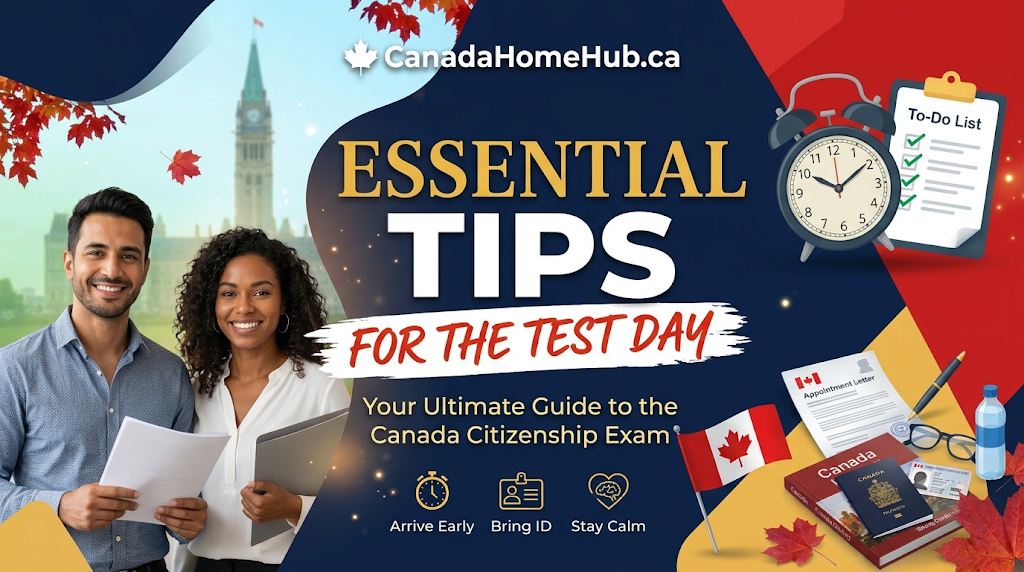
Essential Tips for the Test Day
After weeks of diligent studying, test day will finally arrive. Whether you are taking the test in-person at a Service Canada center or online from the comfort of your living room, here are a few essential tips to ensure the day goes smoothly:
Before the Test
- Gather Your Documents Early: Ensure you have all the required identification exactly as requested in your Notice to Appear. This usually includes your Permanent Resident (PR) card, your current passport (and expired ones if requested), and a second piece of personal ID (like a driver's license or health card).
- Tech Check (For Online Tests): If you are taking the test online, log in early to ensure your webcam is working, your internet connection is stable, and you are in a brightly lit, quiet room with absolutely no one else present. The webcam will take photos of you during the exam to verify your identity and prevent cheating. Ensure your face is clearly visible.
During the Test
- Time Management is Key: 30 minutes is a very generous amount of time for 20 questions. Do not rush.
- Read Carefully: Read every question twice. Pay close attention to words like "NOT", "ALWAYS", or "NEVER". Read every single answer option before clicking, even if you think answer 'A' is correct immediately.
- Flag and Skip: If you are stuck on a difficult question, do not waste 5 minutes panicking. Flag it, skip it, and come back to it at the end. Often, reading a subsequent question might trigger your memory and help you answer the one you skipped.
- Trust Your Gut: Often, your first instinct is correct. Unless you have a very clear, factual reason to change an answer upon reviewing your test at the end, it is usually best to stick with your initial choice. Overthinking can lead to changing correct answers to incorrect ones.
After the Test
Once you submit the test, you will usually see your unofficial score immediately on the screen. If you scored 15 or higher, congratulations! IRCC will contact you in the coming weeks or months with details for your citizenship ceremony. If you scored under 15, take a deep breath. You will be scheduled for a re-test. Use the experience to identify which sections (History, Geography, etc.) gave you the most trouble and double down on your studying.
Conclusion
Becoming a Canadian citizen is a profound commitment and a joyous occasion that will alter the course of your life and your family's future. While the citizenship test can seem intimidating due to the high volume of historical and political facts, it is entirely manageable with a structured study plan and the right strategy.
Do not rely on passive reading alone. Practice actively for the Canadian citizenship test, push yourself with simulated exams, and review your mistakes carefully.
Are you ready to finally claim your citizenship and vote in the next election? Don’t wait until the last minute to start studying. The sooner you start practicing, the more confident you will be. Click here to dive into our full suite of Canadian citizenship test practice exams today and take the final step toward becoming a Canadian.
If you found this comprehensive guide helpful, please share it with friends, family, and colleagues who are also on their journey to becoming Canadian citizens. Good luck, and we look forward to welcoming you into the Canadian family!