Becoming a Canadian citizen is more than completing immigration procedures. It is also an opportunity to gain a deeper understanding of this country. For many applicants, the Canadian citizenship test can be challenging, especially when it comes to understanding and remembering the material. But with the right preparation, you can study more effectively and feel more confident on test day. This guide will help you better understand the Canadian citizenship test and prepare for important steps toward becoming a Canadian citizen.
1. What Is the Canadian Citizenship Test?
The Canadian citizenship test is designed to assess applicants' knowledge of Canada's history, geography, government, laws, and the rights and responsibilities of its citizens. It is one step in the citizenship application process and helps determine whether applicants understand the basic knowledge expected of future Canadian citizens.
Generally, applicants aged 18 to 54 at the time they sign their citizenship application must meet the knowledge test and language requirements. Certain applicants may be exempt under the rules established by Immigration, Refugees and Citizenship Canada (IRCC).
Passing the test is only one part of the application process. It does not automatically grant you Canadian citizenship. You must still meet the other eligibility requirements and complete the remaining steps according to IRCC's instructions.
2. Canadian Citizenship Test Format and Structure
Before you begin preparing for the Canadian citizenship test, it is important to understand the format and structure of the exam.
2.1. How Is the Canadian Citizenship Test Structured?
According to Immigration, Refugees and Citizenship Canada (IRCC), the Canadian citizenship test consists of 20 multiple-choice or true-or-false questions. You have up to 45 minutes to complete the test and must answer at least 15 questions correctly, equivalent to a score of 75%, to pass. Under the current rules, you are allowed up to three attempts.
With 20 questions and 45 minutes, you have an average of approximately 2 minutes and 15 seconds per question. However, you should avoid spending all your time on difficult questions. Read each question carefully, eliminate unlikely answers, and leave enough time to review your responses before submitting the test.
2.2. How Is the Canadian Citizenship Test Administered?
Most applicants are invited to take the test online after submitting their citizenship applications. In some cases, IRCC may arrange an in-person test or an oral test through Microsoft Teams, depending on the applicant's circumstances and any support they may require.
If you are invited to take the online test, pay attention to the following practical requirements:
- Testing deadline: Your invitation will specify when you can access and complete the test. Under current guidance, the usual testing period is 30 days.
- Device requirements: Use a desktop computer, laptop, or tablet with a compatible webcam. IRCC currently recommends Chrome or Safari. Mobile phones cannot be used to take the test.
- Identity verification: Prepare acceptable identification documents and take the required photographs according to the system's instructions.
- Testing environment: Choose a well-lit, quiet location with a stable internet connection where you can complete the test alone.
- Test rules: Do not use study materials, other devices, or switch to other browser windows or programs while taking the test.
You do not necessarily have to be in Canada to take the online test. However, you must follow the instructions in your invitation and prepare your equipment before starting.
3. What Questions Are on the Test?
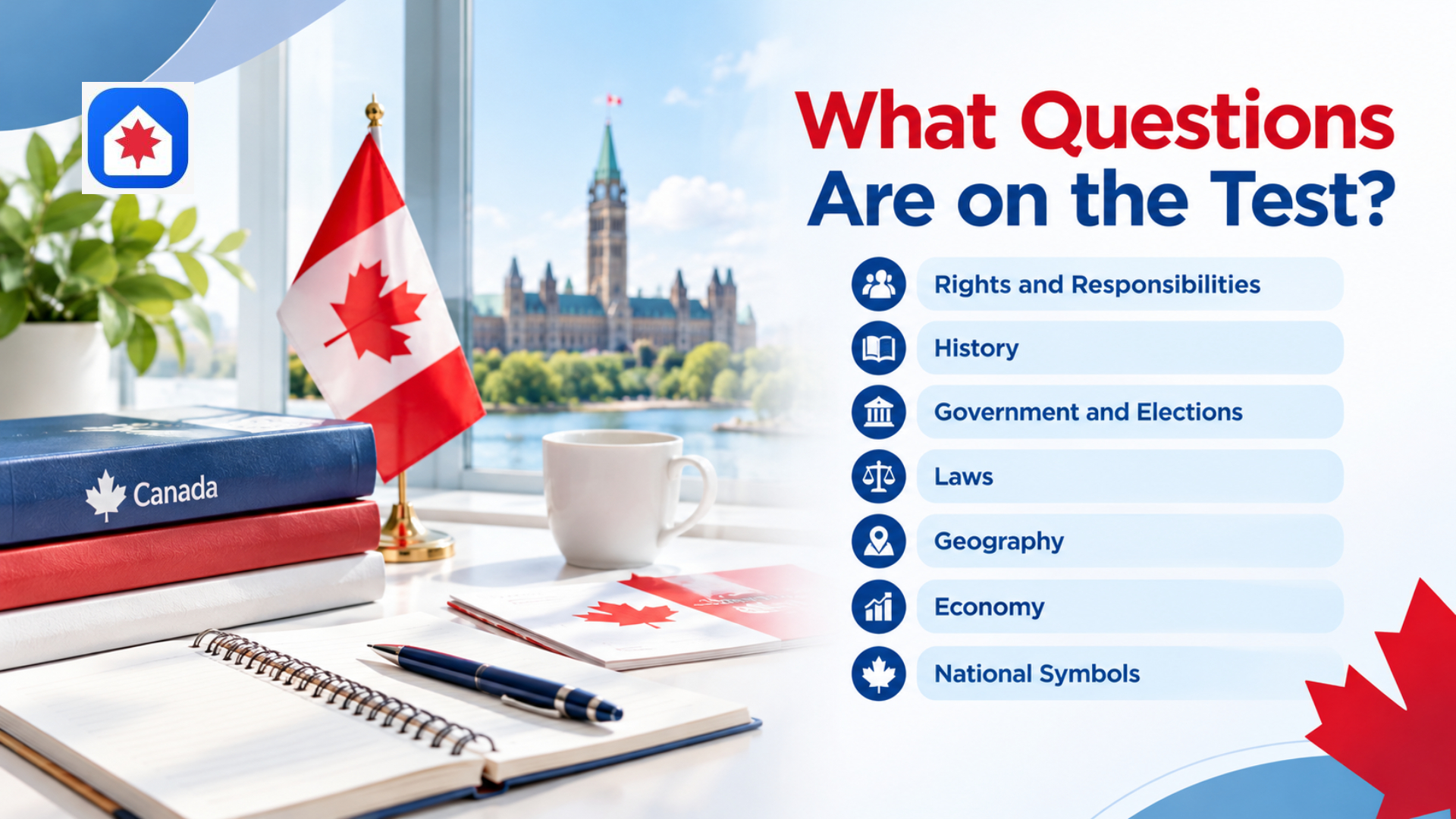
The Canadian citizenship test is based on the Government of Canada's official study guide, Discover Canada: The Rights and Responsibilities of Citizenship. To prepare effectively, divide the material into the following subject areas. Each covers specific facts you need to remember, as well as concepts you should understand to avoid confusion when answering questions.
3.1. Rights and Responsibilities
You will need to understand the fundamental rights and freedoms protected by Canadian law, along with citizens' responsibilities to their country and communities. These include equality before the law, freedom of religion, the right to vote, the obligation to obey the law, and jury duty when summoned. Make sure you can distinguish between the rights citizens enjoy and the responsibilities they are expected to fulfill.
3.2. History
This section explores Canada's development, from Indigenous communities and the colonial period to Confederation and major events that shaped the country. Pay attention to notable historical figures, their contributions, and the significance of important events described in the study guide. Understanding the connections between people, events, and historical periods is more useful than memorizing dates in isolation.
3.3. Government and Elections
Canada operates as a constitutional monarchy and parliamentary democracy. Key topics include the roles of Parliament, the Prime Minister, the Governor General, and other relevant institutions, as well as the differences between federal, provincial, and local governments. You should also understand the basic principles of elections, voting rights, and government formation. Study this section carefully because political positions and levels of government can be easy to confuse.
3.4. Laws
This section focuses on the rule of law, the role of courts, and the basic principles that support justice in Canadian society. You should understand that everyone must obey the law and become familiar with the roles of law enforcement agencies and the justice system. When studying, focus on the functions of different institutions and the principles presented in Discover Canada rather than going into specialized legal details.
3.5. Geography
Geography requires you to remember several specific facts, particularly the names of Canada's 10 provinces, 3 territories, and their respective capitals. You should also become familiar with Canada's regions, major geographical features, natural resources, and the relationship between geography and economic activities. Using a map to learn locations and place names can make the material easier to remember and help you avoid confusing provinces with their capitals.
3.6. Economy
Canada's economy includes industries that play important roles in its development, such as natural resources, agriculture, manufacturing, and services. Focus on their contributions and the economic characteristics mentioned in the study guide. You do not need to explore extensive, up-to-date economic statistics unless they are part of the official study material. Your priority should remain the information covered in Discover Canada.
3.7. National Symbols
This section introduces symbols associated with Canada's history and identity, including the national flag, national anthem, coat of arms, important holidays, and traditions. When studying, learn the significance of each symbol and the events associated with it rather than memorizing names alone.
4. How to Study for the Canadian Citizenship Test
To prepare effectively for the citizenship test in Canada, start with the Government of Canada's official study material, then supplement it with practice questions and suitable memorization techniques. Citizenship test preparation helps you build a solid understanding of the required knowledge, identify areas for improvement, and avoid relying entirely on memorized answers.
4.1. Using Discover Canada to Study
Discover Canada: The Rights and Responsibilities of Citizenship is the official study guide for the citizenship test. According to IRCC, all test questions are based on this material. It should therefore be your primary study resource before you turn to external practice tests.
You can access Discover Canada on the Government of Canada's website to read it online, download the PDF or e-book, listen to the audio recording, and review practice questions. The material is available free of charge.
4.2. Other Ways to Practice
In addition to Discover Canada, you can use practice websites, flashcard apps, or citizenship classes to vary your study methods. These resources can help you answer more questions, improve recall, and get explanations for topics you do not fully understand.
- Online practice websites and mock tests: These platforms may offer topic-based questions or simulated tests to help you assess your knowledge. Before using them, check whether the content aligns with Discover Canada, includes answer explanations, and has been updated. Do not assume that any external question bank contains the exact questions used in the actual test.
- Flashcards and study apps: These are useful for reviewing historical figures, events, provincial capitals, national symbols, and concepts that are easy to confuse. You can create your own flashcards from the material you have studied and review them at intervals to reinforce your memory.
- Citizenship classes and community support: If you struggle with the study material or political and historical terminology, ask local libraries, schools, community centres, or immigrant support organizations about citizenship classes. You can also ask friends or family members to quiz you without letting you look at the answers.
Regardless of which methods you choose, use Discover Canada as your main reference. IRCC cautions that third-party study materials may not always be accurate, so verify any conflicting information against the official guide before memorizing it.
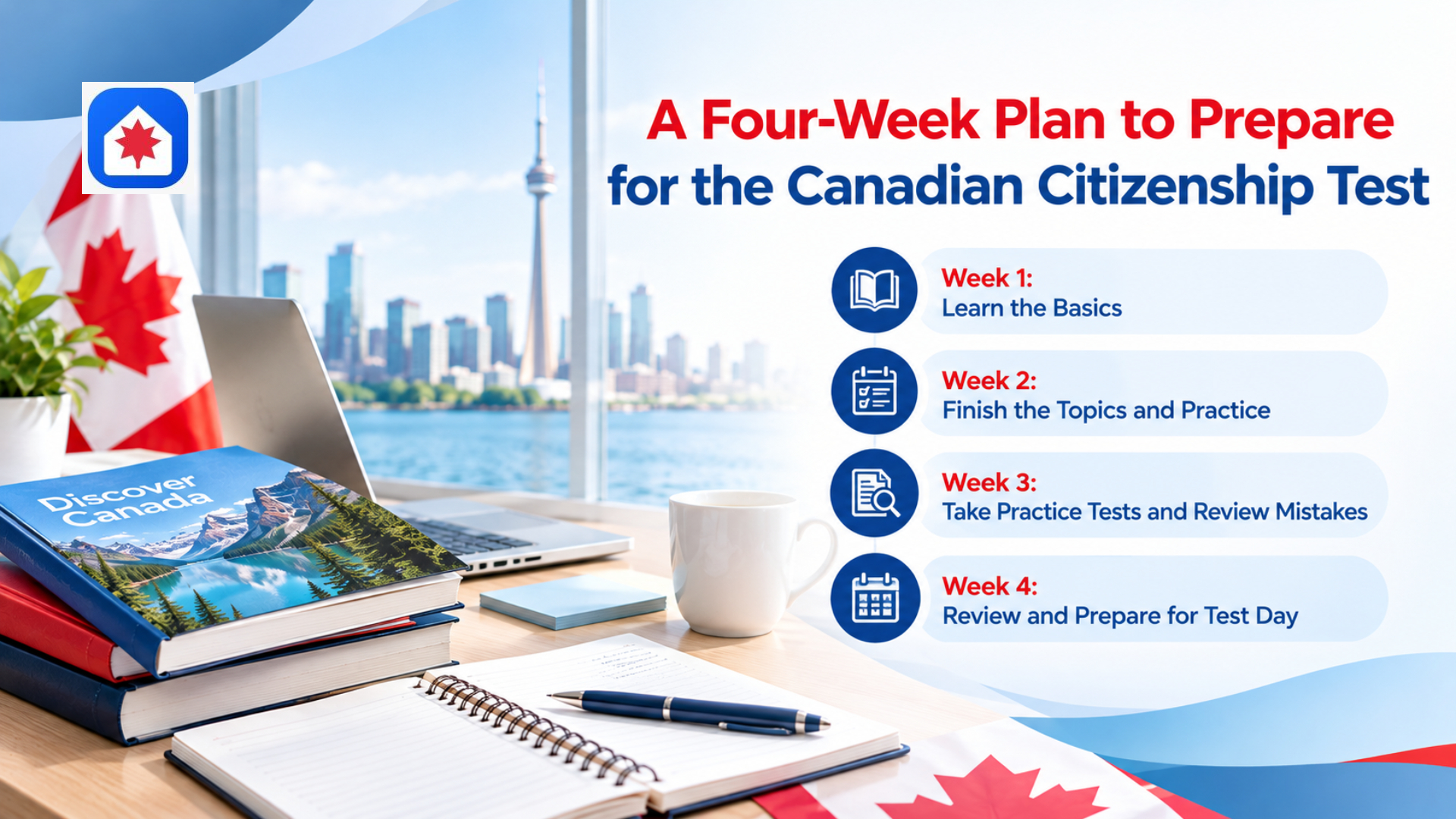
5. A Four-Week Plan to Prepare for the Canadian Citizenship Test
The following four-week citizenship test preparation plan is suitable for applicants who already have a copy of Discover Canada and want to balance learning, practice questions, and progress checks.
5.1. Week 1: Learn the Basics
During the first week, read through Discover Canada to understand the scope of the material. Then begin studying topics such as citizens' rights and responsibilities, Canadian history, and major historical events. The goal at this stage is to build a foundation, so focus on understanding the content instead of trying to memorize every detail immediately.
After each study session, write down important information and try answering a few related questions without looking at the guide. If you encounter unfamiliar concepts, mark them for review rather than skipping them.
5.2. Week 2: Finish the Topics and Practice
During the second week, continue studying Canada's government, elections, laws, geography, economy, and national symbols. For information that is easy to confuse, such as the responsibilities of political officials or the names of provinces and capitals, use comparison tables, maps, or flashcards.
Start practicing citizenship test questions Canada applicants may encounter, organized by topic. After each practice session, check your answers and return to Discover Canada to review any questions you answered incorrectly. This will help you identify knowledge gaps before moving on to full practice tests.
5.3. Week 3: Take Practice Tests and Review Mistakes
Once you have covered the main topics, begin Canadian citizenship test practice with mock tests that follow the official format: 20 questions and a 45-minute time limit. This will help you become familiar with the test format and time pressure. You can use online practice resources, but compare any conflicting answers with the official study guide. Do more than check your score after each test. Categorize your mistakes by cause: misunderstanding the material, forgetting information, confusing similar concepts, or misreading questions. Then revisit the relevant sections of Discover Canada.
If you score below 15 out of 20, focus on strengthening your knowledge instead of repeatedly taking new tests. Even if you pass a practice test, review any answers you were unsure about so you do not become overly dependent on guessing.
5.4. Week 4: Review and Prepare for Test Day
During the final week, concentrate on weaker topics and questions you previously answered incorrectly. Avoid trying to memorize large amounts of new information at the last minute, especially if doing so makes it harder to remember what you have already learned.
Take a few more practice tests under conditions similar to the actual test. Also, review the instructions in your IRCC invitation. If you are required to take the test online, prepare your device, webcam, internet connection, and identification documents according to the instructions. If you are scheduled for an in-person test or another format, follow the appointment details and directions provided by IRCC.
The four-week plan is intended to organize your study time; it does not guarantee that you will pass. Assess your readiness based on how well you understand Discover Canada, answer questions correctly, and maintain consistent results across multiple practice sessions.
6. What Happens After You Pass?
After completing the online citizenship test, you may see a preliminary result on the screen. However, this may not be the final official result. IRCC must review and confirm the result according to its procedures.
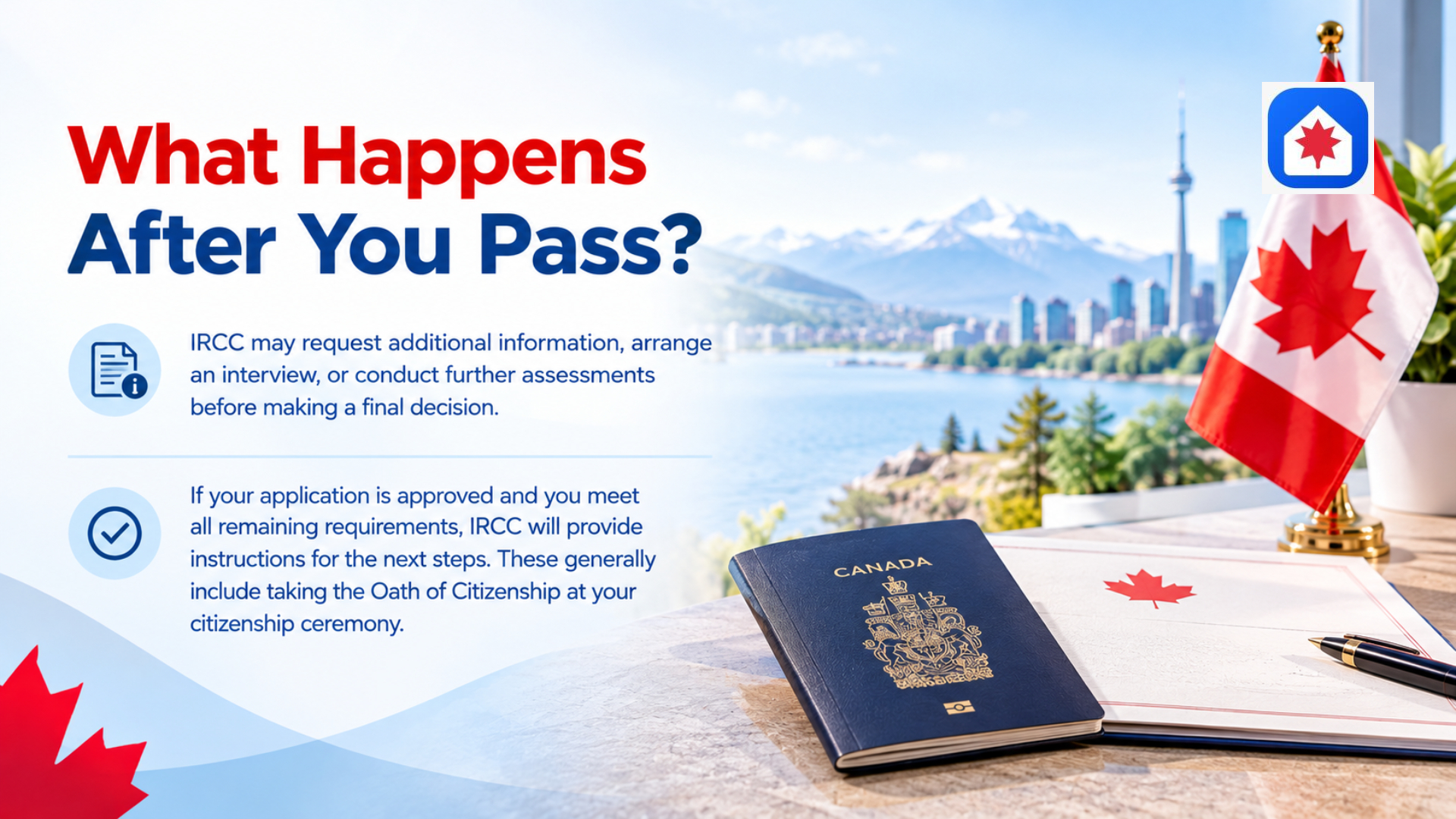
If you pass the test, your Canadian citizenship application will continue through the processing stages. Depending on your circumstances, IRCC may request additional information, arrange an interview, or conduct further assessments before making a final decision. You can use IRCC's application tracker to check for updates on your application status.
If your application is approved and you meet all remaining requirements, IRCC will provide instructions for the next steps. These generally include taking the Oath of Citizenship at your citizenship ceremony. Therefore, passing the test does not mean you automatically become a Canadian citizen. You must complete all applicable procedures and wait for confirmation in accordance with the rules.
7. What Happens If You Fail?
If you do not pass on your first attempt, your citizenship application is not necessarily refused immediately. IRCC generally allows applicants up to three attempts to pass the test. Read your notification carefully to understand how and when to take the next attempt.
Before retaking the test, identify the subjects that caused you to lose points, such as Canadian history, government, citizens' rights and responsibilities, or geography. Return to Discover Canada to review the relevant material and practice questions by topic. Understanding why an answer was incorrect is more useful than simply memorizing the answer from your previous attempt.
If you do not pass after the permitted attempts, IRCC may invite you to attend a citizenship knowledge hearing with a citizenship official. This gives you another opportunity to demonstrate that you meet the knowledge requirement. If you do not meet the requirement at the hearing, your application may be refused.
If you receive a refusal decision, read the letter carefully to understand the reasons and your available options. If you still wish to become a Canadian citizen, you may need to submit a new application and pay the applicable fee, depending on your circumstances.
In short, to prepare effectively for the Canadian citizenship test, start with Discover Canada, practice answering questions, take mock tests, and review any topics you have not fully understood. A suitable study plan can help you retain information, become familiar with the test format, and feel more confident on test day. Remember to follow the latest IRCC guidance so you understand the testing process and the next steps in your Canadian citizenship application.
Thank you for taking the time to read this article.
For more information, please contact us at CANADAHOMEHUB.